Dieffenbachia (Dumb Cane): Care, Light & Styling Tips
 Flora Medical GlobalPublished: 4/10/2026Updated: 6/16/202619 min read
Editorial Disclaimer: This article is for informational and educational purposes only. It is not a substitute for professional medical advice, diagnosis, or treatment. Always consult a qualified healthcare provider or certified herbalist before using any plant for medicinal purposes, especially if you are pregnant, nursing, taking medication, or have a medical condition.
01What is Dieffenbachia?
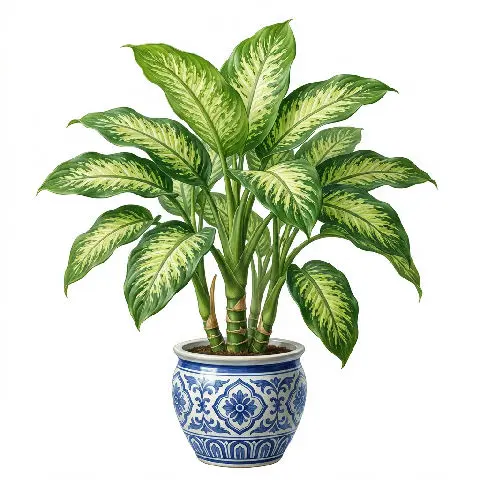
Dieffenbachia seguine, commonly known as Dumb Cane, is an erect, broadleaf evergreen perennial belonging to the Araceae family.
A good article on Dieffenbachia (Dumb Cane) should not stop at one-line claims. Readers need taxonomy, habitat, safety, cultivation, and evidence in the same place so they can make sound decisions.
The aim is simple: make the article detailed enough for serious readers while keeping the structure clear enough for fast scanning and confident decision-making.
- Dieffenbachia is a popular, toxic ornamental houseplant.
- Contains irritant calcium oxalate crystals causing oral swelling.
- Ingestion leads to temporary speechlessness, hence 'Dumb Cane'.
- Requires careful handling
- Keep away from children and pets.
- No known medicinal applications
- Used purely for decorative foliage.
- Contact with sap causes skin and eye irritation.
This guide is designed to help the reader move from scattered facts to practical understanding. Instead of relying on a thin summary, it pulls together the identity, uses, care profile, safety notes, and evidence context around Dieffenbachia (Dumb Cane) so the article works as a real reference rather than a keyword page.
02Dieffenbachia Botanical Profile
Dieffenbachia (Dumb Cane) should be anchored to the correct taxonomic identity before any discussion of care, use, or safety begins.
| Common name | Dieffenbachia (Dumb Cane) |
|---|---|
| Scientific name | Dieffenbachia seguineW |
| Family | Araceae |
| Order | Alismatales |
| Genus | Dieffenbachia |
| Species epithet | seguine |
| Author citation | Schott |
| Basionym | Arum seguine Jacq. |
| Synonyms | Dieffenbachia picta, Vernacular, Caña muda, Cucaracho |
| Common names | ডম্ব কেন, ডাইফেনবাকিয়া, লেপার্ড লিলি, Dumb Cane, Dieffenbachia, Leopard Lily, डम्ब केन, डाइफेनबाकिया |
| Local names | Dieffenbachie, Schweigrohrwurzel, cana-de-Imbe, aro seguino, Chucha, Kuchi manti, Dieffenbachia des fleuristes, Tomira, Tsanbu tape, canne à gratter, Millonaria, Mandí del cerdo |
| Origin | Tropical Americas |
| Life cycle | Perennial |
| Growth habit | Tree |
Using the accepted scientific name Dieffenbachia seguine helps readers avoid confusion caused by old synonyms, loose common names, or inconsistent plant labels.
Family and order placement also matter because they explain recurring structural traits, likely relatives, and the kinds of mistakes readers often make when they rely on appearance alone.
03What Dieffenbachia Looks Like
A practical reading of the plant starts with visible structure:
- Leaf: Leaves of Dieffenbachia are large, broad, and elliptical, typically ranging from 8 to 18 inches in length and about 4 to 10 inches in width. They.
- Stem: The stem is erect, cylindrical, and can grow between 2 to 6 feet tall indoors, depending on conditions. It is thick with a smooth, glossy texture.
- Root: The root system is fibrous, shallow, and typically extends outwards rather than deep into the soil, allowing for effective water absorption in the.
- Flower: Dieffenbachia is not commonly cultivated for its flowers indoors; when they occur, the flower is borne in a spadix covered by a spathe, usually.
- Fruit: The fruit is a small, berry-like structure, typically not observed in indoor specimens. When produced, it turns from green to orange as it ripens.
- Seed: Seeds are small, measuring about 1-2 mm in diameter when mature, round and smooth, often dispersed by water or animals when the fruits become.
Microscopic or internal identification notes deepen the picture, especially for processed material: Trichomes are generally absent or scarce on Dieffenbachia leaves, contributing to their smooth texture. Stomata are commonly paracytic or anomocytic, found predominantly on the abaxial (lower) leaf surface, facilitating gas exchange. Powdered plant material reveals abundant needle-shaped calcium oxalate raphides, often bundled, along with fragments of parenchyma cells and spiral.
In overall habit, the plant is described as Tree with a mature height around Typically 0.2-1.5 m and spread of Typically 0.2-1 m.
04Native Range of Dieffenbachia
The native or historically recorded center of distribution for Dieffenbachia (Dumb Cane) is Tropical Americas. That origin is more than background trivia; it explains how the plant responds to heat, moisture, shade, and seasonal change.
The plant is associated with the following countries or range markers: Colombia, Costa Rica.
Environmental notes in the live record add more context: Dieffenbachia seguine thrives in warm, humid environments, mimicking its native tropical habitat. Ideal conditions include: Climate: Prefers consistently warm temperatures, generally between 65-75°F (18-24°C). Avoid prolonged exposure to temperatures below 60°F (15°C) and sudden cold drafts. Soil: Requires well-draining, fertile potting mix. A.
In cultivation terms, the main ecological clues are: Full sun to partial shade; Moderate; Well-drained to evenly moist; Species-dependent; often grown in warm seasons; Perennial; Tree.
Physiology data reinforce the habitat story: Highly sensitive to cold temperatures, direct sunlight, and drought stress, manifesting as leaf yellowing, wilting, or browning of leaf margins. Dieffenbachia primarily utilizes C3 photosynthesis, common for plants adapted to shaded understory conditions in tropical forests. Exhibits moderate to high transpiration rates, characteristic of tropical plants adapted to humid environments, requiring consistent soil moisture.
05Dieffenbachia in Tradition & Culture
The Dieffenbachia seguine, commonly known as Dumb Cane, holds a complex and often cautionary cultural significance rooted in its potent properties. While not a plant typically found in culinary traditions or mainstream religious rituals due to its toxicity, its presence in folk medicine and its cautionary nomenclature speak volumes about its historical interaction with human societies in the Tropical Americas.
Explore Our Platforms
 InfiniCore DataWorks
 Nex-Automata
Ethnobotanical records also show how this plant has been framed across different places: Angina in West Indies (Duke, 1992 ); Aphrodisiac in Cuba (Duke, 1992 ); Arrow in Brazil (Altschul, Siri Von Reis. 1973. Drugs and foods from little-known plants. Harvard Univ. Press); Castration in Germany (Duke, 1992 ); Contraceptive in Cuba (Duke, 1992 ); Contraceptive in Guadelupe (Duke, 1992 ); Contraceptive in Portorico (Duke, 1992 ); Corn in Cuba (Hartwell, J.L. 1967-71. Plants used against cancer. A survey. Lloydia 30-34.).
Local names help show how different communities notice and classify the plant: Dieffenbachie, Schweigrohrwurzel, cana-de-Imbe, aro seguino, Chucha, Kuchi manti, Dieffenbachia des fleuristes, Tomira, Tsanbu tape, canne à gratter.
Traditional context matters, but it should always be separated from modern certainty. Historical use can guide questions, yet it does not automatically prove present-day clinical effectiveness.
06Dieffenbachia Health Benefits
The main benefit themes associated with the plant include:
- Cautionary Example in Traditional Medicine — Dieffenbachia serves as a potent reminder in various traditional medical systems regarding the critical.
- Absence of Therapeutic Use — Across Ayurvedic, Traditional Chinese Medicine (TCM), Unani, and Siddha systems, Dieffenbachia is consistently recognized for its.
- Indigenous Awareness — Some indigenous cultures have historically noted Dieffenbachia's potent irritant properties, using it as a deterrent or in specific.
- Plant Toxin Studies — Modern research on Dieffenbachia primarily focuses on its toxicological profile, particularly the mechanism of action of calcium oxalate.
- Educational Tool for Plant Safety — Due to its well-documented irritant effects, Dieffenbachia is often used as an educational example to teach about.
- Understanding Irritant Compounds — The study of Dieffenbachia's chemical constituents, like calcium oxalate, provides insights into how plants produce and.
- Reminder of Botanical Diversity — Its ornamental popularity contrasted with its toxicity highlights the diverse chemical ecology of the plant kingdom, where.
- No Internal Application — It is unequivocally established that Dieffenbachia has no safe internal medicinal applications in any traditional or modern.
The evidence matrix gives a more careful picture of those claims: Ingestion causes severe oral irritation and swelling. Case reports, toxicological studies, clinical observations. High. The irritant effects of calcium oxalate crystals are well-documented across numerous reports of accidental ingestion. Sap contact leads to contact dermatitis. Clinical observations, anecdotal reports. Moderate. Skin irritation and rash are commonly reported among individuals handling the plant without protection. Dieffenbachia lacks recognized medicinal benefits. Comprehensive literature review, ethnobotanical surveys. High. No traditional or modern medical system advocates for its internal or external therapeutic use due to its toxicity.
The stored evidence confidence for this profile is traditional. That should shape how strongly any benefit statement is interpreted.
For non-medicinal or mostly ornamental contexts, the safest approach is to keep the claims modest. A plant may still be valuable ecologically, visually, or culturally without being promoted as a treatment.
- Cautionary Example in Traditional Medicine — Dieffenbachia serves as a potent reminder in various traditional medical systems regarding the critical.
- Absence of Therapeutic Use — Across Ayurvedic, Traditional Chinese Medicine (TCM), Unani, and Siddha systems, Dieffenbachia is consistently recognized for its.
- Indigenous Awareness — Some indigenous cultures have historically noted Dieffenbachia's potent irritant properties, using it as a deterrent or in specific.
- Plant Toxin Studies — Modern research on Dieffenbachia primarily focuses on its toxicological profile, particularly the mechanism of action of calcium oxalate.
- Educational Tool for Plant Safety — Due to its well-documented irritant effects, Dieffenbachia is often used as an educational example to teach about.
- Understanding Irritant Compounds — The study of Dieffenbachia's chemical constituents, like calcium oxalate, provides insights into how plants produce and.
- Reminder of Botanical Diversity — Its ornamental popularity contrasted with its toxicity highlights the diverse chemical ecology of the plant kingdom, where.
- No Internal Application — It is unequivocally established that Dieffenbachia has no safe internal medicinal applications in any traditional or modern.
- Topical Irritant Effects — While not medicinal, the sap's irritant nature has been an object of historical observation, illustrating the immediate.
- Avoidance as a Primary 'Use' — The most significant 'use' of Dieffenbachia, from a health perspective, is the practice of avoidance and careful handling, a.
07Dieffenbachia: Chemical Constituents
The broader constituent profile includes:
- Calcium Oxalate Crystals — These microscopic, needle-shaped crystals (raphides) are the primary toxic agents in.
- Proteolytic Enzymes — The plant sap contains enzymes like dieffenbachin, which work synergistically with calcium.
- Saponins — While less prominent than calcium oxalates, some Dieffenbachia species may contain saponins, which can.
- Flavonoids — Like many plants, Dieffenbachia contains various flavonoids, typically present in trace amounts and.
- Alkaloids — Certain alkaloid compounds might be present in minute quantities; however, their contribution to the plant's acute toxicity is considered minor compared to the dominant calcium.
- Cyanogenic Glycosides — While common in some Araceae family members, the presence and significant contribution of.
- Histamines — Some reports suggest the presence of histamine-like substances in the sap, which could contribute to the.
- Organic Acids — Various organic acids are present in plant tissues, contributing to general plant metabolism, but not.
The detailed phytochemistry file adds these markers: Calcium Oxalate, Inorganic Salt, All parts, especially sap and leaves, Highmg/g fresh weight; Proteolytic Enzymes (e.g., Dieffenbachin), Protein, Sap, ModerateQualitative; Saponins, Glycosides, Leaves, stem, LowQualitative; Flavonoids, Polyphenols, Leaves, TraceQualitative; Alkaloids, Nitrogenous Compounds, Various tissues, TraceQualitative.
Local chemistry records also support the profile: CALCIUM-OXALATE in Plant (not available-not available ppm); DUMBCAIN in Plant (not available-not available ppm); L-ASPARAGINE in Plant (not available-not available ppm).
Compound profiles also shift with plant part, age, season, processing, and storage. The chemistry of a fresh leaf, dried root, or concentrated extract should never be treated as automatically identical.
08How to Use Dieffenbachia
Recorded preparation and use methods include:
- Ornamental Display — Dieffenbachia is exclusively cultivated for its attractive foliage as an indoor ornamental plant, enhancing home and office aesthetics. Landscape Accent (Tropical Zones) — In appropriate tropical climates, it can be grown outdoors as a striking landscape plant, adding a lush, exotic touch. Air Purification (Limited) — Like many houseplants, it contributes to minor air purification, though this is a secondary and limited benefit given its primary ornamental role.
- Cautionary Handling — Always wear gloves when handling Dieffenbachia, especially during pruning or repotting, to prevent skin irritation from the sap.
- Child and Pet Safety — Place plants in locations inaccessible to young children and pets to prevent accidental ingestion or contact with the toxic sap.
- Hand Hygiene — Thoroughly wash hands with soap and water immediately after any contact with the plant, particularly after touching the sap.
- Educational Display — Can be used in botanical gardens or educational settings as an example of a toxic ornamental plant, emphasizing plant safety.
- Avoid Ingestion — Under no circumstances should any part of Dieffenbachia be ingested or prepared for consumption due to its severe toxicity.
The plant part most closely linked to use is recorded as Leaves, flowers, roots, seeds, or whole herb cited in related taxa.
Edibility and processing notes matter here as well: Varies by species and plant part; verify before use.
For indoor readers, “how to use” usually means how the plant is placed, styled, handled, propagated, and maintained within the living space rather than how it is taken internally.
- Identify the exact species and plant part first.
- Match the preparation to the intended use.
- Check safety, interactions, and processing details before routine use or large-scale handling.
09Is Dieffenbachia Safe? Precautions & Cautions
The first safety note is direct: Moderate
Specific warnings recorded for this plant include:
- High Toxicity — Dieffenbachia is considered highly toxic if ingested, primarily due to calcium oxalate crystals and proteolytic enzymes.
- Keep Away from Children and Pets — Essential to place plants out of reach of curious children and domestic animals to prevent accidental exposure.
- Wear Protective Gear — Always wear gloves when handling Dieffenbachia, especially during repotting, pruning, or propagation, to avoid skin contact with the sap.
- Immediate Hand Washing — Wash hands thoroughly with soap and water immediately after any contact with the plant, even if gloves were worn.
- Avoid Contact with Eyes and Mouth — Exercise extreme caution to prevent sap from splashing into the eyes or coming into contact with the mouth.
- Seek Medical Attention — In case of ingestion or severe contact, seek immediate medical attention or contact a poison control center.
- No Medicinal Use — Emphatically, Dieffenbachia is not a medicinal plant and should never be used for therapeutic purposes internally or externally.
- Oral Irritation — Immediate and intense burning sensation in the mouth, tongue, and throat upon ingestion due to calcium oxalate crystals.
- Swelling of Mucous Membranes — Rapid and painful swelling of the tongue, lips, gums, and throat, potentially leading to difficulty breathing and swallowing.
- Temporary Speechlessness — The swelling and irritation can cause temporary aphonia or dysphonia, hence the common name 'Dumb Cane'.
Quality-control notes add another warning: Adulteration risk is not applicable as the plant has no recognized medicinal or commercial value beyond ornamental cultivation.
No plant should be described as universally safe. Identity, dose, plant part, preparation style, age, pregnancy status, medication use, allergies, and contamination risk all change the answer.
10How to Grow Dieffenbachia
The cultivation record emphasizes these practical steps:
- Indoor Cultivation — Primarily grown as a houseplant in pots, requiring stable indoor temperatures and protection from cold drafts.
- Light Requirements — Prefers bright, indirect light; direct sunlight can scorch its variegated leaves.
- Soil Preference — Thrives in loose, fertile, well-draining soil rich in organic matter.
- Watering Schedule — Water thoroughly, then allow the top 1 inch of soil to dry out completely before rewatering to prevent root rot.
- Humidity — Benefits from moderate to high humidity; consider misting or using a pebble tray.
- Fertilization — Feed with a balanced liquid fertilizer every 2-4 weeks during the growing season (spring and summer), reducing in winter.
The broader growth environment is described like this: Dieffenbachia seguine thrives in warm, humid environments, mimicking its native tropical habitat. Ideal conditions include: Climate: Prefers consistently warm temperatures, generally between 65-75°F (18-24°C). Avoid prolonged exposure to temperatures below 60°F (15°C) and sudden cold drafts. Soil: Requires well-draining, fertile potting mix. A.
Planning becomes easier when these traits are kept in view: Tree; Typically 0.2-1.5 m; Typically 0.2-1 m.
In practice, healthy cultivation comes from systems thinking rather than one-off tricks. Site choice, drainage, timing, spacing, pruning, feeding, and observation all reinforce one another.
11Caring for Dieffenbachia: Light, Water & Soil
The most useful care snapshot is this: Light: Full sun to partial shade; Water: Moderate; Soil: Well-drained to evenly moist; USDA zone: Species-dependent; often grown in warm seasons.
Indoors, the plant responds to microclimate more than many people expect. Window direction, airflow, heating, and room humidity can change the care rhythm quickly.
| Light | Full sun to partial shade |
|---|---|
| Water | Moderate |
| Soil | Well-drained to evenly moist |
| USDA zone | Species-dependent; often grown in warm seasons |
Light, water, and soil should never be treated as separate checkboxes. A plant in stronger light often dries faster, soil texture changes how quickly water moves, and temperature plus humidity influence how stress appears in leaves and roots.
For Dieffenbachia (Dumb Cane), the safest care approach is to treat Full sun to partial shade, Moderate, and Well-drained to evenly moist as linked decisions rather than isolated tips. If one condition shifts, the other two usually need to be reconsidered as well.
12Propagating Dieffenbachia
Documented propagation routes include Propagation of Dieffenbachia can be achieved effectively through stem cuttings. Step-by-step instructions include: 1. Select a healthy, non-flowering stem.
Propagation works best when the parent stock is healthy, correctly identified, and handled in the right season. That sounds obvious, but it is exactly where many failures begin.
- Propagation of Dieffenbachia can be achieved effectively through stem cuttings. Step-by-step instructions include: 1. Select a healthy, non-flowering stem.
Propagation works best when the reader matches method to biology. Some plants respond readily to cuttings, some to division, some to seed, and others require more patience or more exact seasonal timing.
A successful propagation guide therefore starts with healthy parent material and realistic expectations. Weak stock, rushed handling, and poor aftercare can make even a technically correct method fail.
13Dieffenbachia Pests & Diseases
Indoor problems usually start quietly: mites, mealybugs, scale, root stress, weak light, or stale soil structure. Routine inspection is what keeps small issues from becoming full infestations.
The smartest response sequence is observation first, environmental correction second, and treatment only after the real pattern is clear.
Pest and disease management is strongest when it begins before visible damage becomes severe. Routine observation, clean handling, sensible spacing, air movement, and balanced watering reduce many problems before treatment is even needed.
When symptoms do appear on Dieffenbachia (Dumb Cane), the most reliable response is diagnostic rather than reactive. Yellowing, spots, wilt, chewing, and stunting can all have multiple causes, so a rushed treatment can waste time or worsen the problem.
Good troubleshooting also includes environmental correction. Pests and disease often reveal a deeper issue such as root stress, poor airflow, inconsistent watering, weak light, or exhausted soil structure.
14Harvesting & Storing Dieffenbachia
The plant part most often associated with harvest or processing is Leaves, flowers, roots, seeds, or whole herb cited in related taxa.
Storage guidance from the quality-control record reads as follows: Storage stability is primarily relevant for maintaining the plant's ornamental quality, not for medicinal potency, as it possesses none.
For indoor plants, this section often translates into trimming, leaf cleanup, offset collection, occasional flower removal, and safe handling of spent growth.
Whatever the purpose, the rule is the same: harvest clean material, label it clearly, and store it in a way that preserves identity and condition.
Harvest and storage determine whether a plant's quality is preserved after it leaves the bed, pot, field, or wild source. Clean timing, correct plant part selection, and careful drying or handling all matter more than many readers expect.
For Dieffenbachia (Dumb Cane), this means the reader should think beyond collection. Material that is poorly labeled, overheated, damp in storage, or mixed with the wrong part of the plant can quickly lose value or create confusion later.
15Companion Plants for Dieffenbachia
In indoor styling, Dieffenbachia (Dumb Cane) usually works best beside plants that share similar moisture expectations but offer contrast in texture, height, or silhouette.
Companion planting and design are not only aesthetic decisions. They affect airflow, root competition, moisture sharing, harvest access, visibility, and the general logic of the planting scheme.
With Dieffenbachia (Dumb Cane), good placement means thinking about mature size, maintenance rhythm, and how neighboring plants change the feel and function of the space. A plant can be healthy on its own and still be poorly placed within the broader composition.
That is why the best design advice combines biology with usability. The planting should look coherent, but it should also make watering, pruning, harvest, and pest observation easier rather than harder.
16Dieffenbachia: Scientific Evidence
The evidence matrix points to several recurring themes: Ingestion causes severe oral irritation and swelling. Case reports, toxicological studies, clinical observations. High. The irritant effects of calcium oxalate crystals are well-documented across numerous reports of accidental ingestion. Sap contact leads to contact dermatitis. Clinical observations, anecdotal reports. Moderate. Skin irritation and rash are commonly reported among individuals handling the plant without protection. Dieffenbachia lacks recognized medicinal benefits. Comprehensive literature review, ethnobotanical surveys. High. No traditional or modern medical system advocates for its internal or external therapeutic use due to its toxicity.
Ethnobotanical activity records add historical reference trails: Angina — West Indies [Duke, 1992 ]; Aphrodisiac — Cuba [Duke, 1992 ]; Arrow — Brazil [Altschul, Siri Von Reis. 1973. Drugs and foods from little-known plants. Harvard Univ. Press]; Castration — Germany [Duke, 1992 ]; Contraceptive — Cuba [Duke, 1992 ]; Contraceptive — Guadelupe [Duke, 1992 *].
The compiled source count behind the live profile is 8. That does not guarantee certainty, but it does suggest the record has been cross-checked beyond a single note.
Analytical testing notes also strengthen the evidence base: Microscopic examination for the characteristic needle-shaped calcium oxalate raphides is the primary method for identifying Dieffenbachia plant material.
A careful evidence section should say what is known, what is plausible, and what remains uncertain. Readers are better served by clear limits than by exaggerated confidence.
Evidence note: this section blends the live plant record, local ethnobotanical activity data, chemistry records, and the linked Flora Medical Global plant profile for Dieffenbachia (Dumb Cane).
17Choosing Quality Dieffenbachia
Quality markers worth checking include Calcium oxalate crystals (raphides) are the primary marker for identification and confirmation of Dieffenbachia, serving as a marker of its toxic nature.
Adulteration and substitution risk should not be ignored: Adulteration risk is not applicable as the plant has no recognized medicinal or commercial value beyond ornamental cultivation.
When buying Dieffenbachia (Dumb Cane), start with verified botanical identity. The label, scientific name, and the source page should agree before you judge price, size, or claimed benefits.
For living plants, inspect roots, stem firmness, foliage health, and early pest signs. For dried or processed material, look for batch clarity, clean aroma, absence of mold, and any sign that the product has been over-processed to disguise poor quality.
Buying advice should begin with identity. The label, scientific name, visible condition, and seller credibility should agree before price or convenience becomes the deciding factor.
18Common Questions About Dieffenbachia
What is Dieffenbachia (Dumb Cane) best known for?
Dieffenbachia seguine, commonly known as Dumb Cane, is an erect, broadleaf evergreen perennial belonging to the Araceae family.
Is Dieffenbachia (Dumb Cane) beginner-friendly?
That depends on the growing environment and the intended use. Some plants are easy to grow but not simple to use medicinally, while others are the opposite.
How much light does Dieffenbachia (Dumb Cane) need?
Full sun to partial shade
How often should Dieffenbachia (Dumb Cane) be watered?
Moderate
Can Dieffenbachia (Dumb Cane) be propagated at home?
Yes, but the best method depends on whether the species responds best to seed, cuttings, division, offsets, or other propagation routes.
Does Dieffenbachia (Dumb Cane) have safety concerns?
Moderate
What is the biggest mistake people make with Dieffenbachia (Dumb Cane)?
The most common mistake is applying generic advice instead of matching the plant to its real environment, identity, and limits.
Where can I verify more information about Dieffenbachia (Dumb Cane)?
Start with the Flora Medical Global plant profile: https://www.floramedicalglobal.com/indoor-plants/dieffenbachia
Why do sources sometimes disagree about Dieffenbachia (Dumb Cane)?
Different references may use different synonyms, plant parts, cultivation conditions, or evidence standards. That is why taxonomy and source quality both matter.
19Dieffenbachia: References & Further Reading
Authoritative sources and related guides:
- Wikipedia — background reference
- PubMed — peer-reviewed studies
- Kew POWO — botanical reference
- NCBI PMC — open-access research
- WHO — global health authority
Related on Flora Medical Global
Reviewed by the Flora Medical Global Botanical Review Panel
Multi-disciplinary editorial group · Botany · Ethnobotany · Herbal-medicine literature
Who reviewed this: This page was checked by the Flora Medical Global Botanical Review Panel — an in-house editorial group of botany graduates, ethnobotany researchers, and horticulture practitioners who collectively maintain our 7,000+ plant encyclopedia. Meet the team.
Our 4-step verification process
1. Taxonomic verification
Scientific names and synonyms cross-checked against Kew POWO, World Flora Online, and The Plant List.
2. Phytochemical & medicinal cross-reference
Active compounds, traditional uses, and reported activities are cross-referenced with PubMed, USDA Dr. Duke's database, and peer-reviewed ethnobotanical literature.
3. Conservation & distribution check
Distribution, ecology, and conservation status confirmed against GBIF occurrence records and the IUCN Red List.
4. Editorial & safety review
Every entry passes an editorial pass for clarity, originality, and safety notices (toxicity, contraindications, dosage caveats) before publication.
Last reviewed:
Explore Our Platforms
Comments (0)
No comments yet. Be the first!