
Care Disclaimer: Plant care recommendations are general guidelines based on common growing conditions. Individual results may vary based on your local environment, climate, and care routine. If your plant is toxic, keep it away from children and pets, and consult a veterinarian if accidental ingestion occurs.
1.Acer Palmatum — Overview
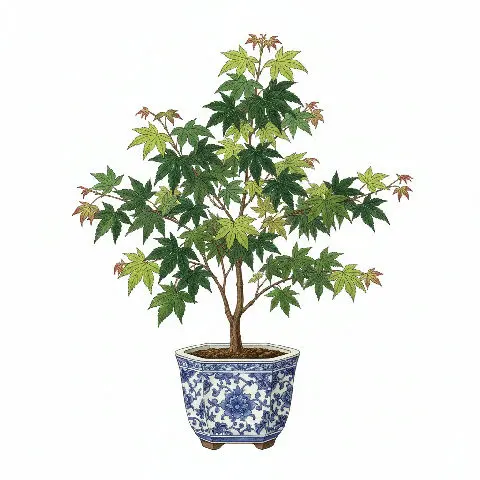
Acer palmatum, commonly known as the Japanese Maple, is a highly ornamental deciduous tree or large shrub belonging to the Sapindaceae family. Native to Japan, Korea, and parts of Russia and Mongolia, this species is globally cherished for its exquisite foliage, graceful form, and spectacular seasonal color transitions. The name 'palmatum' is derived from Latin, meaning 'palm-shaped,' a direct reference to its distinctive deeply lobed leaves. These trees typically thrive as understory plants in forested regions, preferring environments with dappled sunlight and consistently moist, well-drained, slightly acidic soils.
Depending on the cultivar, Japanese Maples can attain heights of 15 to 25 feet, exhibiting diverse growth habits from upright, vase-shaped forms to elegant weeping structures. Its smooth, often greenish-brown bark gradually matures to a grayish hue, adding to its year-round aesthetic appeal. The simple, opposite leaves, measuring 2 to 5 inches, display incredible variability in shape and color, transitioning from vibrant greens in summer to a breathtaking palette of yellows, oranges, reds, and deep purples in autumn. With a slow to moderate growth rate, Acer palmatum's intricate branching patterns provide significant architectural interest, particularly during the winter months.
While predominantly cultivated for its unparalleled ornamental value, traditional East Asian medicine has historically investigated the potential therapeutic properties of its bark and leaves, although these applications are less comprehensively documented compared to more prominent medicinal flora. Contemporary scientific inquiry has begun to reveal a rich phytochemical profile, including various flavonoids, phenolic acids, and tannins, which are known for their antioxidant and anti-inflammatory potential.
Trusted Scientific References
1. Authoritative external sources for Acer palmatum
1.1 Wikipedia — Acer palmatum
1.2 Kew POWO (Plants of the World Online)
1.3 PubMed — peer-reviewed research
1.4 NCBI Taxonomy Browser
1.5 GBIF — Global Biodiversity
1.1.Acer Palmatum — Key Features
- ✓ <strong>Striking deeply lobed, palm</strong> — shaped leaves.
- ✓ <strong>Vibrant seasonal foliage</strong> — Vibrant seasonal foliage changes from green to brilliant red, orange, or purple.
- ✓ <strong>Elegant growth habit,</strong> — Elegant growth habit, ranging from upright trees to weeping shrubs.
- ✓ <strong>Slow to moderate</strong> — Slow to moderate growth rate with architectural branching.
- ✓ <strong>Native to Japan,</strong> — Native to Japan, Korea, and parts of Russia/Mongolia.
- ✓ <strong>Belongs to the</strong> — Belongs to the Sapindaceae family.
- ✓ <strong>Prefers dappled shade and moist, well</strong> — drained, acidic soil.
- ✓ <strong>Rich in beneficial</strong> — Rich in beneficial phytochemicals like flavonoids and tannins.
- ✓ <strong>Thousands of distinct</strong> — Thousands of distinct ornamental cultivars exist globally.
- ✓ <strong>Significant cultural importance</strong> — Significant cultural importance in Japanese gardening.
1.2.Acer Palmatum — Quick Summary
- Acer palmatum, Japanese Maple, is a revered ornamental tree from East Asia.
- Rich in flavonoids, phenolic acids, and tannins, offering antioxidant and anti-inflammatory potential.
- Traditional East Asian medicine explored its bark and leaves, though documentation is limited.
- Primarily valued for its aesthetic beauty and diverse cultivars.
- Requires dappled shade, moist, well-drained soil, and protection from harsh elements.
- Safety data for internal human medicinal use is currently insufficient.
2.Acer Palmatum — Scientific Identity
3.Acer Palmatum — Quick Facts
4.Acer Palmatum — Appearance & Identification
5.Acer Palmatum — Native Habitat
6.Acer Palmatum — Water Requirements
- ✓ Site Selection — Plant in a location with dappled shade, especially protecting from intense afternoon sun to prevent leaf scorch, though some red cultivars tolerate more sun.
- ✓ Soil Requirements — Prefers consistently moist, well-drained, slightly acidic soils rich in organic matter; avoid heavy clay or excessively sandy conditions.
- ✓ Watering — Requires regular and deep watering, particularly during dry spells and in its establishment phase; do not allow the soil to completely dry out.
- ✓ Protection — Shield young trees from strong, drying winds and late spring frosts, which can damage tender new leaves and inhibit growth.
- ✓ Pruning — Prune sparingly to maintain shape and remove dead or crossing branches, ideally in late summer or early winter when the tree is dormant to avoid "bleeding" sap.
- ✓ Fertilization — Apply a balanced, slow-release granular fertilizer formulated for acid-loving plants in early spring, avoiding excessive nitrogen which can lead to leggy growth.
- ✓ Pest and Disease Management — Monitor for common pests like aphids and scale, and diseases such as anthracnose; ensure good air circulation to minimize fungal issues.
Reviewed by the Flora Medical Global Botanical Review Panel
Multi-disciplinary editorial group · Botany · Ethnobotany · Herbal-medicine literature
Who reviewed this: This page was checked by the Flora Medical Global Botanical Review Panel — an in-house editorial group of botany graduates, ethnobotany researchers, and horticulture practitioners who collectively maintain our 7,000+ plant encyclopedia. Meet the team.
Our 4-step verification process
1. Taxonomic verification
Scientific names and synonyms cross-checked against Kew POWO, World Flora Online, and The Plant List.
2. Phytochemical & medicinal cross-reference
Active compounds, traditional uses, and reported activities are cross-referenced with PubMed, USDA Dr. Duke's database, and peer-reviewed ethnobotanical literature.
3. Conservation & distribution check
Distribution, ecology, and conservation status confirmed against GBIF occurrence records and the IUCN Red List.
4. Editorial & safety review
Every entry passes an editorial pass for clarity, originality, and safety notices (toxicity, contraindications, dosage caveats) before publication.
Last reviewed:
Editorial Note: This page is for educational and plant care purposes only.
Written by: Flora Medical Global Editorial Team
Reviewed by: Flora Medical Global Botanical Review Panel
Last Updated: June 16, 2026







Acer Palmatum — Comments & Community Reviews
Rate this plant