
Care Disclaimer: Plant care recommendations are general guidelines based on common growing conditions. Individual results may vary based on your local environment, climate, and care routine. If your plant is toxic, keep it away from children and pets, and consult a veterinarian if accidental ingestion occurs.
1.Agapanthus — Overview
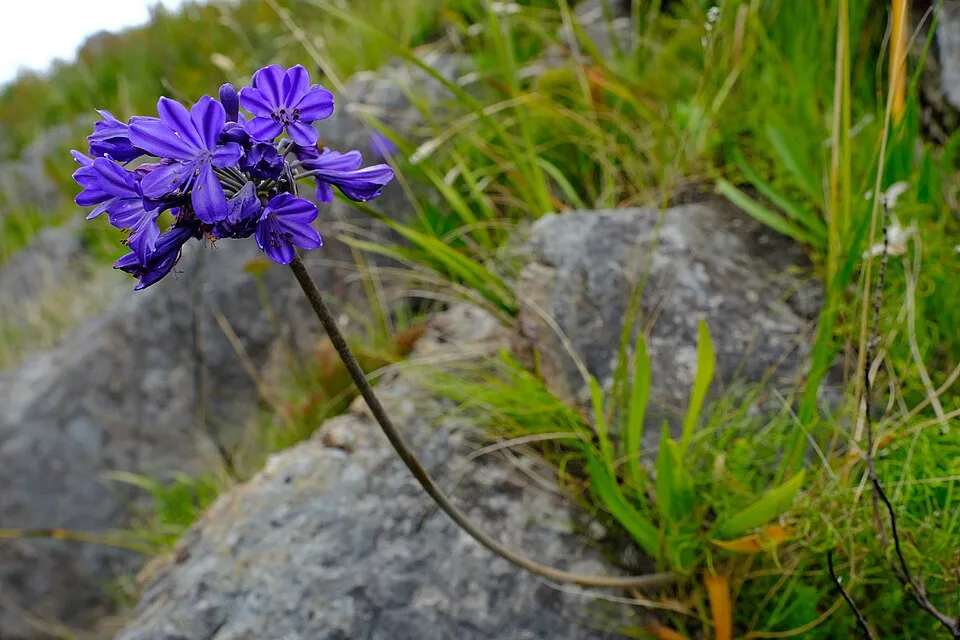
Agapanthus africanus, widely recognized as the African Lily or Lily of the Nile, is a striking perennial flowering plant native to the Western Cape of South Africa. This resilient species thrives in environments characterized by well-drained, sandy-loam soils and benefits from full sun to partial shade exposure. Morphologically, it presents an upright, clump-forming growth habit, typically reaching heights of up to 1 meter.
Its foliage consists of robust, strap-like evergreen leaves, which can measure between 30 to 60 centimeters in length, arching gracefully to form a lush basal tuft. The plant develops short, tuberous roots from fleshy rhizomes, contributing to its drought tolerance. During the summer months, Agapanthus africanus produces dramatic inflorescences atop tall, rigid stalks.
These flower clusters comprise numerous tubular or bell-shaped florets, which commonly display shades of vibrant blue, purple, or pure white, often with a darker stripe down each petal. The genus name, Agapanthus, beautifully combines the Ancient Greek words ‘agape’ meaning love, and ‘anthos’ meaning flower, reflecting its widespread appeal and aesthetic charm. Taxonomically, while once classified under Liliaceae, modern phylogenetic studies have firmly placed it within the Amaryllidaceae family, alongside other notable monocots.
Trusted Scientific References
1. Authoritative external sources for Agapanthus africanus
1.1 Wikipedia — Agapanthus africanus
1.2 Kew POWO (Plants of the World Online)
1.3 PubMed — peer-reviewed research
1.4 NCBI Taxonomy Browser
1.5 GBIF — Global Biodiversity
1.6Agapanthus should be interpreted through verified botanical identity, practical care, and responsible safety language. This recovery note adds the missing context needed for a complete profile: match light to the plant's habit, use well-drained soil, water according to season, and avoid unsupported medicinal or edible claims. For publishing, the plant can be presented as a source-backed garden plant with clear care guidance, common problem diagnosis, and conservative safety wording.
1.1.Agapanthus — Key Features
- ✓ <strong>Native to the</strong> — Native to the Western Cape of South Africa, adapted to diverse climates.
- ✓ <strong>Produces dramatic clusters</strong> — Produces dramatic clusters of blue, purple, or white tubular flowers in summer.
- ✓ <strong>Characterized by robust, strap</strong> — like evergreen foliage.
- ✓ <strong>Historically utilized in</strong> — Historically utilized in traditional African medicine for labor induction and anti-inflammatory effects.
- ✓ <strong>Rich in beneficial</strong> — Rich in beneficial phytochemicals, including steroidal saponins and various flavonoids.
- ✓ <strong>Highly valued as</strong> — Highly valued as an ornamental plant globally for its beauty and resilience.
- ✓ <strong>Exhibits a perennial, clump</strong> — forming growth habit from fleshy rhizomes.
- ✓ <strong>Demonstrates good drought</strong> — Demonstrates good drought tolerance and is notably resistant to deer.
- ✓ <strong>Classified within the</strong> — Classified within the Amaryllidaceae family, a reclassification from Liliaceae.
- ✓ <strong>Possesses low severity</strong> — Possesses low severity toxic characteristics, requiring careful handling and use.
1.2.Agapanthus — Quick Summary
- ✓ Agapanthus africanus, or African Lily, is a South African perennial known for its striking flowers.
- ✓ Traditionally used by indigenous communities for obstetric aid, anti-inflammatory, and wound healing purposes.
- ✓ Contains important chemical constituents such as steroidal saponins (agapanthosides) and flavonoids.
- ✓ Requires well-drained soil and full sun to partial shade, and is notably deer resistant.
- ✓ Caution is paramount due to its low severity toxic characteristics and potential uterine stimulant effects, especially during pregnancy.
2.Agapanthus — Scientific Identity
3.Agapanthus — Quick Facts
4.Agapanthus — Appearance & Identification
5.Agapanthus — Native Habitat
6.Agapanthus — Water Requirements
- ✓ Site Selection — Plant Agapanthus africanus in a location receiving full sun to partial shade for optimal growth and flowering.
- ✓ Soil Requirements — Ensure well-drained, sandy-loam soil to prevent root rot; it tolerates a range of soil types but prefers good drainage.
- ✓ Planting Depth — Rhizomes should be planted approximately 1 inch deep and spaced about 8 inches apart to allow for proper growth and clumping.
- ✓ Container Growing — For container plants, allow the Agapanthus to become somewhat rootbound, as this condition often encourages more prolific blooming.
- ✓ Propagation Techniques — Division of rhizomes is the most effective method for propagation, though plants propagated this way may not flower in their first year. Seed propagation can take up to five years to achieve blooming.
- ✓ Watering Regimen — Water moderately, allowing the soil to dry out slightly between waterings; avoid overwatering, especially in cooler months.
- ✓ Winter Protection — Evergreen varieties should be treated as houseplants or protected from frost in colder zones; deciduous types can be stored in a cool, dark, frost-free place or heavily mulched if left in the ground in zone 7 and above.
- ✓ Pest and Disease Resistance — Agapanthus is generally deer resistant and suffers from few significant pest or disease problems, though root rot can occur in overly wet conditions.
Reviewed by the Flora Medical Global Botanical Review Panel
Multi-disciplinary editorial group · Botany · Ethnobotany · Herbal-medicine literature
Who reviewed this: This page was checked by the Flora Medical Global Botanical Review Panel — an in-house editorial group of botany graduates, ethnobotany researchers, and horticulture practitioners who collectively maintain our 7,000+ plant encyclopedia. Meet the team.
Our 4-step verification process
1. Taxonomic verification
Scientific names and synonyms cross-checked against Kew POWO, World Flora Online, and The Plant List.
2. Phytochemical & medicinal cross-reference
Active compounds, traditional uses, and reported activities are cross-referenced with PubMed, USDA Dr. Duke's database, and peer-reviewed ethnobotanical literature.
3. Conservation & distribution check
Distribution, ecology, and conservation status confirmed against GBIF occurrence records and the IUCN Red List.
4. Editorial & safety review
Every entry passes an editorial pass for clarity, originality, and safety notices (toxicity, contraindications, dosage caveats) before publication.
Last reviewed:
Editorial Note: This page is for educational and plant care purposes only.
Written by: Flora Medical Global Editorial Team
Reviewed by: Flora Medical Global Botanical Review Panel
Last Updated: June 16, 2026







Agapanthus — Comments & Community Reviews
Rate this plant