
Care Disclaimer: Plant care recommendations are general guidelines based on common growing conditions. Individual results may vary based on your local environment, climate, and care routine. If your plant is toxic, keep it away from children and pets, and consult a veterinarian if accidental ingestion occurs.
1.Ageratum — Overview
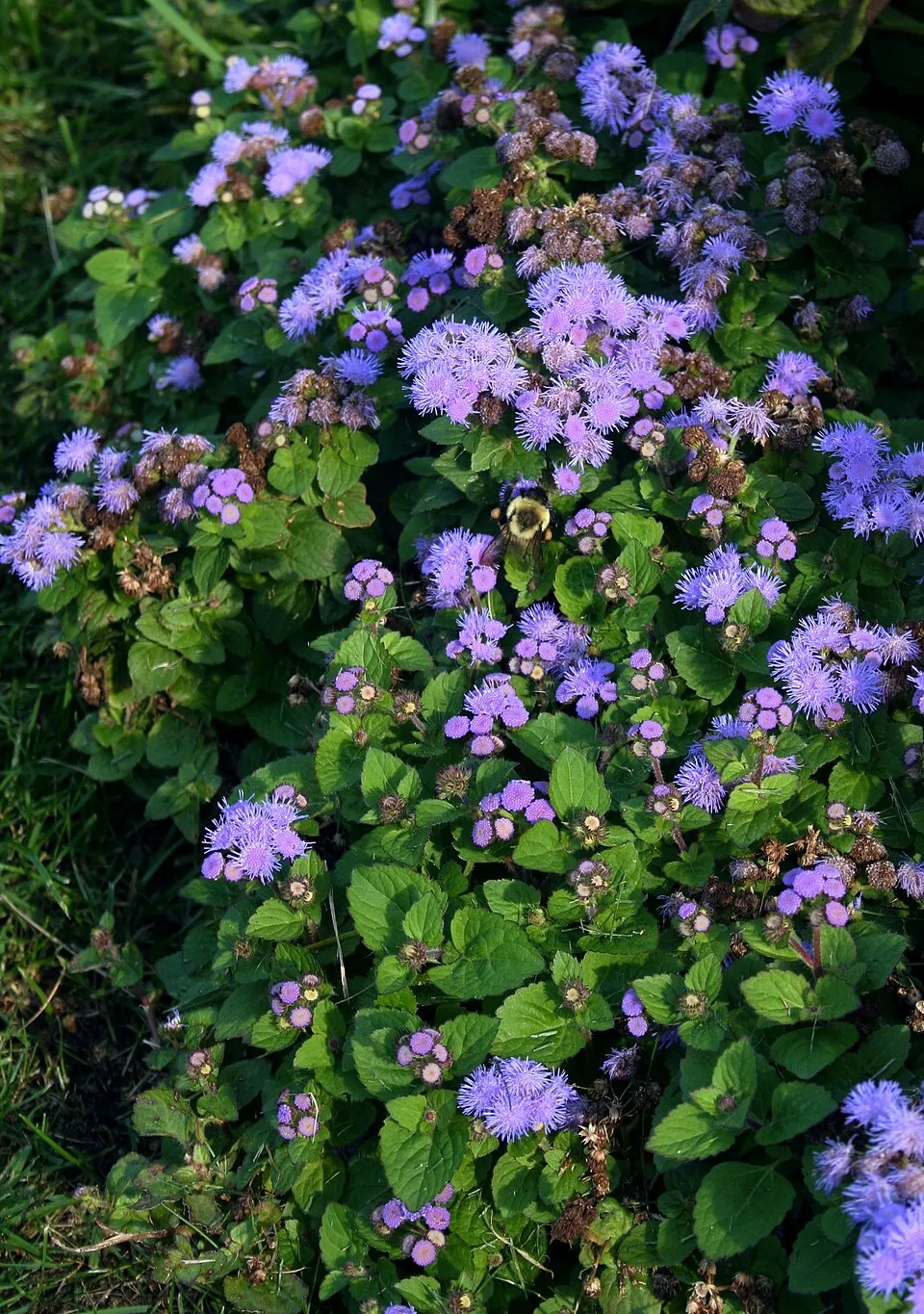
Ageratum houstonianum, commonly known as Floss Flower, Bluemink, or Mexican Ageratum, is a captivating annual herbaceous plant indigenous to the tropical and subtropical regions of Central America and Mexico, notably Guatemala and Belize. Thriving in its native humid environments, its ornamental allure has led to its widespread cultivation and naturalization across similar climatic zones globally. Botanically, this member of the vast Asteraceae family typically presents with soft, often noticeably hairy stems that can reach heights ranging from 30 to 75 centimeters.
Its leaves are generally ovate to deltoid in form, characterized by crenate or serrate margins, and are arranged oppositely along the stem. The plant's most distinguishing feature is its composite flower heads, which are densely packed with numerous disc florets and conspicuously lack ray florets. This unique structure imparts a soft, brush-like appearance to the flowers, which are celebrated for their vibrant hues of blue, purple, pink, or white, primarily due to rich anthocyanin pigments.
While historically valued for its aesthetic contribution to gardens, borders, and containers due to its uniform growth and prolonged blooming season, modern pharmacological investigations into Ageratum houstonianum have revealed a complex phytochemical profile. This includes a significant presence of pyrrolizidine alkaloids (PAs), such as lycopsamine and echimidine, alongside a diverse array of flavonoids and coumarins, which underscore its potential, yet complex, medicinal applications.
Trusted Scientific References
1. Authoritative external sources for Ageratum houstonianum
1.1 Wikipedia — Ageratum houstonianum
1.2 Kew POWO (Plants of the World Online)
1.3 PubMed — peer-reviewed research
1.4 NCBI Taxonomy Browser
1.5 GBIF — Global Biodiversity
1.6Ageratum should be interpreted through verified botanical identity, practical care, and responsible safety language. This recovery note adds the missing context needed for a complete profile: match light to the plant's habit, use well-drained soil, water according to season, and avoid unsupported medicinal or edible claims. For publishing, the plant can be presented as a source-backed garden plant with clear care guidance, common problem diagnosis, and conservative safety wording.
1.1.Ageratum — Key Features
- ✓ <strong>Common Name</strong> — Floss Flower, Bluemink, Mexican Ageratum.
- ✓ <strong>Scientific Name</strong> — Ageratum houstonianum.
- ✓ <strong>Family</strong> — Asteraceae, commonly known as the daisy or sunflower family.
- ✓ <strong>Native Region</strong> — Central America and Mexico, particularly Guatemala and Belize.
- ✓ <strong>Key Phytochemicals</strong> — Pyrrolizidine alkaloids (PAs), flavonoids, coumarins, chromenes, terpenoids.
- ✓ <strong>Primary Traditional Uses</strong> — Wound healing, skin conditions, antimicrobial, insect repellent.
- ✓ <strong>Modern Research Focus</strong> — Antifungal and antimicrobial potential, phytochemical analysis.
- ✓ <strong>Toxicity Warning</strong> — Contains hepatotoxic pyrrolizidine alkaloids (PAs), making internal use unsafe.
- ✓ <strong>Growth Habit</strong> — Annual herbaceous plant, typically 30-75 cm tall, with fluffy, composite flower heads.
- ✓ <strong>Ornamental Value</strong> — Widely cultivated globally for its long-lasting blue, purple, pink, or white flowers.
1.2.Ageratum — Quick Summary
- ✓ Ornamental annual with traditional uses, primarily external.
- ✓ Contains hepatotoxic pyrrolizidine alkaloids (PAs).
- ✓ Exhibits antifungal, antimicrobial, and wound-healing properties.
- ✓ Strictly for external application; internal use is highly dangerous.
- ✓ Requires professional guidance due to significant safety concerns.
- ✓ Valued for its aesthetic appeal and potential as a natural insect repellent.
2.Ageratum — Scientific Identity
3.Ageratum — Quick Facts
4.Ageratum — Appearance & Identification
5.Ageratum — Native Habitat
6.Ageratum — Water Requirements
- ✓ Climate and Light — Ageratum houstonianum thrives in full sun to partial shade, preferring warm, tropical, or subtropical climates, and is typically grown as an annual in temperate zones.
- ✓ Soil Requirements — It prefers well-drained, fertile soil with a neutral to slightly acidic pH, ideally enriched with organic matter for optimal growth.
- ✓ Watering — Consistent moisture is crucial, especially during dry periods; water regularly to keep the soil evenly moist but avoid waterlogging.
- ✓ Propagation — Primarily propagated from seeds, which can be sown indoors 6-8 weeks before the last frost or directly outdoors after all danger of frost has passed.
- ✓ Spacing — Plant seedlings or thin direct-sown plants to about 15-30 cm apart to allow for proper air circulation and growth.
- ✓ Fertilization — A balanced liquid fertilizer can be applied every 2-4 weeks, particularly for container-grown plants, to encourage continuous blooming.
- ✓ Pruning and Maintenance — Deadheading spent flowers regularly will promote continuous blooming and maintain a tidy appearance, preventing self-seeding where it might become invasive.
- ✓ Pest and Disease Management — Generally resistant, but monitor for common garden pests like aphids or whiteflies, and ensure good air circulation to prevent fungal diseases.
Reviewed by the Flora Medical Global Botanical Review Panel
Multi-disciplinary editorial group · Botany · Ethnobotany · Herbal-medicine literature
Who reviewed this: This page was checked by the Flora Medical Global Botanical Review Panel — an in-house editorial group of botany graduates, ethnobotany researchers, and horticulture practitioners who collectively maintain our 7,000+ plant encyclopedia. Meet the team.
Our 4-step verification process
1. Taxonomic verification
Scientific names and synonyms cross-checked against Kew POWO, World Flora Online, and The Plant List.
2. Phytochemical & medicinal cross-reference
Active compounds, traditional uses, and reported activities are cross-referenced with PubMed, USDA Dr. Duke's database, and peer-reviewed ethnobotanical literature.
3. Conservation & distribution check
Distribution, ecology, and conservation status confirmed against GBIF occurrence records and the IUCN Red List.
4. Editorial & safety review
Every entry passes an editorial pass for clarity, originality, and safety notices (toxicity, contraindications, dosage caveats) before publication.
Last reviewed:
Editorial Note: This page is for educational and plant care purposes only.
Written by: Flora Medical Global Editorial Team
Reviewed by: Flora Medical Global Botanical Review Panel
Last Updated: June 16, 2026







Ageratum — Comments & Community Reviews
Rate this plant