
Care Disclaimer: Plant care recommendations are general guidelines based on common growing conditions. Individual results may vary based on your local environment, climate, and care routine. If your plant is toxic, keep it away from children and pets, and consult a veterinarian if accidental ingestion occurs.
1.Alstroemeria — Overview
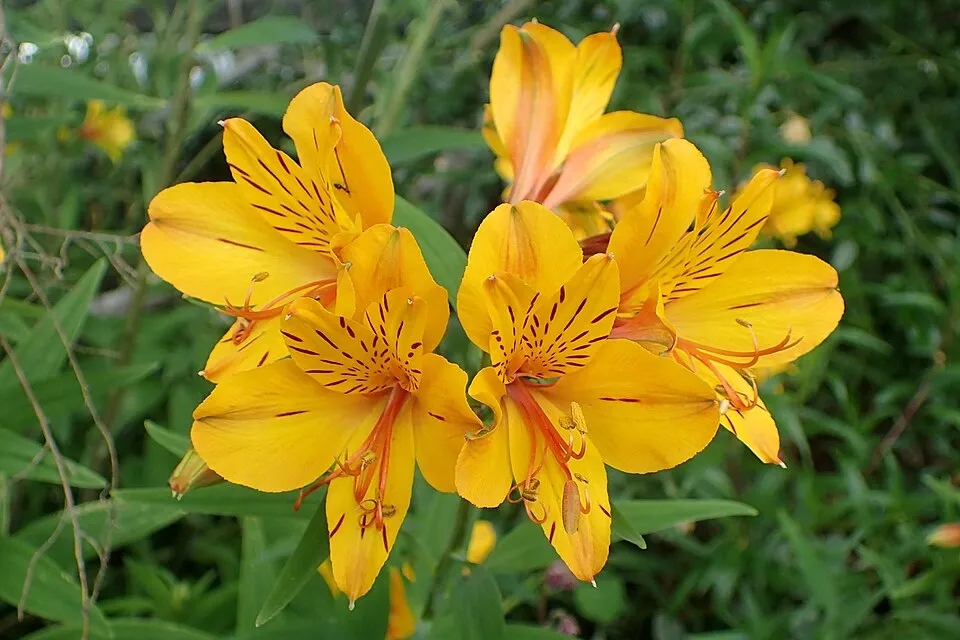
Alstroemeria aurea, commonly recognized as the Peruvian Lily or Inca Lily, is a captivating perennial rhizomatous plant within the Alstroemeriaceae family. This species originates from the diverse mountainous regions of Chile, particularly the Andes, where its natural habitat spans from central to southern Chile.
It thrives in well-drained soils at elevations typically ranging from 500 to 2000 meters, showcasing its adaptability to varied conditions. The plant was first formally documented by Graham in 1833, while the genus itself was named by Carl Linnaeus in honor of his student, Clas Alströmer, underscoring its historical botanical significance.
Botanically, Alstroemeria aurea is distinguished by its robust tuberous, fleshy roots and upright, leafy stems that can reach heights of 0.6 to 1.2 meters. A unique morphological characteristic of the genus is its resupinate leaves, which twist at the base causing the underside to face upwards. The plant produces vibrant, showy blooms, often in shades of orange to yellow-gold, frequently adorned with distinctive darker streaks or flecks.
While Alstroemeria aurea is highly valued in the floriculture industry for its robust nature, extended vase life, and ornamental appeal, its traditional medicinal uses have historically been more localized, primarily documented in folk remedies for minor dermatological irritations. Contemporary scientific inquiry, however, is increasingly investigating its rich phytochemical profile, which includes unique saponins, flavonoids, and other bioactive compounds, hinting at broader pharmacological potential beyond its recognized ornamental charm.
Trusted Scientific References
1. Authoritative external sources for Alstroemeria aurea
1.1 Wikipedia — Alstroemeria aurea
1.2 Kew POWO (Plants of the World Online)
1.3 PubMed — peer-reviewed research
1.4 NCBI Taxonomy Browser
1.5 GBIF — Global Biodiversity
1.6Alstroemeria should be interpreted through verified botanical identity, practical care, and responsible safety language. This recovery note adds the missing context needed for a complete profile: match light to the plant's habit, use well-drained soil, water according to season, and avoid unsupported medicinal or edible claims. For publishing, the plant can be presented as a source-backed garden plant with clear care guidance, common problem diagnosis, and conservative safety wording.
1.1.Alstroemeria — Key Features
- ✓ <strong>Striking Perennial Plant</strong> — Alstroemeria aurea is a robust, long-lived perennial known for its ornamental beauty.
- ✓ <strong>Native to Chilean Andes</strong> — Originates from high-altitude regions of Chile, adapted to specific environmental conditions.
- ✓ <strong>Vibrant Orange</strong> — Gold Blooms — Features showy, often streaked flowers that are highly prized.
- ✓ <strong>Resupinate Leaf Morphology</strong> — Distinctive twisted leaves where the underside faces upwards.
- ✓ <strong>Tuberous Rhizomatous Growth</strong> — Possesses underground rhizomes for perennial survival and propagation.
- ✓ <strong>Rich in Saponins and Flavonoids</strong> — Contains a complex phytochemical profile with potential bioactive compounds.
- ✓ <strong>Primarily Ornamental Value</strong> — Extensively cultivated globally for the cut flower industry due to its vase life.
- ✓ <strong>Emerging Medicinal Research</strong> — Gaining scientific interest for its potential pharmacological activities.
- ✓ <strong>Folk Dermatological Uses</strong> — Historically applied topically for minor skin irritations in traditional practices.
- ✓ <strong>Adaptable and Resilient</strong> — Relatively easy to cultivate in temperate zones with proper care.
1.2.Alstroemeria — Quick Summary
- ✓ Alstroemeria aurea, or Peruvian Lily, is a striking perennial native to the Chilean Andes.
- ✓ Valued for its vibrant orange-gold blooms and long-lasting cut flowers in floriculture.
- ✓ Contains saponins and flavonoids, suggesting potential anti-inflammatory and antioxidant properties.
- ✓ Historically used in folk remedies for minor dermatological irritations.
- ✓ Cultivation is relatively easy, preferring well-drained soil and sun.
- ✓ Caution advised for topical use due to potential contact dermatitis; ingestion is toxic.
2.Alstroemeria — Scientific Identity
3.Alstroemeria — Quick Facts
4.Alstroemeria — Appearance & Identification
5.Alstroemeria — Native Habitat
6.Alstroemeria — Water Requirements
- ✓ Soil Requirements — Thrives in well-drained, fertile soil rich in organic matter; avoid heavy, waterlogged conditions.
- ✓ Light Exposure — Prefers full sun to partial shade; in hotter climates, afternoon shade protects blooms from scorching.
- ✓ Watering — Requires consistent moisture, especially during dry periods; water deeply but allow the topsoil to dry slightly between waterings.
- ✓ Temperature and Hardiness — Hardy in USDA zones 5-10, tolerating cold if rhizomes are mulched; some varieties may need winter protection.
- ✓ Propagation — Primarily propagated by division of its tuberous rhizomes in early spring or fall; seeds can also be sown but take longer to mature.
- ✓ Fertilization — Benefit from a balanced slow-release fertilizer in spring, or liquid feed every few weeks during the growing season.
- ✓ Pests and Diseases — Generally robust, but watch for slugs, snails, and aphids; good air circulation helps prevent fungal issues.
Reviewed by the Flora Medical Global Botanical Review Panel
Multi-disciplinary editorial group · Botany · Ethnobotany · Herbal-medicine literature
Who reviewed this: This page was checked by the Flora Medical Global Botanical Review Panel — an in-house editorial group of botany graduates, ethnobotany researchers, and horticulture practitioners who collectively maintain our 7,000+ plant encyclopedia. Meet the team.
Our 4-step verification process
1. Taxonomic verification
Scientific names and synonyms cross-checked against Kew POWO, World Flora Online, and The Plant List.
2. Phytochemical & medicinal cross-reference
Active compounds, traditional uses, and reported activities are cross-referenced with PubMed, USDA Dr. Duke's database, and peer-reviewed ethnobotanical literature.
3. Conservation & distribution check
Distribution, ecology, and conservation status confirmed against GBIF occurrence records and the IUCN Red List.
4. Editorial & safety review
Every entry passes an editorial pass for clarity, originality, and safety notices (toxicity, contraindications, dosage caveats) before publication.
Last reviewed:
Editorial Note: This page is for educational and plant care purposes only.
Written by: Flora Medical Global Editorial Team
Reviewed by: Flora Medical Global Botanical Review Panel
Last Updated: June 16, 2026







Alstroemeria — Comments & Community Reviews
Rate this plant