


Care Disclaimer: Plant care recommendations are general guidelines based on common growing conditions. Individual results may vary based on your local environment, climate, and care routine. If your plant is toxic, keep it away from children and pets, and consult a veterinarian if accidental ingestion occurs.
1.Arctotis — Overview
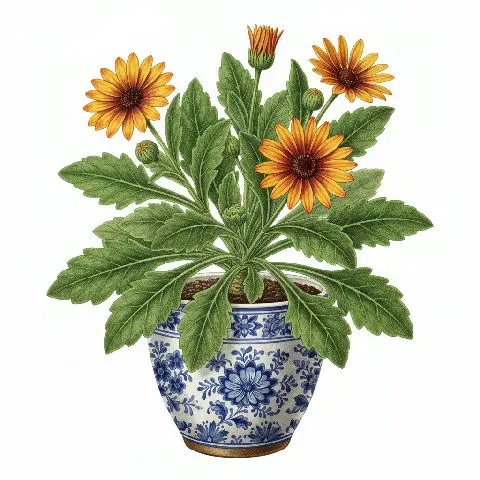
Arctotis, commonly known as African Daisy or Gousblom, represents a vibrant genus within the extensive Asteraceae family, predominantly native to the arid and semi-arid regions of southern Africa. The specific designation 'Arctotis hybrid' refers to a diverse array of cultivated varieties, meticulously developed through cross-breeding various wild species like Arctotis fastuosa, A. stoechadifolia, and A. venusta. This hybridization aims to enhance desirable horticultural traits, including an expanded palette of flower colors, increased bloom size, prolonged flowering seasons, and improved resilience across varied climatic conditions.
Morphologically, these plants typically exhibit a mounding or spreading habit, reaching heights of 1 to 2 feet. Their distinctive foliage is often finely cut or lobed, presenting a silvery-green hue, frequently covered in soft, woolly hairs. This indumentum is a key adaptation, reducing transpiration and allowing the plant to thrive in dry, stony slopes. The flowers are the most striking feature, resembling large daisies, approximately 3 inches in diameter. They display a spectacular range of colors including fiery oranges, deep reds, soft pinks, sunny yellows, and pure whites, often with captivating concentric rings of contrasting shades and metallic sheens, all centered around a dark disc of florets.
These radiant blooms characteristically open fully in bright sunlight and tend to close in the evening or on cloudy days. The genus name, Arctotis, is rooted in Greek, combining 'arctos' (bear) and 'otis' (ear), likely referring to the soft, hairy texture of the sepals in certain species, reminiscent of a bear's ear. Beyond their ornamental appeal, Arctotis hybrids are ecologically valuable, serving as significant nectar and pollen sources for local pollinators such as bees and butterflies, thereby supporting biodiversity in garden ecosystems.
Trusted Scientific References
1. Authoritative external sources for Arctotis hybrid
1.1 Wikipedia — Arctotis hybrid
1.2 Kew POWO (Plants of the World Online)
1.3 PubMed — peer-reviewed research
1.4 NCBI Taxonomy Browser
1.5 GBIF — Global Biodiversity
1.1.Arctotis — Key Features
- ✓ <strong>Striking Daisy</strong> — like Flowers — Vibrant colors with concentric rings and metallic sheens.
- ✓ <strong>Drought</strong> — Tolerant — Thrives in dry, arid conditions with minimal water.
- ✓ <strong>Silvery, Woolly Foliage</strong> — A key adaptation for water conservation and aesthetic appeal.
- ✓ <strong>Extended Blooming Period</strong> — Provides continuous color from late spring through autumn.
- ✓ <strong>Low Maintenance</strong> — Requires minimal care once established, ideal for various garden settings.
- ✓ <strong>Pollinator Attractor</strong> — Rich source of nectar and pollen for bees and butterflies.
- ✓ <strong>Native to Southern Africa</strong> — Adapted to harsh environments.
- ✓ <strong>Asteraceae Family Member</strong> — Shares characteristics with other daisy-like plants.
- ✓ <strong>Hybrid Vigor</strong> — Cultivated for enhanced size, color, and adaptability.
- ✓ <strong>Deer and Rabbit Resistant</strong> — Less prone to browsing by common garden pests.
1.2.Arctotis — Quick Summary
- ✓ Arctotis hybrids are vibrant, drought-tolerant African Daisies.
- ✓ Primarily valued for their ornamental beauty and low maintenance.
- ✓ Support pollinator populations like bees and butterflies.
- ✓ Possess a rich phytochemical profile with potential antioxidant and anti-inflammatory properties.
- ✓ Lack prominent traditional medicinal documentation but are subjects of modern research.
- ✓ Generally safe for garden use but ingestion is not recommended.
2.Arctotis — Scientific Identity
3.Arctotis — Quick Facts
4.Arctotis — Appearance & Identification
5.Arctotis — Native Habitat
6.Arctotis — Water Requirements
- ✓ Site Selection — Plant in full sun (at least 6-8 hours daily) for optimal flowering and growth.
- ✓ Soil Requirements — Prefers well-drained, sandy, or rocky soils; avoid heavy, waterlogged conditions to prevent root rot.
- ✓ Watering — Drought-tolerant once established, requiring infrequent watering; allow soil to dry out between waterings.
- ✓ Propagation — Can be grown from seeds sown in spring after the last frost, or from cuttings taken in late summer.
- ✓ Fertilization — Generally low-maintenance; a balanced, slow-release fertilizer can be applied sparingly in spring.
- ✓ Pruning — Deadhead spent flowers regularly to encourage continuous blooming and maintain a tidy appearance.
- ✓ Pest and Disease Management — Watch for aphids, spider mites, and leaf miners; powdery mildew and leaf spot can occur in humid conditions.
- ✓ Environmental Adaptability — Resistant to deer and rabbits, and tolerant of salt air, making it suitable for coastal gardens.
Reviewed by the Flora Medical Global Botanical Review Panel
Multi-disciplinary editorial group · Botany · Ethnobotany · Herbal-medicine literature
Who reviewed this: This page was checked by the Flora Medical Global Botanical Review Panel — an in-house editorial group of botany graduates, ethnobotany researchers, and horticulture practitioners who collectively maintain our 7,000+ plant encyclopedia. Meet the team.
Our 4-step verification process
1. Taxonomic verification
Scientific names and synonyms cross-checked against Kew POWO, World Flora Online, and The Plant List.
2. Phytochemical & medicinal cross-reference
Active compounds, traditional uses, and reported activities are cross-referenced with PubMed, USDA Dr. Duke's database, and peer-reviewed ethnobotanical literature.
3. Conservation & distribution check
Distribution, ecology, and conservation status confirmed against GBIF occurrence records and the IUCN Red List.
4. Editorial & safety review
Every entry passes an editorial pass for clarity, originality, and safety notices (toxicity, contraindications, dosage caveats) before publication.
Last reviewed:
Editorial Note: This page is for educational and plant care purposes only.
Written by: Flora Medical Global Editorial Team
Reviewed by: Flora Medical Global Botanical Review Panel
Last Updated: June 16, 2026







Arctotis — Comments & Community Reviews
Rate this plant