
Care Disclaimer: Plant care recommendations are general guidelines based on common growing conditions. Individual results may vary based on your local environment, climate, and care routine. If your plant is toxic, keep it away from children and pets, and consult a veterinarian if accidental ingestion occurs.
1.Armeria — Overview
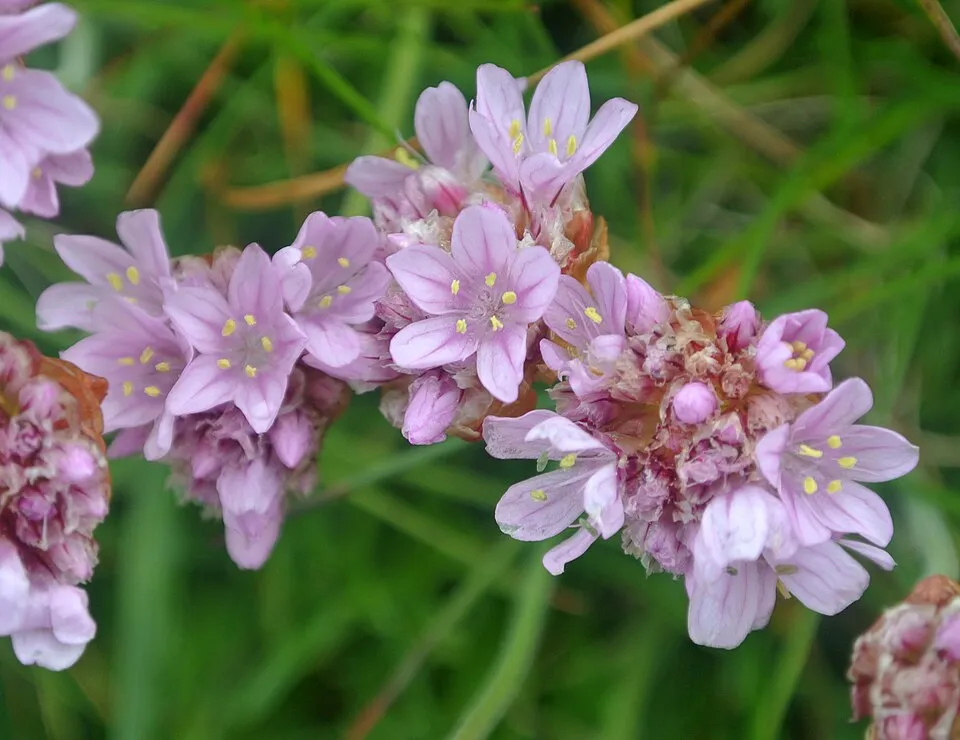
Armeria maritima, commonly known as Sea Pink or Thrift, is an exceptionally hardy herbaceous perennial belonging to the Plumbaginaceae family. This resilient species is native to a broad range of temperate coastal and mountainous regions across the Northern Hemisphere, extending from the rocky shores of Northern Europe, including Iceland, to Siberia and the Pacific coast of North America, notably Northern California.
It thrives in challenging environments characterized by lean, well-drained, and often salty soils, forming dense, evergreen clumps that are remarkably tolerant of drought and wind.
Morphologically, Armeria maritima forms a compact, low-growing mound, typically reaching 6 to 12 inches in both height and spread. Its foliage consists of numerous stiff, linear, dark-green leaves arranged in a tight basal rosette, giving the appearance of an ornamental grass. These leaves often feature fine hairs along their margins, an adaptation to reduce water loss.
From late spring through summer, slender, unbranched, leafless stalks emerge prominently above the foliage, each culminating in a charming, globular cluster of small, five-petaled flowers. These florets, which can be pink, lavender, or occasionally white, are subtended by distinctive purplish, papery bracts, contributing to the plant's ornamental appeal. The plant develops a robust, woody taproot, which anchors it firmly and aids in its survival in poor, sandy substrates.
Several geographic subspecies exist, exhibiting minor variations primarily in flower and pollen morphology.
Trusted Scientific References
1. Authoritative external sources for Armeria maritima
1.1 Wikipedia — Armeria maritima
1.2 Kew POWO (Plants of the World Online)
1.3 PubMed — peer-reviewed research
1.4 NCBI Taxonomy Browser
1.5 GBIF — Global Biodiversity
1.6Armeria should be interpreted through verified botanical identity, practical care, and responsible safety language. This recovery note adds the missing context needed for a complete profile: match light to the plant's habit, use well-drained soil, water according to season, and avoid unsupported medicinal or edible claims. For publishing, the plant can be presented as a source-backed garden plant with clear care guidance, common problem diagnosis, and conservative safety wording.
1.1.Armeria — Key Features
- ✓ <strong>Botanical Identity</strong> — Armeria maritima, a member of the Plumbaginaceae family.
- ✓ <strong>Common Names</strong> — Sea Pink, Thrift, Common Thrift.
- ✓ <strong>Habitat</strong> — Native to temperate coastal and mountainous regions of the Northern Hemisphere.
- ✓ <strong>Morphology</strong> — Low-growing, evergreen perennial with linear leaves and globular pink-to-white flower clusters.
- ✓ <strong>Chemical Profile</strong> — Rich in phenolic compounds, flavonoids, and triterpenoids.
- ✓ <strong>Traditional Uses</strong> — Folk remedies for minor inflammation, skin irritations, and as a mild diuretic.
- ✓ <strong>Ecological Role</strong> — Important for stabilizing coastal sands and rocky outcrops.
- ✓ <strong>Cultivation</strong> — Prefers full sun, lean, very well-drained soils; drought and salt tolerant.
- ✓ <strong>Ornamental Value</strong> — Widely cultivated for rock gardens, edging, and xeriscaping.
- ✓ <strong>Adaptability</strong> — Exhibits remarkable resilience in harsh environmental conditions.
1.2.Armeria — Quick Summary
- ✓ Armeria maritima, or Sea Pink, is a resilient coastal perennial.
- ✓ Known for its vibrant flowers and evergreen foliage.
- ✓ Traditionally used for minor inflammation and skin irritations.
- ✓ Rich in phenolic compounds and triterpenoids with antioxidant potential.
- ✓ Requires full sun and excellent drainage for cultivation.
- ✓ Primarily used topically, with caution advised for internal applications.
2.Armeria — Scientific Identity
3.Armeria — Quick Facts
4.Armeria — Appearance & Identification
5.Armeria — Native Habitat
6.Armeria — Water Requirements
- ✓ Site Selection — Plant Armeria maritima in full sun exposure to ensure robust growth and abundant flowering.
- ✓ Soil Requirements — Requires lean, very well-drained soil; sandy or gravelly conditions are ideal. Avoid heavy clay or overly fertile soils.
- ✓ Drainage is Crucial — Excellent drainage is paramount to prevent root rot, especially in wet and cool climates.
- ✓ Watering — Once established, Sea Pink is highly drought-tolerant and requires minimal watering.
- ✓ Fertilization — Fertilization is generally not necessary; lean soils are preferred to prevent sprawling growth and central dieback.
- ✓ Propagation — Can be propagated from seed, typically flowering in the second year, or by division in spring.
- ✓ Pruning — Deadhead spent flower stems to encourage sporadic reblooming throughout the summer.
- ✓ Winter Care — As an evergreen, avoid cutting back foliage in the fall, which can impact spring bloom.
Reviewed by the Flora Medical Global Botanical Review Panel
Multi-disciplinary editorial group · Botany · Ethnobotany · Herbal-medicine literature
Who reviewed this: This page was checked by the Flora Medical Global Botanical Review Panel — an in-house editorial group of botany graduates, ethnobotany researchers, and horticulture practitioners who collectively maintain our 7,000+ plant encyclopedia. Meet the team.
Our 4-step verification process
1. Taxonomic verification
Scientific names and synonyms cross-checked against Kew POWO, World Flora Online, and The Plant List.
2. Phytochemical & medicinal cross-reference
Active compounds, traditional uses, and reported activities are cross-referenced with PubMed, USDA Dr. Duke's database, and peer-reviewed ethnobotanical literature.
3. Conservation & distribution check
Distribution, ecology, and conservation status confirmed against GBIF occurrence records and the IUCN Red List.
4. Editorial & safety review
Every entry passes an editorial pass for clarity, originality, and safety notices (toxicity, contraindications, dosage caveats) before publication.
Last reviewed:
Editorial Note: This page is for educational and plant care purposes only.
Written by: Flora Medical Global Editorial Team
Reviewed by: Flora Medical Global Botanical Review Panel
Last Updated: June 16, 2026







Armeria — Comments & Community Reviews
Rate this plant