


Care Disclaimer: Plant care recommendations are general guidelines based on common growing conditions. Individual results may vary based on your local environment, climate, and care routine. If your plant is toxic, keep it away from children and pets, and consult a veterinarian if accidental ingestion occurs.
1.Asparagus — Overview
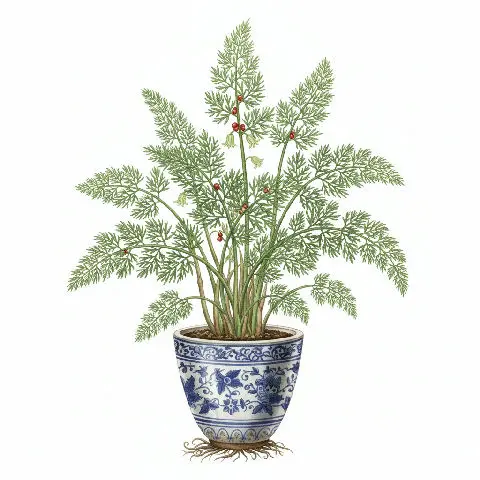
Asparagus officinalis, commonly known as garden asparagus, is an esteemed perennial flowering plant belonging to the Asparagaceae family, a taxonomic reclassification from its former placement in Liliaceae. This herbaceous plant is believed to be native to the coastal regions of Europe, North Africa, and Western Asia, though its cultivation and naturalization have led to its widespread presence across temperate zones globally, including North America and Australia. Botanically, Asparagus officinalis is characterized by a robust, fibrous underground root system known as a crown, from which its highly prized young, fleshy shoots, or spears, emerge in early spring. These spears are botanically modified stems, harvested before they develop into the plant’s distinctive feathery, fern-like foliage that can reach heights of up to 1.5 meters.
The plant produces small, bell-shaped, yellowish-green flowers, which eventually yield vibrant red berries that are toxic to humans. Historically, asparagus boasts a rich culinary and medicinal lineage, with records of its cultivation and appreciation dating back to ancient Egyptians, Greeks, and Romans. Its journey through European monasteries in the 15th century eventually brought it to the Americas by the mid-19th century. The cultivation of Asparagus officinalis demands specific environmental conditions, including well-draining, sandy soil and a suitable temperature range.
Successful production requires a plant to develop a strong root crown for at least two years, with harvesting commencing from the third year and continuing for up to 10-12 years. The unique composition of green asparagus, exposed to light, differs from white asparagus, which is blanched by being grown under cover to prevent chlorophyll development.
Trusted Scientific References
1. Authoritative external sources for Asparagus officinalis
1.1 Wikipedia — Asparagus officinalis
1.2 Kew POWO (Plants of the World Online)
1.3 PubMed — peer-reviewed research
1.4 NCBI Taxonomy Browser
1.5 GBIF — Global Biodiversity
1.1.Asparagus — Key Features
- ✓ <strong>Perennial herbaceous plant</strong> — Perennial herbaceous plant with edible young shoots.
- ✓ <strong>Distinctive feathery foliage</strong> — Distinctive feathery foliage when mature.
- ✓ <strong>Rich source of</strong> — Rich source of vitamins K, C, A, E, and folate.
- ✓ <strong>Contains unique sulfur</strong> — containing compounds.
- ✓ <strong>Demonstrates significant diuretic</strong> — Demonstrates significant diuretic properties.
- ✓ <strong>Potent antioxidant capacity</strong> — Potent antioxidant capacity from flavonoids.
- ✓ <strong>Supports liver detoxification</strong> — Supports liver detoxification and health.
- ✓ <strong>Has a long</strong> — Has a long history of culinary and medicinal use.
- ✓ <strong>Requires specific soil</strong> — Requires specific soil and climate conditions for cultivation.
- ✓ <strong>Produces red berries</strong> — Produces red berries that are toxic if ingested.
1.2.Asparagus — Quick Summary
- ✓ Botanical Origin — A perennial herbaceous plant native to Europe, North Africa, and Western Asia, now globally cultivated.
- ✓ Key Uses — Primarily valued as a nutritious spring vegetable, also recognized for its traditional medicinal properties.
- ✓ Bioactive Compounds — Rich in health-promoting saponins, flavonoids, vitamins (K, C, folate), and unique sulfur compounds.
- ✓ Primary Benefits — Known for significant diuretic, antioxidant, anti-inflammatory, and hepatoprotective effects.
- ✓ Culinary and Medicinal History — Cultivated since ancient times for both its culinary appeal and purported therapeutic value.
- ✓ Important Caution — The red berries are toxic to humans; individuals with gout should consume in moderation.
2.Asparagus — Scientific Identity
3.Asparagus — Quick Facts
4.Asparagus — Appearance & Identification
5.Asparagus — Native Habitat
6.Asparagus — Water Requirements
- ✓ Soil Requirements — Thrives in well-drained, sandy loam soils with a neutral to slightly alkaline pH (6.5-7.0) to prevent root rot.
- ✓ Climate — Prefers temperate regions with distinct cold winters for dormancy and warm summers for growth; requires at least 6-8 hours of direct sunlight daily.
- ✓ Planting — Typically planted from one-year-old crowns in early spring, spaced about 12-18 inches apart in trenches 6-8 inches deep for optimal establishment.
- ✓ Establishment Period — Plants require a minimum of two years to develop a strong, healthy root crown before the first harvest to ensure long-term productivity.
- ✓ Harvesting — Spears are harvested in spring when they are 6-10 inches tall and pencil-thick, typically for a period of 6-8 weeks, by snapping or cutting them at ground level.
- ✓ Irrigation — Requires consistent moisture, especially during dry spells and spear development; avoid waterlogging.
- ✓ Fertilization — Benefits from balanced fertilization in early spring and after harvest to replenish nutrients.
- ✓ Longevity — A properly cared-for asparagus bed can remain productive for 10-15 years, making it a long-term investment.
Reviewed by the Flora Medical Global Botanical Review Panel
Multi-disciplinary editorial group · Botany · Ethnobotany · Herbal-medicine literature
Who reviewed this: This page was checked by the Flora Medical Global Botanical Review Panel — an in-house editorial group of botany graduates, ethnobotany researchers, and horticulture practitioners who collectively maintain our 7,000+ plant encyclopedia. Meet the team.
Our 4-step verification process
1. Taxonomic verification
Scientific names and synonyms cross-checked against Kew POWO, World Flora Online, and The Plant List.
2. Phytochemical & medicinal cross-reference
Active compounds, traditional uses, and reported activities are cross-referenced with PubMed, USDA Dr. Duke's database, and peer-reviewed ethnobotanical literature.
3. Conservation & distribution check
Distribution, ecology, and conservation status confirmed against GBIF occurrence records and the IUCN Red List.
4. Editorial & safety review
Every entry passes an editorial pass for clarity, originality, and safety notices (toxicity, contraindications, dosage caveats) before publication.
Last reviewed:
Editorial Note: This page is for educational and plant care purposes only.
Written by: Flora Medical Global Editorial Team
Reviewed by: Flora Medical Global Botanical Review Panel
Last Updated: June 16, 2026







Asparagus — Comments & Community Reviews
Rate this plant