
Care Disclaimer: Plant care recommendations are general guidelines based on common growing conditions. Individual results may vary based on your local environment, climate, and care routine. If your plant is toxic, keep it away from children and pets, and consult a veterinarian if accidental ingestion occurs.
1.Astilbe — Overview
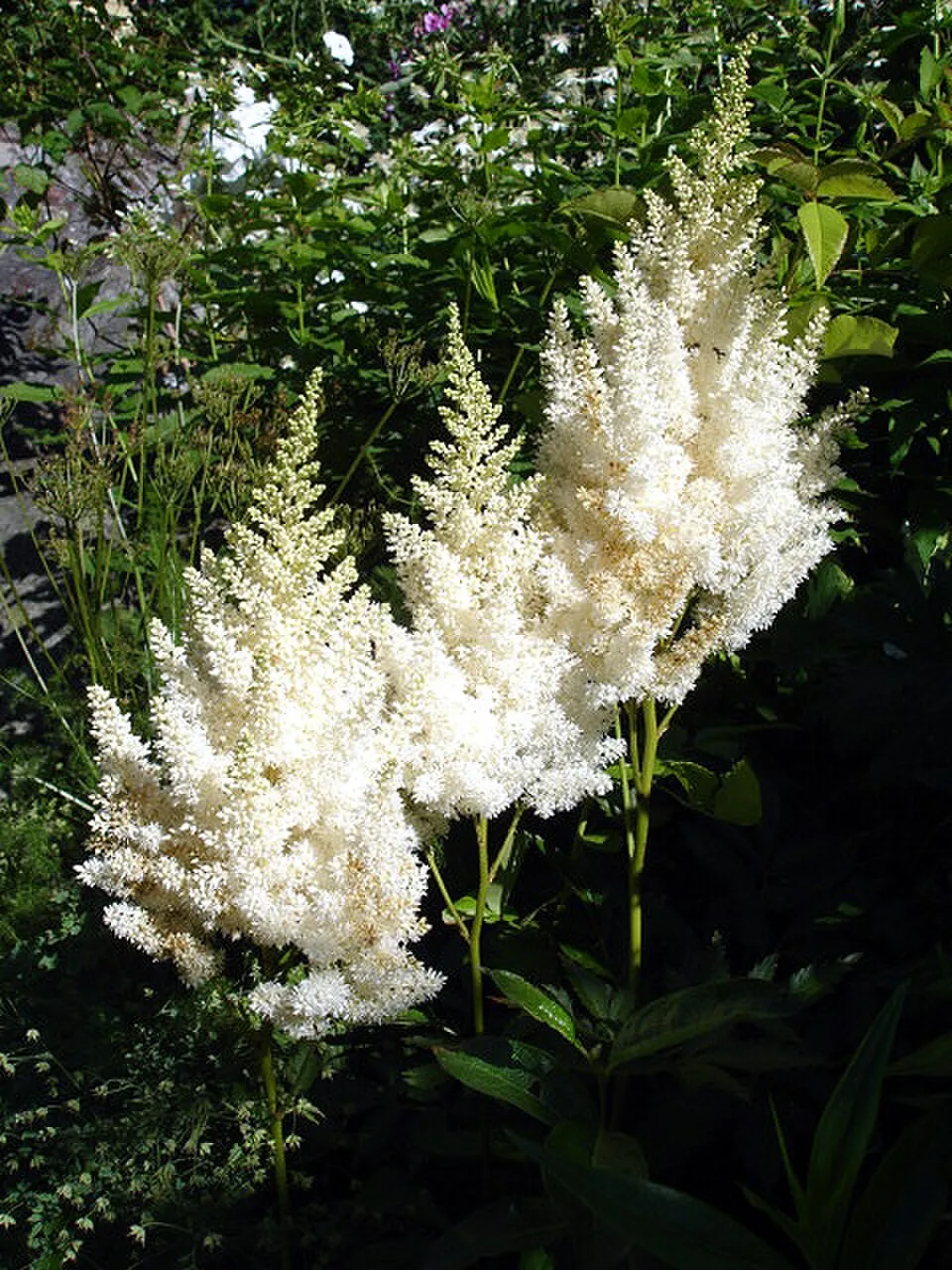
Astilbe x arendsii, commonly recognized as Arends' Astilbe or False Spirea, is a robust herbaceous perennial esteemed for its elegant, fern-like foliage and spectacular, feathery plumes of vibrant flowers. This garden hybrid is a horticultural masterpiece, meticulously developed in the early 20th century by German nurseryman George Arends through interspecific crosses primarily involving several East Asian Astilbe species, such as Astilbe chinensis, Astilbe japonica, Astilbe thunbergii, and Astilbe astilboides. While not indigenous to a single geographical region, its ancestral species thrive in the cool, moist woodlands and mountainous terrains of East Asia, including China, Japan, and Korea. Typically forming a dense, upright clump, Astilbe x arendsii reaches a height and spread of 0.6 to 1.2 meters (2 to 4 feet), varying with the specific cultivar.
Its deeply dissected, bipinnate or tripinnate leaves emerge with a bronze-green hue in spring, maturing to a rich, glossy dark green, often adorned with reddish tints, providing a lush textural backdrop throughout the growing season. The plant's most striking feature is its inflorescence—erect, often pyramidal or spikelike panicles densely packed with countless minute, star-shaped flowers. These bloom profusely from early to late summer, presenting an extensive color palette from pristine white, creamy ivory, and soft pink to vivid magenta, deep red, and purple. Astilbe thrives in partial to full shade and consistently moist, organically rich, well-drained soil, mimicking the conditions of its woodland origins.
It is a moisture-loving plant that will decline in dry conditions, making it an ideal choice for shady borders, stream banks, or moist woodland gardens, attracting butterflies while resisting deer and rabbits. Although predominantly cultivated for its ornamental value, the traditional ethnobotanical uses of its parent species in regions like China and Korea hint at potential pharmacological properties, including anti-inflammatory and analgesic effects, which modern research continues to explore.
Trusted Scientific References
1. Authoritative external sources for Astilbe x arendsii
1.1 Wikipedia — Astilbe x arendsii
1.2 Kew POWO (Plants of the World Online)
1.3 PubMed — peer-reviewed research
1.4 NCBI Taxonomy Browser
1.5 GBIF — Global Biodiversity
1.1.Astilbe — Key Features
- ✓ <strong>Hybrid ornamental perennial,</strong> — Hybrid ornamental perennial, Astilbe x arendsii, known for vibrant plumes.
- ✓ <strong>Derived from East</strong> — Derived from East Asian Astilbe species (e.g., A. chinensis, A. japonica).
- ✓ <strong>Feathery, pyramidal or</strong> — Feathery, pyramidal or spikelike flower panicles in diverse colors.
- ✓ <strong>Deeply dissected, fern</strong> — like foliage, often with bronze or reddish tints.
- ✓ <strong>Thrives in partial</strong> — Thrives in partial to full shade and consistently moist, rich soil.
- ✓ <strong>Traditional medicinal uses</strong> — Traditional medicinal uses of parent species include anti-inflammatory and analgesic effects.
- ✓ <strong>Contains beneficial phytochemicals</strong> — Contains beneficial phytochemicals like flavonoids, tannins, and saponins.
- ✓ <strong>Attracts butterflies and</strong> — Attracts butterflies and is resistant to deer and rabbits.
- ✓ <strong>Excellent for shade</strong> — Excellent for shade gardens, woodland settings, and wet sites.
- ✓ <strong>Rhizomatous root system,</strong> — Rhizomatous root system, easy to propagate by division.
1.2.Astilbe — Quick Summary
- ✓ Astilbe x arendsii is a popular ornamental hybrid with medicinal potential derived from its East Asian parent species.
- ✓ Traditional uses include anti-inflammatory, analgesic, and antioxidant applications.
- ✓ Rich in flavonoids, phenolic acids, tannins, and saponins.
- ✓ Prefers shady, moist, organically rich soil conditions.
- ✓ Primarily propagated by rhizome division for garden cultivation.
- ✓ Should be used cautiously, especially during pregnancy or with certain medications.
2.Astilbe — Scientific Identity
3.Astilbe — Quick Facts
4.Astilbe — Appearance & Identification
5.Astilbe — Native Habitat
6.Astilbe — Water Requirements
- ✓ Site Selection — Choose a location with partial to full shade; full sun is tolerated only with consistent moisture.
- ✓ Soil Requirements — Plant in organically rich, consistently moist, and well-drained soil, ideally with a slightly acidic to neutral pH.
- ✓ Watering — Provide regular and ample water, especially during dry spells, as Astilbe is highly sensitive to drought.
- ✓ Fertilization — Apply a balanced, slow-release granular fertilizer in spring, or amend with compost to maintain soil fertility.
- ✓ Propagation — Propagate readily by division of rhizomes in early spring or fall, typically every 3-4 years to maintain vigor.
- ✓ Pruning — Deadhead spent flower plumes to improve appearance, though dried seed heads can offer winter interest.
- ✓ Pest and Disease Management — Generally robust, but monitor for powdery mildew in humid conditions or for pests like whitefly and Japanese beetles.
Reviewed by the Flora Medical Global Botanical Review Panel
Multi-disciplinary editorial group · Botany · Ethnobotany · Herbal-medicine literature
Who reviewed this: This page was checked by the Flora Medical Global Botanical Review Panel — an in-house editorial group of botany graduates, ethnobotany researchers, and horticulture practitioners who collectively maintain our 7,000+ plant encyclopedia. Meet the team.
Our 4-step verification process
1. Taxonomic verification
Scientific names and synonyms cross-checked against Kew POWO, World Flora Online, and The Plant List.
2. Phytochemical & medicinal cross-reference
Active compounds, traditional uses, and reported activities are cross-referenced with PubMed, USDA Dr. Duke's database, and peer-reviewed ethnobotanical literature.
3. Conservation & distribution check
Distribution, ecology, and conservation status confirmed against GBIF occurrence records and the IUCN Red List.
4. Editorial & safety review
Every entry passes an editorial pass for clarity, originality, and safety notices (toxicity, contraindications, dosage caveats) before publication.
Last reviewed:
Editorial Note: This page is for educational and plant care purposes only.
Written by: Flora Medical Global Editorial Team
Reviewed by: Flora Medical Global Botanical Review Panel
Last Updated: June 16, 2026







Astilbe — Comments & Community Reviews
Rate this plant