


Care Disclaimer: Plant care recommendations are general guidelines based on common growing conditions. Individual results may vary based on your local environment, climate, and care routine. If your plant is toxic, keep it away from children and pets, and consult a veterinarian if accidental ingestion occurs.
1.Astrantia — Overview
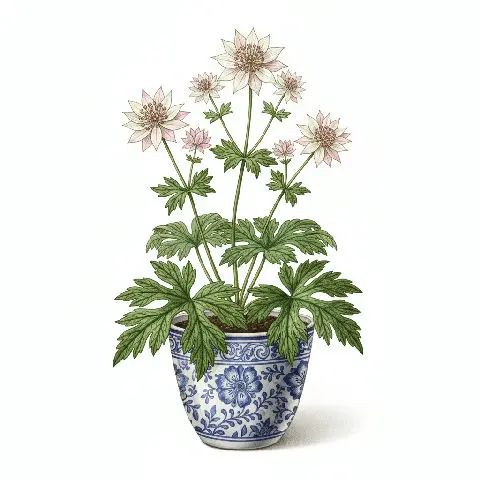
Astrantia major, commonly known as Great Masterwort, is a captivating herbaceous perennial belonging to the Apiaceae family, native to the diverse landscapes of central and eastern Europe, extending into western Asia. This resilient plant flourishes in its natural habitats of mountain meadows, woodland clearings, grasslands, and along stream banks, thriving in cool, moist conditions. Botanically, Astrantia major forms elegant mounded clumps, typically reaching up to 1.5 feet (45 cm) in height and spreading through stolons. Its basal leaves are distinctively palmate, measuring 3-6 inches long, with 3-7 deeply divided, toothed lobes, maintaining an attractive medium green hue throughout the growing season.
The plant's most striking feature is its intricate, pincushion-like flowerheads, which are dense, compact, and domed compound umbels, about an inch across. These umbels are held aloft on wiry, branched stems, adorned with sparse, narrow leaves. Each central cluster of tiny, true flowers is encircled by a prominent ruff of 19-20 showy, papery, petal-like involucral bracts. These bracts, which can range in color from silvery-white to subtle shades of pink, rose, and deep claret, provide much of the plant's visual appeal and contribute to its longevity as a cut flower.
The genus name 'Astrantia' derives from the Latin 'aster,' meaning star, a clear reference to these star-shaped floral bracts. The species epithet 'major' distinguishes it as the larger form within its genus. Blooming from summer through fall, Great Masterwort's faintly fragrant, five-petaled flowers with long stamens are highly attractive to a variety of pollinators, including bees, flies, and beetles. While primarily celebrated for its ornamental charm in temperate gardens, its historical medicinal applications are less specifically documented compared to other Apiaceae members.
Trusted Scientific References
1. Authoritative external sources for Astrantia major
1.1 Wikipedia — Astrantia major
1.2 Kew POWO (Plants of the World Online)
1.3 PubMed — peer-reviewed research
1.4 NCBI Taxonomy Browser
1.5 GBIF — Global Biodiversity
1.1.Astrantia — Key Features
- ✓ <strong>Distinctive pincushion</strong> — like flowerheads with prominent star-shaped bracts.
- ✓ <strong>Member of the</strong> — Member of the Apiaceae family, native to central and eastern Europe and western Asia.
- ✓ <strong>Herbaceous perennial, forming</strong> — Herbaceous perennial, forming mounded clumps up to 1.5 feet tall.
- ✓ <strong>Favors cool, moist,</strong> — Favors cool, moist, and partially shaded environments with rich, organic soil.
- ✓ <strong>Highly valued as</strong> — Highly valued as an ornamental garden plant and for its long-lasting cut flowers.
- ✓ <strong>Attracts a variety</strong> — Attracts a variety of pollinators, including bees, flies, and beetles.
- ✓ <strong>Historical medicinal uses</strong> — Historical medicinal uses are generally associated with the broader 'Masterwort' concept, not specifically Astrantia major.
- ✓ <strong>Research into its</strong> — Research into its specific phytochemical profile and medicinal applications is emerging but still limited.
- ✓ <strong>Known for its</strong> — Known for its attractive foliage and extended blooming period from summer to fall.
- ✓ <strong>Propagation is primarily</strong> — Propagation is primarily via fresh seed or division of established clumps.
1.2.Astrantia — Quick Summary
- ✓ Astrantia major, or Great Masterwort, is a captivating ornamental perennial from the Apiaceae family.
- ✓ Features distinctive pincushion-like flowerheads surrounded by star-shaped bracts.
- ✓ Native to European woodlands and meadows, preferring cool, moist, part-shade conditions.
- ✓ Its medicinal legacy is less documented, often conflated with other 'Masterwort' species like Peucedanum ostruthium.
- ✓ Traditional European herbalism attributes general carminative, diuretic, and stomachic properties to the broader Masterwort concept.
- ✓ Safety profile requires caution due to limited specific research, with potential for photosensitivity and allergic reactions.
2.Astrantia — Scientific Identity
3.Astrantia — Quick Facts
4.Astrantia — Appearance & Identification
5.Astrantia — Native Habitat
6.Astrantia — Water Requirements
- ✓ Hardiness Zones — Thrives in USDA hardiness zones 4-7, indicating good tolerance to cold.
- ✓ Soil Requirements — Prefers rich, continuously moist soil with abundant organic material for optimal growth.
- ✓ Light Conditions — Best grown in part shade, ideally receiving a few hours of morning sun followed by dappled shade for the rest of the day.
- ✓ Watering Needs — Does not tolerate dry soil; requires consistent irrigation if natural rainfall is insufficient to keep the soil moist.
- ✓ Climate Preference — Performs best in cool climates where night temperatures consistently dip below 70°F (21°C), making it suitable for many temperate regions.
- ✓ Fertilization — Benefits from fertilization in early spring and again at mid-summer, though it may not be necessary in already rich soils.
- ✓ Propagation — Can be propagated from fresh seeds, which require 2-3 months of cold stratification, or by dividing established plants in early spring or fall.
- ✓ Maintenance — Deadheading spent flowers can encourage continued bloom, and foliage can be cut back in fall or left for winter interest.
Reviewed by the Flora Medical Global Botanical Review Panel
Multi-disciplinary editorial group · Botany · Ethnobotany · Herbal-medicine literature
Who reviewed this: This page was checked by the Flora Medical Global Botanical Review Panel — an in-house editorial group of botany graduates, ethnobotany researchers, and horticulture practitioners who collectively maintain our 7,000+ plant encyclopedia. Meet the team.
Our 4-step verification process
1. Taxonomic verification
Scientific names and synonyms cross-checked against Kew POWO, World Flora Online, and The Plant List.
2. Phytochemical & medicinal cross-reference
Active compounds, traditional uses, and reported activities are cross-referenced with PubMed, USDA Dr. Duke's database, and peer-reviewed ethnobotanical literature.
3. Conservation & distribution check
Distribution, ecology, and conservation status confirmed against GBIF occurrence records and the IUCN Red List.
4. Editorial & safety review
Every entry passes an editorial pass for clarity, originality, and safety notices (toxicity, contraindications, dosage caveats) before publication.
Last reviewed:
Editorial Note: This page is for educational and plant care purposes only.
Written by: Flora Medical Global Editorial Team
Reviewed by: Flora Medical Global Botanical Review Panel
Last Updated: June 16, 2026







Astrantia — Comments & Community Reviews
Rate this plant