


Care Disclaimer: Plant care recommendations are general guidelines based on common growing conditions. Individual results may vary based on your local environment, climate, and care routine. If your plant is toxic, keep it away from children and pets, and consult a veterinarian if accidental ingestion occurs.
1.Banana — Overview
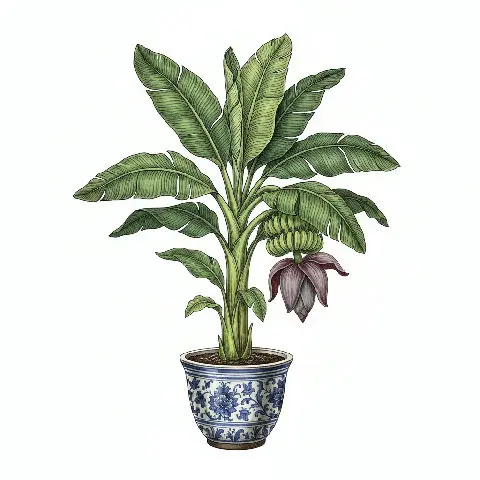
Musa spp., universally known as banana, represents a botanical anomaly – a giant herbaceous plant, often mistaken for a tree, belonging to the Musaceae family. Originating from the biodiverse regions of Southeast Asia and Papua New Guinea, archaeological findings suggest its cultivation dates back to approximately 8000 BCE in New Guinea's Kuk Swamp. From these ancient roots, the banana plant embarked on a remarkable journey, traversing continents via early maritime trade routes and later through colonial expansion, embedding itself into cultures and economies worldwide.
Its 'trunk' is not lignified wood but a robust pseudostem, formed by the tightly overlapping bases of its massive leaf sheaths. These plants typically reach heights of 3 to 10 meters, unfurling enormous, paddle-shaped leaves that can extend up to 3 meters in length and 60 cm in width. The characteristic elongated, curved fruits develop from a striking central inflorescence that emerges from the pseudostem, hanging downwards in large clusters.
Taxonomically, the genus Musa encompasses a vast array of species and hybrids, broadly categorized into two main groups: dessert bananas, primarily derived from Musa acuminata, consumed raw for their sweet flavor, and plantains, largely from Musa balbisiana and its hybrids, which are starchy and typically cooked before consumption. This botanical versatility, coupled with its nutritional density, has cemented banana's status as a global staple and a subject of extensive traditional and modern medicinal inquiry.
Trusted Scientific References
1. Authoritative external sources for Musa spp.
1.1 Wikipedia — Musa spp.
1.2 Kew POWO (Plants of the World Online)
1.3 PubMed — peer-reviewed research
1.4 NCBI Taxonomy Browser
1.5 GBIF — Global Biodiversity
1.6Banana should be interpreted through verified botanical identity, practical care, and responsible safety language. This recovery note adds the missing context needed for a complete profile: match light to the plant's habit, use well-drained soil, water according to season, and avoid unsupported medicinal or edible claims. For publishing, the plant can be presented as a source-backed garden plant with clear care guidance, common problem diagnosis, and conservative safety wording.
1.1.Banana — Key Features
- ✓ <strong>Herbaceous Giant</strong> — Botanically, a large herbaceous plant, not a tree, characterized by its pseudostem.
- ✓ <strong>Tropical Origin</strong> — Native to Southeast Asia and Papua New Guinea, now cultivated globally in tropical and subtropical zones.
- ✓ <strong>High Potassium Content</strong> — Renowned for its significant levels of potassium, crucial for electrolyte balance and blood pressure.
- ✓ <strong>Rich in Dietary Fiber</strong> — Provides soluble and insoluble fibers, aiding digestion and promoting gut health.
- ✓ <strong>Source of Diverse Antioxidants</strong> — Contains various phenolic compounds, flavonoids, and carotenoids.
- ✓ <strong>Versatile Culinary Uses</strong> — Consumed raw as dessert fruit or cooked as a starchy vegetable (plantain).
- ✓ <strong>Traditional Healing Applications</strong> — Employed in Ayurveda, TCM, Unani, and folk medicine for a range of ailments.
- ✓ <strong>Global Economic Importance</strong> — A major staple food and cash crop worldwide, supporting livelihoods.
- ✓ <strong>Rapid Growth and High Yield</strong> — Characterized by its relatively fast growth cycle and high fruit productivity per unit area.
- ✓ <strong>Adaptable Plant Parts</strong> — Fruit, peel, flower, leaves, and pseudostem all have culinary, medicinal, or industrial applications.
1.2.Banana — Quick Summary
- ✓ Global staple fruit and versatile medicinal plant, Musa spp.
- ✓ Rich in essential vitamins, minerals, and potent antioxidants.
- ✓ Supports digestive health, cardiovascular function, and mood regulation.
- ✓ Utilized across traditional medicine systems for various health benefits.
- ✓ Every part of the plant – fruit, peel, flower, stem, leaves – holds value.
- ✓ Generally safe for consumption, with specific considerations for allergies or underlying health conditions.
2.Banana — Scientific Identity
3.Banana — Quick Facts
4.Banana — Appearance & Identification
5.Banana — Native Habitat
6.Banana — Water Requirements
- ✓ Climate Preference — Thrives in tropical and subtropical regions with consistent warmth, high humidity, and ample rainfall, ideally between 20-30°C.
- ✓ Soil Requirements — Prefers deep, fertile, well-drained loamy soils with a pH ranging from 6.0-7.0, rich in organic matter.
- ✓ Propagation — Primarily propagated vegetatively using 'suckers' (offshoots) or tissue-cultured plantlets, as most commercial varieties are sterile triploids.
- ✓ Water Management — Requires consistent and abundant moisture, often necessitating irrigation in drier periods, but susceptible to waterlogging.
- ✓ Nutrient Needs — High demand for potassium, nitrogen, and phosphorus, requiring regular fertilization to support rapid growth and fruit production.
- ✓ Pest and Disease Control — Vigilant management is crucial against common threats like Panama disease (Fusarium wilt), Sigatoka leaf spot, and various insect pests.
- ✓ Wind Protection — Due to their large, fragile leaves and shallow root systems, banana plants benefit from windbreaks to prevent damage and toppling.
- ✓ Harvesting — Fruits are typically harvested when mature but still green, allowing for controlled ripening during transport and storage.
Reviewed by the Flora Medical Global Botanical Review Panel
Multi-disciplinary editorial group · Botany · Ethnobotany · Herbal-medicine literature
Who reviewed this: This page was checked by the Flora Medical Global Botanical Review Panel — an in-house editorial group of botany graduates, ethnobotany researchers, and horticulture practitioners who collectively maintain our 7,000+ plant encyclopedia. Meet the team.
Our 4-step verification process
1. Taxonomic verification
Scientific names and synonyms cross-checked against Kew POWO, World Flora Online, and The Plant List.
2. Phytochemical & medicinal cross-reference
Active compounds, traditional uses, and reported activities are cross-referenced with PubMed, USDA Dr. Duke's database, and peer-reviewed ethnobotanical literature.
3. Conservation & distribution check
Distribution, ecology, and conservation status confirmed against GBIF occurrence records and the IUCN Red List.
4. Editorial & safety review
Every entry passes an editorial pass for clarity, originality, and safety notices (toxicity, contraindications, dosage caveats) before publication.
Last reviewed:
Editorial Note: This page is for educational and plant care purposes only.
Written by: Flora Medical Global Editorial Team
Reviewed by: Flora Medical Global Botanical Review Panel
Last Updated: June 16, 2026







Banana — Comments & Community Reviews
Rate this plant