


Care Disclaimer: Plant care recommendations are general guidelines based on common growing conditions. Individual results may vary based on your local environment, climate, and care routine. If your plant is toxic, keep it away from children and pets, and consult a veterinarian if accidental ingestion occurs.
1.Banksia — Overview
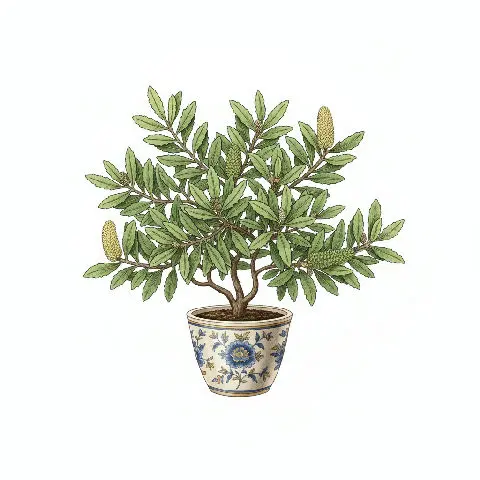
Banksia integrifolia, widely recognized as the Coast Banksia, stands as an exceptionally resilient and emblematic Australian species, a distinguished member of the Proteaceae family. This plant holds considerable historical and ecological significance, notably being one of the initial four Banksia species documented by Joseph Banks in 1770 during Captain Cook's inaugural voyage to New Holland. Its specific epithet, 'integrifolia', aptly describes its typically entire, unmangled leaves, a key characteristic distinguishing it from many other Banksias. Geographically, Banksia integrifolia flourishes along Australia's eastern seaboard, extending from Victoria northward into Central Queensland. Its remarkable adaptability allows it to colonize diverse habitats, ranging from exposed coastal dunes and headlands to dry sclerophyll forests and even montane elevations up to 1500 meters.
This extensive distribution underscores its considerable resilience and genetic diversity. Morphologically, Banksia integrifolia can present as a sprawling shrub, a modest tree, or, in more sheltered coastal environments, a substantial tree reaching heights of up to 25 meters, distinguished by its deeply furrowed, grey, corky bark. Its leaves are typically narrowly obovate to oblong, measuring 4-20 cm in length and 6-35 mm in width, featuring a vibrant dark green upper surface and a striking, often densely hairy (tomentose) white underside. The most prominent botanical feature is its inflorescence—a large, erect, pale yellow to golden-yellow cylindrical spike, usually 10-12 cm high and 5 cm in diameter. These flower spikes, densely packed with hundreds of individual florets, are a rich source of nectar, rendering them an indispensable food source for a multitude of native fauna, including honeyeaters, small mammals like possums and gliders, and various insects.
Flowering predominantly occurs from late summer through winter (March to August), though some bloom can be observed throughout the year, enhancing its continuous ecological contribution. Post-pollination, the spent flowers mature into woody 'cones' (which are actually fruiting receptacles) containing numerous follicles that safeguard the seeds. These follicles are typically oval-shaped and tough. Trusted Scientific References Authoritative external sources for Banksia integrifolia : Wikipedia — Banksia integrifolia Kew POWO (Plants of the World Online) PubMed — peer-reviewed research NCBI Taxonomy Browser GBIF — Global Biodive ...[CURRENT TEXT EXISTS: 2505 chars]
1.1.Banksia — Key Features
- ✓ <strong>Native to Eastern</strong> — Native to Eastern Australia, ranging from Victoria to Central Queensland.
- ✓ <strong>Highly adaptable, growing</strong> — Highly adaptable, growing as a shrub or a tree up to 25 meters tall.
- ✓ <strong>Distinctive deeply furrowed,</strong> — Distinctive deeply furrowed, grey, corky bark.
- ✓ <strong>Leaves feature a</strong> — Leaves feature a dark green upper surface and a white, hairy underside, typically entire.
- ✓ <strong>Produces large, erect,</strong> — Produces large, erect, cylindrical, pale yellow to golden-yellow flower spikes.
- ✓ <strong>Flower spikes are</strong> — Flower spikes are exceptionally rich in nectar, attracting a wide array of native birds and insects.
- ✓ <strong>Develops woody 'cones'</strong> — Develops woody 'cones' (fruiting receptacles) containing numerous seed follicles after flowering.
- ✓ <strong>Exhibits remarkable resilience</strong> — Exhibits remarkable resilience to coastal conditions, including salt spray and strong winds.
- ✓ <strong>Capable of resprouting</strong> — Capable of resprouting from epicormic shoots after fire, aiding its survival in bushfire-prone areas.
- ✓ <strong>Holds significant ecological</strong> — Holds significant ecological importance as a food source and habitat provider for Australian wildlife.
1.2.Banksia — Quick Summary
- ✓ Iconic Australian native, Banksia integrifolia, known as Coast Banksia, is a highly adaptable plant.
- ✓ Its large, nectar-rich flower spikes are vital for native fauna and provide an edible energy source.
- ✓ Contains tannins and flavonoids, suggesting potential astringent, anti-inflammatory, and antioxidant benefits.
- ✓ Traditionally, the nectar has been consumed for energy and soothing minor ailments.
- ✓ Thrives in coastal, nutrient-poor, acidic soils and is resilient to harsh environmental conditions.
- ✓ Offers significant ecological value and ornamental appeal in landscaping.
2.Banksia — Scientific Identity
3.Banksia — Quick Facts
4.Banksia — Appearance & Identification
5.Banksia — Native Habitat
6.Banksia — Water Requirements
- ✓ Climate Preference — Thrives in warm temperate to tropical zones, tolerating temperatures between 10°C and 37°C, with optimal growth between 18°C and 32°C.
- ✓ Soil Requirements — Prefers well-drained, acidic sandy loams (pH 5-6.5), requiring lime-free conditions and low nutrient levels, particularly phosphates and nitrates.
- ✓ Light Exposure — Best grown in a sunny position, though it can tolerate partial shade, especially in hotter climates.
- ✓ Water Needs — Requires a mean annual rainfall between 850 mm and 1,600 mm, tolerating ranges from 650 mm to 2,000 mm.
- ✓ Environmental Resilience — Highly resistant to wind and salt spray, making it an excellent choice for coastal planting and exposed sites.
- ✓ Propagation — Primarily propagated from seeds, which often require heat treatment (scarification or fire simulation) for optimal germination, or from semi-hardwood cuttings.
- ✓ Maintenance and Pruning — Established plants are robust and can resprout vigorously from epicormic shoots after fire or severe pruning, maintaining their form.
- ✓ Nutrient Sensitivity — Avoid high-phosphorus fertilizers common for other plants, as Proteaceae species are highly sensitive to excess phosphorus.
Reviewed by the Flora Medical Global Botanical Review Panel
Multi-disciplinary editorial group · Botany · Ethnobotany · Herbal-medicine literature
Who reviewed this: This page was checked by the Flora Medical Global Botanical Review Panel — an in-house editorial group of botany graduates, ethnobotany researchers, and horticulture practitioners who collectively maintain our 7,000+ plant encyclopedia. Meet the team.
Our 4-step verification process
1. Taxonomic verification
Scientific names and synonyms cross-checked against Kew POWO, World Flora Online, and The Plant List.
2. Phytochemical & medicinal cross-reference
Active compounds, traditional uses, and reported activities are cross-referenced with PubMed, USDA Dr. Duke's database, and peer-reviewed ethnobotanical literature.
3. Conservation & distribution check
Distribution, ecology, and conservation status confirmed against GBIF occurrence records and the IUCN Red List.
4. Editorial & safety review
Every entry passes an editorial pass for clarity, originality, and safety notices (toxicity, contraindications, dosage caveats) before publication.
Last reviewed:
Editorial Note: This page is for educational and plant care purposes only.
Written by: Flora Medical Global Editorial Team
Reviewed by: Flora Medical Global Botanical Review Panel
Last Updated: June 16, 2026







Banksia — Comments & Community Reviews
Rate this plant