


Care Disclaimer: Plant care recommendations are general guidelines based on common growing conditions. Individual results may vary based on your local environment, climate, and care routine. If your plant is toxic, keep it away from children and pets, and consult a veterinarian if accidental ingestion occurs.
1.Bitter Gourd — Overview
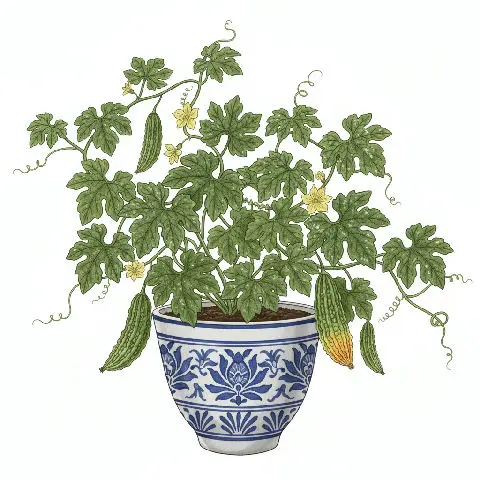
Momordica charantia, commonly known as Bitter Gourd or Bitter Melon, is a tropical and subtropical herbaceous vine belonging to the Cucurbitaceae family, widely recognized for its distinctive, warty fruit which is among the most bitter in the plant kingdom. This monoecious climbing perennial, often cultivated as an annual, originated in ancient India where it was first domesticated and integrated into Ayurvedic medicinal practices, with its historical use documented in texts like the Sushruta Samhita.
From its Indian roots, the plant's cultivation expanded across Southeast Asia, China, Africa, and subsequently reached the Caribbean and parts of South America, becoming a significant component in diverse traditional cuisines and pharmacopoeias worldwide.
Botanically, Momordica charantia is characterized by its slender stems that can reach up to 5 meters in length, supported by tendrils. Its alternate leaves are deeply lobed, typically with 3 to 7 main lobes, and are vibrant green. The plant produces solitary, bright yellow, five-petaled flowers, with male and female flowers appearing on the same plant.
The fruit, the most prominent feature, is oblong to fusiform, varying in length from 5 to 20 cm, covered in characteristic longitudinal ridges and irregular warts. Immature fruits are green, transitioning to a yellow-orange hue upon ripening, at which point they typically split open to reveal seeds encased in a bright red, sweet aril. The intense bitterness, a hallmark of the plant, is primarily attributed to a group of cucurbitacin compounds.
Bitter Gourd thrives in warm, humid climates, mirroring its native tropical environment, and requires ample sunlight and well-drained soil for optimal growth.
Trusted Scientific References
1. Authoritative external sources for Momordica charantia
1.1 Wikipedia — Momordica charantia
1.2 Kew POWO (Plants of the World Online)
1.3 PubMed — peer-reviewed research
1.4 NCBI Taxonomy Browser
1.5 GBIF — Global Biodiversity
1.6Bitter Gourd should be interpreted through verified botanical identity, practical care, and responsible safety language. This recovery note adds the missing context needed for a complete profile: match light to the plant's habit, use well-drained soil, water according to season, and avoid unsupported medicinal or edible claims. For publishing, the plant can be presented as a source-backed garden plant with clear care guidance, common problem diagnosis, and conservative safety wording.
1.1.Bitter Gourd — Key Features
- ✓ <strong>Potent Antidiabetic Agent</strong> — Scientifically validated for blood sugar control.
- ✓ <strong>Rich in Bioactive Compounds</strong> — Contains charantin, polypeptide-p, triterpenoids, and flavonoids.
- ✓ <strong>Global Ethnomedicinal Use</strong> — Valued in Ayurveda, TCM, Unani, and other traditional systems.
- ✓ <strong>Distinctive Bitter Flavor</strong> — Due to cucurbitacin compounds, a defining characteristic.
- ✓ <strong>Culinary Versatility</strong> — Integral to Asian, African, and Caribbean dishes.
- ✓ <strong>Antioxidant Powerhouse</strong> — Protects against cellular damage from free radicals.
- ✓ <strong>Anti</strong> — inflammatory Support — Helps mitigate chronic inflammatory responses.
- ✓ <strong>Immunomodulatory Effects</strong> — Supports and balances the immune system.
- ✓ <strong>Tropical and Subtropical Cultivation</strong> — Thrives in warm, humid climates.
- ✓ <strong>Comprehensive Plant Utilization</strong> — Fruit, leaves, and seeds all possess medicinal value.
1.2.Bitter Gourd — Quick Summary
- ✓ Bitter Gourd (Momordica charantia) is a tropical vine known for its intensely bitter, warty fruit.
- ✓ Renowned for its potent antidiabetic properties, widely used in traditional medicine systems like Ayurveda and TCM.
- ✓ Contains key compounds like charantin, polypeptide-p ('plant insulin'), and various triterpenoids.
- ✓ Offers significant antioxidant, anti-inflammatory, and immunomodulatory benefits.
- ✓ Used culinarily in diverse global cuisines and medicinally as juice, tea, or supplements.
- ✓ Requires careful use, especially for diabetics, pregnant individuals, and those with G6PD deficiency.
2.Bitter Gourd — Scientific Identity
3.Bitter Gourd — Quick Facts
4.Bitter Gourd — Appearance & Identification
5.Bitter Gourd — Native Habitat
6.Bitter Gourd — Water Requirements
- ✓ Climate Requirement — Thrives in warm, humid tropical and subtropical climates, ideally with temperatures between 25-35°C (77-95°F).
- ✓ Soil Preference — Prefers well-drained, fertile sandy loam to loamy soils with a pH between 6.0 and 7.0.
- ✓ Seed Propagation — Seeds can be directly sown or started indoors; soaking seeds for 24 hours prior to planting can improve germination rates.
- ✓ Watering — Requires consistent and ample moisture, especially during flowering and fruiting, but avoid waterlogging to prevent root rot.
- ✓ Support System — As a climbing vine, it needs a strong trellis, stake, or arbor for support to ensure proper air circulation and fruit development.
- ✓ Pest and Disease Management — Monitor for common cucurbit pests like aphids, fruit flies, and powdery mildew; organic pesticides and good cultural practices are recommended.
- ✓ Fertilization — Benefits from regular feeding with balanced organic fertilizers or compost, particularly during active growth.
- ✓ Harvesting — Fruits are typically harvested when green and tender, before they start to ripen and turn yellow, usually 50-60 days after planting.
Reviewed by the Flora Medical Global Botanical Review Panel
Multi-disciplinary editorial group · Botany · Ethnobotany · Herbal-medicine literature
Who reviewed this: This page was checked by the Flora Medical Global Botanical Review Panel — an in-house editorial group of botany graduates, ethnobotany researchers, and horticulture practitioners who collectively maintain our 7,000+ plant encyclopedia. Meet the team.
Our 4-step verification process
1. Taxonomic verification
Scientific names and synonyms cross-checked against Kew POWO, World Flora Online, and The Plant List.
2. Phytochemical & medicinal cross-reference
Active compounds, traditional uses, and reported activities are cross-referenced with PubMed, USDA Dr. Duke's database, and peer-reviewed ethnobotanical literature.
3. Conservation & distribution check
Distribution, ecology, and conservation status confirmed against GBIF occurrence records and the IUCN Red List.
4. Editorial & safety review
Every entry passes an editorial pass for clarity, originality, and safety notices (toxicity, contraindications, dosage caveats) before publication.
Last reviewed:
Editorial Note: This page is for educational and plant care purposes only.
Written by: Flora Medical Global Editorial Team
Reviewed by: Flora Medical Global Botanical Review Panel
Last Updated: June 16, 2026







Bitter Gourd — Comments & Community Reviews
Rate this plant