


Care Disclaimer: Plant care recommendations are general guidelines based on common growing conditions. Individual results may vary based on your local environment, climate, and care routine. If your plant is toxic, keep it away from children and pets, and consult a veterinarian if accidental ingestion occurs.
1.Bottle Gourd — Overview
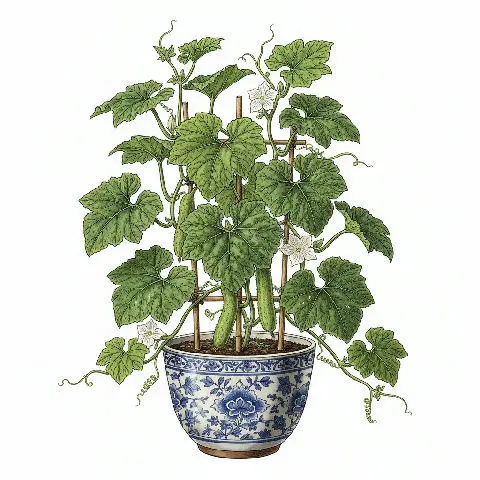
Lagenaria siceraria, commonly known as Bottle Gourd or calabash, is an ancient and globally significant member of the Cucurbitaceae family. Its history spans over 10,000 years, making it one of humanity's earliest cultivated plants, with genetic evidence pointing to an African origin followed by widespread dispersal to Asia and the Americas. This vigorous annual climbing vine can extend up to 9-12 meters (30-40 feet), necessitating robust support structures for optimal growth. Its large, softly hairy, heart-shaped leaves provide a lush canopy.
The plant produces solitary, white, nocturnal flowers, which are typically pollinated by moths and other night-flying insects, a fascinating adaptation to its environment. The fruits of Bottle Gourd exhibit remarkable morphological plasticity, varying significantly in shape and size from small and round to elongated, club-shaped, or even serpentine, often exceeding a meter in length. Young fruits are harvested as a versatile vegetable, while mature fruits develop a hard, woody, waterproof outer rind, transforming into durable containers, musical instruments, or craft materials. Internally, the mature fruit's flesh becomes dry and fibrous.
Beyond its culinary and practical uses, Bottle Gourd holds significant value in traditional medicine systems such as Ayurveda, Unani, and Traditional Chinese Medicine (TCM) for its acclaimed cooling, diuretic, and detoxifying properties. Modern research continues to explore its rich phytochemistry, validating many of these traditional applications.
Trusted Scientific References
1. Authoritative external sources for Lagenaria siceraria
1.1 Wikipedia — Lagenaria siceraria
1.2 Kew POWO (Plants of the World Online)
1.3 PubMed — peer-reviewed research
1.4 NCBI Taxonomy Browser
1.5 GBIF — Global Biodiversity
1.6Bottle Gourd should be interpreted through verified botanical identity, practical care, and responsible safety language. This recovery note adds the missing context needed for a complete profile: match light to the plant's habit, use well-drained soil, water according to season, and avoid unsupported medicinal or edible claims. For publishing, the plant can be presented as a source-backed garden plant with clear care guidance, common problem diagnosis, and conservative safety wording.
1.1.Bottle Gourd — Key Features
- ✓ <strong>Ancient Cultivar</strong> — One of the oldest cultivated plants globally, with a history spanning over 10,000 years.
- ✓ <strong>Morphological Plasticity</strong> — Fruits exhibit remarkable diversity in shape and size, from round to elongated or serpentine.
- ✓ <strong>Dual Purpose</strong> — Used as a fresh vegetable when young and as durable containers/crafts when mature and dried.
- ✓ <strong>Rich Phytochemistry</strong> — Contains beneficial compounds like cucurbitacins, flavonoids, sterols, and saponins.
- ✓ <strong>Nutritional Value</strong> — Low in calories but high in dietary fiber, vitamins (C, B complex), and essential minerals.
- ✓ <strong>Traditional Medicine Staple</strong> — Highly valued in Ayurveda, Unani, and TCM for cooling, detoxifying, and diuretic effects.
- ✓ <strong>Cardioprotective Potential</strong> — Recognized for its ability to support heart health and manage lipid profiles.
- ✓ <strong>Hepatoprotective Action</strong> — Shows protective effects against liver damage in preliminary research.
- ✓ <strong>Antioxidant Powerhouse</strong> — Abundant in compounds that combat oxidative stress and free radical damage.
- ✓ <strong>Vigorous Climbing Vine</strong> — Requires substantial support for its extensive growth and heavy fruit production.
1.2.Bottle Gourd — Quick Summary
- ✓ Ancient and versatile cucurbit with global distribution.
- ✓ Valued for both culinary and medicinal uses, particularly in Ayurveda and TCM.
- ✓ Rich in vitamins, minerals, fiber, and bioactive compounds like triterpenoids and flavonoids.
- ✓ Known for cardioprotective, hepatoprotective, antioxidant, and diuretic properties.
- ✓ Essential to avoid bitter-tasting fruit due to potential toxicity from cucurbitacins.
- ✓ Requires careful cultivation with support and ample water for optimal growth.
2.Bottle Gourd — Scientific Identity
3.Bottle Gourd — Quick Facts
4.Bottle Gourd — Appearance & Identification
5.Bottle Gourd — Native Habitat
6.Bottle Gourd — Water Requirements
- ✓ Climate — Thrives in warm, tropical to subtropical climates, requiring consistent temperatures above 20°C (68°F).
- ✓ Soil — Prefers well-drained, fertile loamy soil rich in organic matter with a pH between 6.0 and 7.5.
- ✓ Sunlight — Requires full sun exposure, at least 6-8 hours of direct sunlight daily for optimal growth and fruiting.
- ✓ Watering — Needs consistent and ample watering, especially during flowering and fruit development, to prevent stress and ensure good yield.
- ✓ Support — As a vigorous climbing vine, it absolutely requires strong trellises, arbors, or stakes to support its heavy fruits and extensive growth.
- ✓ Sowing — Seeds are typically sown directly into the ground after the last frost, or started indoors and transplanted carefully.
- ✓ Fertilization — Benefits from regular feeding with balanced organic fertilizers, particularly those rich in phosphorus and potassium during the fruiting stage.
- ✓ Pest & Disease Management — Monitor for common cucurbit pests like squash bugs and powdery mildew; practice good air circulation and crop rotation.
Reviewed by the Flora Medical Global Botanical Review Panel
Multi-disciplinary editorial group · Botany · Ethnobotany · Herbal-medicine literature
Who reviewed this: This page was checked by the Flora Medical Global Botanical Review Panel — an in-house editorial group of botany graduates, ethnobotany researchers, and horticulture practitioners who collectively maintain our 7,000+ plant encyclopedia. Meet the team.
Our 4-step verification process
1. Taxonomic verification
Scientific names and synonyms cross-checked against Kew POWO, World Flora Online, and The Plant List.
2. Phytochemical & medicinal cross-reference
Active compounds, traditional uses, and reported activities are cross-referenced with PubMed, USDA Dr. Duke's database, and peer-reviewed ethnobotanical literature.
3. Conservation & distribution check
Distribution, ecology, and conservation status confirmed against GBIF occurrence records and the IUCN Red List.
4. Editorial & safety review
Every entry passes an editorial pass for clarity, originality, and safety notices (toxicity, contraindications, dosage caveats) before publication.
Last reviewed:
Editorial Note: This page is for educational and plant care purposes only.
Written by: Flora Medical Global Editorial Team
Reviewed by: Flora Medical Global Botanical Review Panel
Last Updated: June 16, 2026







Bottle Gourd — Comments & Community Reviews
Rate this plant