


Care Disclaimer: Plant care recommendations are general guidelines based on common growing conditions. Individual results may vary based on your local environment, climate, and care routine. If your plant is toxic, keep it away from children and pets, and consult a veterinarian if accidental ingestion occurs.
1.Bouteloua — Overview
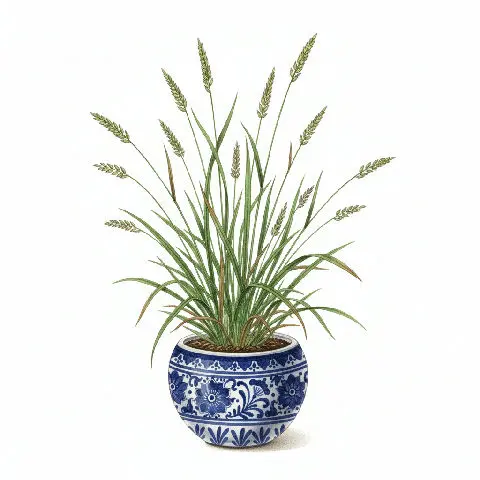
Bouteloua gracilis, commonly known as Blue Grama, is a quintessential perennial, warm-season grass belonging to the Poaceae family, native to the vast grasslands and prairies of North America. This resilient species is particularly dominant in the shortgrass prairies of the Great Plains, where it often coexists with buffalo grass. Morphologically, Blue Grama is characterized by its fine-textured, blue-green foliage that forms dense, attractive tufts, typically reaching heights of 20 to 50 cm.
Its most distinctive feature is the delicate, comb-like flower spikes that emerge in summer, maturing into striking, horizontally arrayed seed heads, which are often described as resembling tiny eyelashes or flags. These unique inflorescences contribute significantly to its ornamental appeal.
Ecologically, Bouteloua gracilis plays a pivotal role in its native ecosystems. Its extensive, dense fibrous root system is highly effective in soil stabilization and erosion control, making it an invaluable plant for arid and semi-arid regions. This deep root network also allows it to access deeper moisture, contributing to its remarkable drought tolerance and heat resistance.
The plant thrives in open, sunny environments with well-drained soils, demonstrating exceptional adaptability to harsh conditions. Historically, Blue Grama served as a vital forage grass for vast herds of bison and later cattle, underscoring its high palatability and nutritional content. While not traditionally a central herb in classical Ayurvedic, TCM, or Unani systems due to its geographic origin, modern ethnobotanical studies and contemporary research are increasingly exploring its potential, particularly concerning its nutritional profile, ecological benefits, and resilience-related compounds.
Indigenous North American tribes, such as the Cheyenne, also utilized parts of the plant for various practical purposes, including potential food or fiber.
Trusted Scientific References
1. Authoritative external sources for Bouteloua gracilis
1.1 Wikipedia — Bouteloua gracilis
1.2 Kew POWO (Plants of the World Online)
1.3 PubMed — peer-reviewed research
1.4 NCBI Taxonomy Browser
1.5 GBIF — Global Biodiversity
1.1.Bouteloua — Key Features
- ✓ <strong>Eyelash</strong> — like seed heads — Unique, comb-like inflorescences that are highly distinctive.
- ✓ <strong>Blue</strong> — green foliage — Fine-textured leaves that form dense, attractive tufts.
- ✓ <strong>Drought and heat tolerant</strong> — Exceptional resilience to arid conditions and high temperatures.
- ✓ <strong>Soil stabilization</strong> — Extensive fibrous root system prevents erosion and improves soil health.
- ✓ <strong>Native to North American prairies</strong> — Indigenous to the Great Plains and surrounding regions.
- ✓ <strong>Excellent forage grass</strong> — Highly palatable and nutritious for grazing animals.
- ✓ <strong>Low maintenance</strong> — Requires minimal water, fertilization, or specialized care once established.
- ✓ <strong>Ecological restoration plant</strong> — Crucial for habitat reconstruction and land reclamation.
- ✓ <strong>Perennial, warm</strong> — season — Returns annually and thrives in hot weather.
- ✓ <strong>Xeriscaping choice</strong> — Ideal for water-wise and sustainable landscape designs.
1.2.Bouteloua — Quick Summary
- ✓ North American native, warm-season prairie grass.
- ✓ Distinctive 'eyelash' seed heads and blue-green foliage.
- ✓ Highly drought-tolerant and plays a critical role in soil stabilization.
- ✓ Excellent nutritional forage for livestock historically and presently.
- ✓ Valued for xeriscaping and ecological restoration projects.
- ✓ Limited traditional human medicinal use, but potential for future research.
2.Bouteloua — Scientific Identity
3.Bouteloua — Quick Facts
4.Bouteloua — Appearance & Identification
5.Bouteloua — Native Habitat
6.Bouteloua — Water Requirements
- ✓ Sunlight — Thrives in full sun exposure, requiring at least six hours of direct sunlight daily for optimal growth and seed production.
- ✓ Soil Requirements — Prefers well-drained soils; adaptable to a wide range of soil types, including sandy, loamy, and clay soils, tolerating poor fertility.
- ✓ Water Needs — Highly drought-tolerant once established, requiring minimal supplemental irrigation; overwatering can be detrimental.
- ✓ Propagation — Primarily propagated by seed, which should be planted in late spring or early summer after the last frost; can also be divided.
- ✓ Planting Depth — Seeds should be sown shallowly, typically no more than 1/4 inch deep, as they require light for germination.
- ✓ Maintenance — Low maintenance; generally does not require fertilization and tolerates occasional mowing to maintain a desired height or aesthetic.
- ✓ Climate — A warm-season grass, it performs best in regions with hot summers and can withstand cold winters.
Reviewed by the Flora Medical Global Botanical Review Panel
Multi-disciplinary editorial group · Botany · Ethnobotany · Herbal-medicine literature
Who reviewed this: This page was checked by the Flora Medical Global Botanical Review Panel — an in-house editorial group of botany graduates, ethnobotany researchers, and horticulture practitioners who collectively maintain our 7,000+ plant encyclopedia. Meet the team.
Our 4-step verification process
1. Taxonomic verification
Scientific names and synonyms cross-checked against Kew POWO, World Flora Online, and The Plant List.
2. Phytochemical & medicinal cross-reference
Active compounds, traditional uses, and reported activities are cross-referenced with PubMed, USDA Dr. Duke's database, and peer-reviewed ethnobotanical literature.
3. Conservation & distribution check
Distribution, ecology, and conservation status confirmed against GBIF occurrence records and the IUCN Red List.
4. Editorial & safety review
Every entry passes an editorial pass for clarity, originality, and safety notices (toxicity, contraindications, dosage caveats) before publication.
Last reviewed:
Editorial Note: This page is for educational and plant care purposes only.
Written by: Flora Medical Global Editorial Team
Reviewed by: Flora Medical Global Botanical Review Panel
Last Updated: June 16, 2026







Bouteloua — Comments & Community Reviews
Rate this plant