


Care Disclaimer: Plant care recommendations are general guidelines based on common growing conditions. Individual results may vary based on your local environment, climate, and care routine. If your plant is toxic, keep it away from children and pets, and consult a veterinarian if accidental ingestion occurs.
1.Boysenberry — Overview
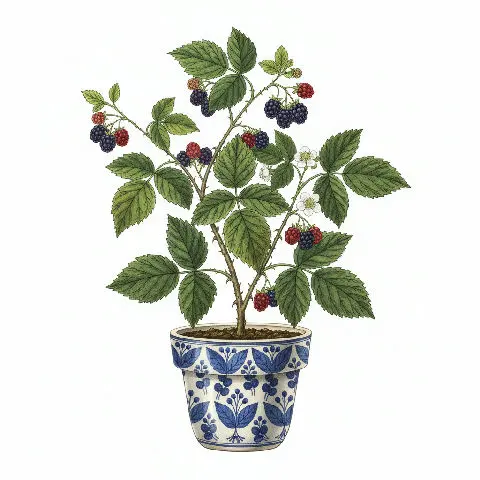
The Boysenberry, botanically recognized as Rubus ursinus × idaeus, is an extraordinary hybrid fruit plant belonging to the Rosaceae family. Its intriguing lineage emerged in the early 20th century in California, primarily through the efforts of Rudolph Boysen on his Anaheim farm, and later commercialized by Walter Knott. While its exact parentage is still debated among botanists, it is widely accepted as a complex cross involving the Pacific blackberry (Rubus ursinus) and the red raspberry (Rubus idaeus), potentially also incorporating elements from the common blackberry (Rubus allegheniensis) and loganberry (Rubus × loganobaccus). This successful hybridization yields a substantial, aggregate fruit, characterized by its deep maroon to rich purple hue, succulent texture, and a distinctive flavor profile. This taste is often described as a harmonious balance of blackberry's tartness with raspberry's sweetness, creating a complex, aromatic, and rich sensory experience. The Boysenberry plant itself is a robust, semi-erect, trailing bramble, capable of producing canes that can extend several meters if left unsupported.
These canes are typically thorny, though modern horticultural advancements have introduced thornless cultivars, significantly easing the harvesting process. Its leaves are generally trifoliate or palmately compound, displaying a medium to dark green coloration, forming a dense canopy. Flowering occurs from late spring into early summer, presenting delicate white to pale pink blossoms that are highly attractive to local pollinators. The fruits ripen in mid to late summer, offering a generous harvest period. Cultivation is prominent in New Zealand and along the Pacific coast of the United States, particularly from Southern California to Oregon. Nutritionally, Boysenberries are a powerhouse of essential micronutrients and a rich source of various bioactive compounds.
They are especially abundant in Vitamin C, Vitamin K, folic acid, manganese, and dietary fiber. Their characteristic deep pigmentation signals a high concentration of anthocyanins, a class of flavonoids renowned for their potent antioxidant capabilities. Ellagic acid, another significant constituent, has garnered extensive scientific interest for its potential anticarcinogenic and anti-inflammatory properties. Trusted Scientific References Authoritative external sources for Rubus ursinus × idaeus : Wikipedia — Rubus ursinus × idaeus Kew POWO (Plants of the World Online) PubMed — peer-re ...[CURRENT TEXT EXISTS: 2564 chars]
1.1.Boysenberry — Key Features
- ✓ <strong>Botanical Hybrid</strong> — A complex interspecific cross involving Rubus ursinus and Rubus idaeus.
- ✓ <strong>Distinct Flavor Profile</strong> — Offers a unique sweet-tart, rich, and aromatic taste that balances its parent berries.
- ✓ <strong>High Antioxidant Content</strong> — Exceptionally rich in anthocyanins, ellagic acid, and other beneficial phenolic compounds.
- ✓ <strong>Nutrient</strong> — Dense — Provides significant levels of Vitamin C, Vitamin K, folic acid, manganese, and dietary fiber.
- ✓ <strong>Vigorous Growth Habit</strong> — A robust, semi-erect, trailing bramble that typically requires structural support.
- ✓ <strong>Deep Maroon to Purple Fruit</strong> — Characterized by large, juicy aggregate drupelets of a striking dark color.
- ✓ <strong>Culinary Versatility</strong> — Highly adaptable for fresh consumption, baking, jams, preserves, sauces, and beverages.
- ✓ <strong>Supports Gut Health</strong> — Contributes to digestive regularity and a healthy microbiome due to its substantial fiber content.
- ✓ <strong>Anti</strong> — inflammatory Potential — Possesses phytochemicals that may help reduce systemic inflammation.
- ✓ <strong>Home Garden Favorite</strong> — Valued by home gardeners for its unique taste, nutritional benefits, and productive yield.
1.2.Boysenberry — Quick Summary
- ✓ Boysenberry is a unique hybrid fruit, combining the best flavors of blackberry and raspberry.
- ✓ Rich in antioxidants like anthocyanins and ellagic acid, offering significant health protective benefits.
- ✓ Excellent source of essential nutrients including Vitamin C, Vitamin K, manganese, and dietary fiber.
- ✓ Supports various bodily systems, including cardiovascular, digestive, immune, and bone health.
- ✓ Highly versatile in culinary applications, from fresh eating to baking, jams, and smoothies.
- ✓ Generally safe for consumption with minimal side effects, primarily linked to high fiber or rare allergies.
2.Boysenberry — Scientific Identity
3.Boysenberry — Quick Facts
4.Boysenberry — Appearance & Identification
5.Boysenberry — Native Habitat
6.Boysenberry — Water Requirements
- ✓ Site Selection — Choose a location that receives full sun exposure for at least 6-8 hours daily, with well-drained soil that is slightly acidic to neutral (pH 6.0-6.8).
- ✓ Planting — Plant dormant bare-root canes in late winter or early spring, ensuring adequate spacing of 2-3 meters (6-10 feet) between plants to allow for vigorous growth and air circulation.
- ✓ Support System — Provide a sturdy trellis, wires, or stakes for the trailing canes to climb, preventing them from sprawling on the ground and facilitating easier harvesting and disease prevention.
- ✓ Watering — Maintain consistent soil moisture, especially crucial during the fruit development period; however, avoid overwatering or waterlogging, which can lead to root rot.
- ✓ Fertilization — Apply a balanced granular fertilizer in the early spring, or incorporate well-rotted organic compost to enrich the soil and provide sustained nutrient release.
- ✓ Pruning — Conduct annual pruning immediately after the harvest season to remove all spent fruiting canes, which are biennial, and encourage the growth of new, productive canes for the following year.
- ✓ Pest and Disease Management — Regularly inspect plants for common berry pests like cane borers or spider mites, and fungal diseases such as anthracnose; implement organic or integrated pest management strategies as needed.
- ✓ Harvesting — Pick boysenberries when they achieve a deep maroon to purple-black color, feel plump, and detach easily from the plant, typically from mid-to-late summer, handling them gently due to their delicate nature.
Reviewed by the Flora Medical Global Botanical Review Panel
Multi-disciplinary editorial group · Botany · Ethnobotany · Herbal-medicine literature
Who reviewed this: This page was checked by the Flora Medical Global Botanical Review Panel — an in-house editorial group of botany graduates, ethnobotany researchers, and horticulture practitioners who collectively maintain our 7,000+ plant encyclopedia. Meet the team.
Our 4-step verification process
1. Taxonomic verification
Scientific names and synonyms cross-checked against Kew POWO, World Flora Online, and The Plant List.
2. Phytochemical & medicinal cross-reference
Active compounds, traditional uses, and reported activities are cross-referenced with PubMed, USDA Dr. Duke's database, and peer-reviewed ethnobotanical literature.
3. Conservation & distribution check
Distribution, ecology, and conservation status confirmed against GBIF occurrence records and the IUCN Red List.
4. Editorial & safety review
Every entry passes an editorial pass for clarity, originality, and safety notices (toxicity, contraindications, dosage caveats) before publication.
Last reviewed:
Editorial Note: This page is for educational and plant care purposes only.
Written by: Flora Medical Global Editorial Team
Reviewed by: Flora Medical Global Botanical Review Panel
Last Updated: June 16, 2026







Boysenberry — Comments & Community Reviews
Rate this plant