


Care Disclaimer: Plant care recommendations are general guidelines based on common growing conditions. Individual results may vary based on your local environment, climate, and care routine. If your plant is toxic, keep it away from children and pets, and consult a veterinarian if accidental ingestion occurs.
1.Brugmansia Arborea — Overview
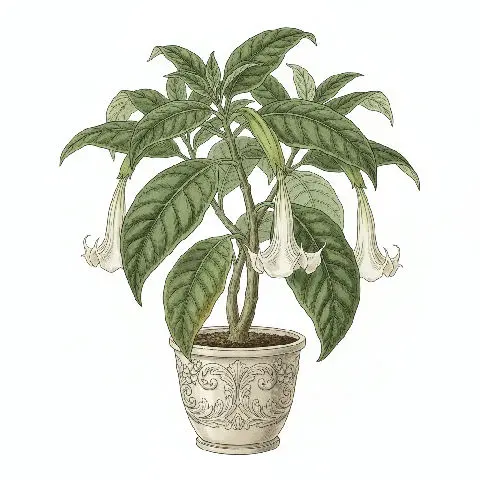
Brugmansia arborea, commonly known as Angel's Trumpet, is a striking flowering shrub or small tree native to the high-altitude regions of the Andes Mountains in South America, spanning countries like Peru, Ecuador, and Colombia. It is a member of the Solanaceae family, which also includes well-known plants such as Datura, tobacco, and tomatoes, all recognized for their diverse and often potent chemical profiles. This species is readily identified by its magnificent, pendulous, trumpet-shaped flowers, which typically display hues from creamy white to pale yellow. These blossoms emit a strong, sweet, and intoxicating fragrance, particularly pronounced during the evening hours, attracting nocturnal pollinators.
The plant exhibits a robust, shrub-like growth habit, often maturing into a small tree, reaching heights of 3 to 5 meters with a similar spread. Over time, it develops a woody trunk, contributing to its substantial presence. Its foliage consists of large, soft, velvety oval leaves, which are another distinguishing characteristic. Historically, Brugmansia arborea has held a dual reputation among indigenous communities, revered for its spiritual applications and simultaneously feared for its potent toxicity.
Its deep historical roots are intertwined with traditional spiritual and medicinal practices, where specific plant parts, primarily leaves and flowers, were meticulously utilized in controlled ceremonial contexts for their profound psychoactive properties. These applications, often guided by experienced shamans, aimed to induce visionary states, facilitate spiritual healing, and enable communication with ancestral spirits. The plant's potent effects are attributed to its rich content of tropane alkaloids, notably scopolamine and atropine, which exert powerful anticholinergic actions within the body.
Trusted Scientific References
1. Authoritative external sources for Brugmansia arborea
1.1 Wikipedia — Brugmansia arborea
1.2 Kew POWO (Plants of the World Online)
1.3 PubMed — peer-reviewed research
1.4 NCBI Taxonomy Browser
1.5 GBIF — Global Biodiversity
1.1.Brugmansia Arborea — Key Features
- ✓ <strong>Botanical Name</strong> — Brugmansia arborea.
- ✓ <strong>Common Name</strong> — Angel's Trumpet.
- ✓ <strong>Family</strong> — Solanaceae (Nightshade family).
- ✓ <strong>Native Range</strong> — Andes Mountains of South America (Peru, Ecuador, Colombia).
- ✓ <strong>Distinctive Flowers</strong> — Large, pendulous, trumpet-shaped, fragrant, creamy white to pale yellow.
- ✓ <strong>Primary Active Compounds</strong> — Tropane alkaloids (scopolamine, atropine, hyoscyamine).
- ✓ <strong>Pharmacological Action</strong> — Potent anticholinergic effects.
- ✓ <strong>Traditional Use</strong> — Indigenous ceremonial and spiritual practices, headache relief.
- ✓ <strong>Extreme Toxicity</strong> — All parts are poisonous, not for internal use.
- ✓ <strong>Ornamental Value</strong> — Popular as a garden ornamental in warm climates.
1.2.Brugmansia Arborea — Quick Summary
- ✓ Brugmansia arborea is a highly toxic plant native to the Andes, known for its beautiful trumpet-shaped flowers.
- ✓ Contains potent tropane alkaloids like scopolamine and atropine, which cause powerful anticholinergic effects.
- ✓ Traditionally used by indigenous shamans for ceremonial purposes, inducing visionary states and spiritual healing.
- ✓ NOT suitable for self-medication due to its extreme toxicity, which can be fatal even in small doses.
- ✓ Symptoms of poisoning include severe hallucinations, delirium, tachycardia, blurred vision, and respiratory failure.
- ✓ Primarily cultivated as an ornamental plant in tropical and subtropical gardens, requiring careful handling.
2.Brugmansia Arborea — Scientific Identity
3.Brugmansia Arborea — Quick Facts
4.Brugmansia Arborea — Appearance & Identification
5.Brugmansia Arborea — Native Habitat
6.Brugmansia Arborea — Water Requirements
- ✓ Climate Preference — Brugmansia arborea thrives in tropical and subtropical climates, preferring conditions that are free from heavy frosts.
- ✓ Light Requirements — This plant performs best in locations that receive full sun to partial shade, adapting well to various light exposures.
- ✓ Soil Composition — It favors a moist yet well-drained soil with a light texture, which supports healthy root development and prevents waterlogging.
- ✓ Flowering Season — Brugmansia arborea is known for its ability to produce abundant flowers throughout much of the year, especially in optimal growing conditions.
- ✓ Propagation by Seed — Seeds can be sown, with optimal germination occurring at temperatures around 20°C; however, many species in this genus produce limited fertile seeds.
- ✓ Propagation by Cuttings — Cuttings of semi-ripe wood taken with a 'heel' (a small piece of older stem) root effectively, particularly when provided with bottom heat at approximately 17°C.
- ✓ Frost Sensitivity — The plant is sensitive to cold and cannot tolerate more than occasional light frosts, necessitating protection or indoor cultivation in cooler regions.
- ✓ Watering Needs — Consistent moisture is important, but overwatering should be avoided to prevent root rot in its preferred well-drained soil.
Reviewed by the Flora Medical Global Botanical Review Panel
Multi-disciplinary editorial group · Botany · Ethnobotany · Herbal-medicine literature
Who reviewed this: This page was checked by the Flora Medical Global Botanical Review Panel — an in-house editorial group of botany graduates, ethnobotany researchers, and horticulture practitioners who collectively maintain our 7,000+ plant encyclopedia. Meet the team.
Our 4-step verification process
1. Taxonomic verification
Scientific names and synonyms cross-checked against Kew POWO, World Flora Online, and The Plant List.
2. Phytochemical & medicinal cross-reference
Active compounds, traditional uses, and reported activities are cross-referenced with PubMed, USDA Dr. Duke's database, and peer-reviewed ethnobotanical literature.
3. Conservation & distribution check
Distribution, ecology, and conservation status confirmed against GBIF occurrence records and the IUCN Red List.
4. Editorial & safety review
Every entry passes an editorial pass for clarity, originality, and safety notices (toxicity, contraindications, dosage caveats) before publication.
Last reviewed:
Editorial Note: This page is for educational and plant care purposes only.
Written by: Flora Medical Global Editorial Team
Reviewed by: Flora Medical Global Botanical Review Panel
Last Updated: June 16, 2026







Brugmansia Arborea — Comments & Community Reviews
Rate this plant