


Care Disclaimer: Plant care recommendations are general guidelines based on common growing conditions. Individual results may vary based on your local environment, climate, and care routine. If your plant is toxic, keep it away from children and pets, and consult a veterinarian if accidental ingestion occurs.
1.Campanula Medium — Overview
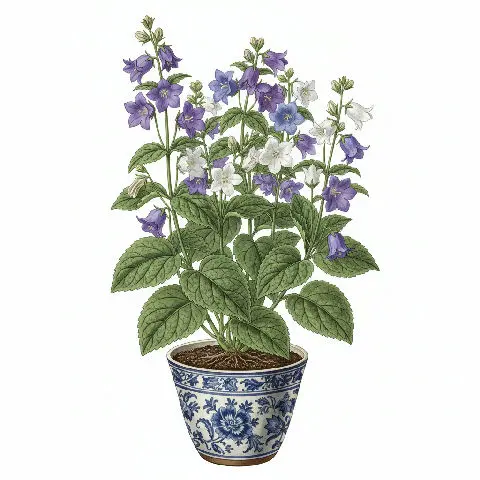
Campanula medium, widely recognized as Canterbury Bells, is a captivating biennial flowering plant belonging to the Campanulaceae family. Native to the rocky slopes and temperate regions of southern Europe, including France, Italy, and parts of North Africa, its name 'Campanula' is derived from the Latin word 'campana,' meaning 'little bell,' a perfect descriptor for its distinctive, pendulous blossoms. In its first year, the plant establishes a robust basal rosette of lanceolate, serrated leaves, typically growing 5 to 6 inches long.
The second year sees the emergence of tall, sturdy flower stalks, which can reach heights of 2 to 3 feet, adorned with numerous bell-shaped flowers in shades of blue, pink, purple, and white. These showy flowers, often single or double, bloom profusely in summer, sometimes emitting a sweet, subtle fragrance. While primarily celebrated for its ornamental appeal in cottage gardens, borders, and cut flower arrangements globally, its botanical classification places it within a diverse genus of over 400 species.
Its resilience and relatively straightforward cultivation in cooler climates contribute to its enduring popularity among gardeners. The plant's fruit is a capsule that, upon maturity, releases small seeds, enabling self-seeding and natural propagation. Despite limited historical records detailing extensive medicinal use, modern botanical inquiry into the broader Campanula genus has identified various phytochemicals, such as flavonoids and phenolic compounds, which are known for their antioxidant and anti-inflammatory properties, hinting at a potential, albeit underexplored, ethnobotanical past for Canterbury Bells.
Trusted Scientific References
1. Authoritative external sources for Campanula medium
1.1 Wikipedia — Campanula medium
1.2 Kew POWO (Plants of the World Online)
1.3 PubMed — peer-reviewed research
1.4 NCBI Taxonomy Browser
1.5 GBIF — Global Biodiversity
1.6Campanula Medium should be interpreted through verified botanical identity, practical care, and responsible safety language. This recovery note adds the missing context needed for a complete profile: match light to the plant's habit, use well-drained soil, water according to season, and avoid unsupported medicinal or edible claims. For publishing, the plant can be presented as a source-backed garden plant with clear care guidance, common problem diagnosis, and conservative safety wording.
1.1.Campanula Medium — Key Features
- ✓ <strong>Showy Bell</strong> — Shaped Flowers — Distinctive, large, pendulous blossoms that give the plant its common name.
- ✓ <strong>Biennial Growth Habit</strong> — Forms a basal rosette in its first year and flowers in its second year.
- ✓ <strong>Native to Southern Europe</strong> — Naturally found in France, Italy, and North African regions.
- ✓ <strong>Wide Array of Cultivars</strong> — Numerous selections available with diverse flower colors and forms.
- ✓ <strong>Ornamental Value</strong> — Highly prized for its aesthetic appeal in gardens and floral designs.
- ✓ <strong>Attracts Pollinators</strong> — Flowers are attractive to bees and hummingbirds.
- ✓ <strong>Self</strong> — Seeding — Can readily reseed, ensuring continuous blooms in successive years if allowed.
- ✓ <strong>Low Maintenance (in suitable climates)</strong> — Relatively easy to grow once established in cool, moist conditions.
- ✓ <strong>Symbolic Meaning</strong> — Represents gratitude and unwavering love in the Victorian language of flowers.
- ✓ <strong>Adaptable to Various Garden Styles</strong> — Fits well in cottage gardens, borders, and cutting gardens.
1.2.Campanula Medium — Quick Summary
- ✓ Canterbury Bells (Campanula medium) is a striking biennial ornamental plant native to southern Europe.
- ✓ Renowned for its bell-shaped flowers in various colors, it is a popular choice for gardens and cut arrangements.
- ✓ Traditional medicinal uses are very limited, anecdotally noted for minor inflammation and as a mild expectorant in folk medicine.
- ✓ Phytochemical analysis of the *Campanula* genus indicates the presence of flavonoids and phenolic acids, suggesting antioxidant and anti-inflammatory potential.
- ✓ Cultivation requires cool temperatures, moist, well-draining soil, and full sun to partial shade.
- ✓ Comprehensive safety data for internal consumption is lacking, thus caution is advised.
2.Campanula Medium — Scientific Identity
3.Campanula Medium — Quick Facts
4.Campanula Medium — Appearance & Identification
5.Campanula Medium — Native Habitat
6.Campanula Medium — Water Requirements
- ✓ Site Selection — Thrives in full sun to partial shade; afternoon shade is beneficial in warmer climates to protect from intense heat.
- ✓ Soil Requirements — Prefers moist, well-draining soil that is rich in organic matter; tolerates a range of soil types from sandy to loamy.
- ✓ Temperature Needs — Best suited for cooler climates as it is intolerant of temperatures consistently above 80 degrees Fahrenheit.
- ✓ Watering — Requires consistent moisture, especially during dry periods; avoid waterlogging to prevent root rot.
- ✓ Winter Protection — A layer of mulch in its first winter is recommended to protect the basal rosette from harsh cold.
- ✓ Propagation — Easily propagated by seeds sown in late spring or early summer; can also be divided in spring, though less common for biennials.
- ✓ Deadheading — Removing spent flowers (deadheading) encourages prolonged blooming and can promote new growth.
- ✓ Support — Planting in groups can provide mutual support, reducing the need for staking, especially in windy locations.
Reviewed by the Flora Medical Global Botanical Review Panel
Multi-disciplinary editorial group · Botany · Ethnobotany · Herbal-medicine literature
Who reviewed this: This page was checked by the Flora Medical Global Botanical Review Panel — an in-house editorial group of botany graduates, ethnobotany researchers, and horticulture practitioners who collectively maintain our 7,000+ plant encyclopedia. Meet the team.
Our 4-step verification process
1. Taxonomic verification
Scientific names and synonyms cross-checked against Kew POWO, World Flora Online, and The Plant List.
2. Phytochemical & medicinal cross-reference
Active compounds, traditional uses, and reported activities are cross-referenced with PubMed, USDA Dr. Duke's database, and peer-reviewed ethnobotanical literature.
3. Conservation & distribution check
Distribution, ecology, and conservation status confirmed against GBIF occurrence records and the IUCN Red List.
4. Editorial & safety review
Every entry passes an editorial pass for clarity, originality, and safety notices (toxicity, contraindications, dosage caveats) before publication.
Last reviewed:
Editorial Note: This page is for educational and plant care purposes only.
Written by: Flora Medical Global Editorial Team
Reviewed by: Flora Medical Global Botanical Review Panel
Last Updated: June 16, 2026







Campanula Medium — Comments & Community Reviews
Rate this plant