
Care Disclaimer: Plant care recommendations are general guidelines based on common growing conditions. Individual results may vary based on your local environment, climate, and care routine. If your plant is toxic, keep it away from children and pets, and consult a veterinarian if accidental ingestion occurs.
1.Digitalis Lutea — Overview
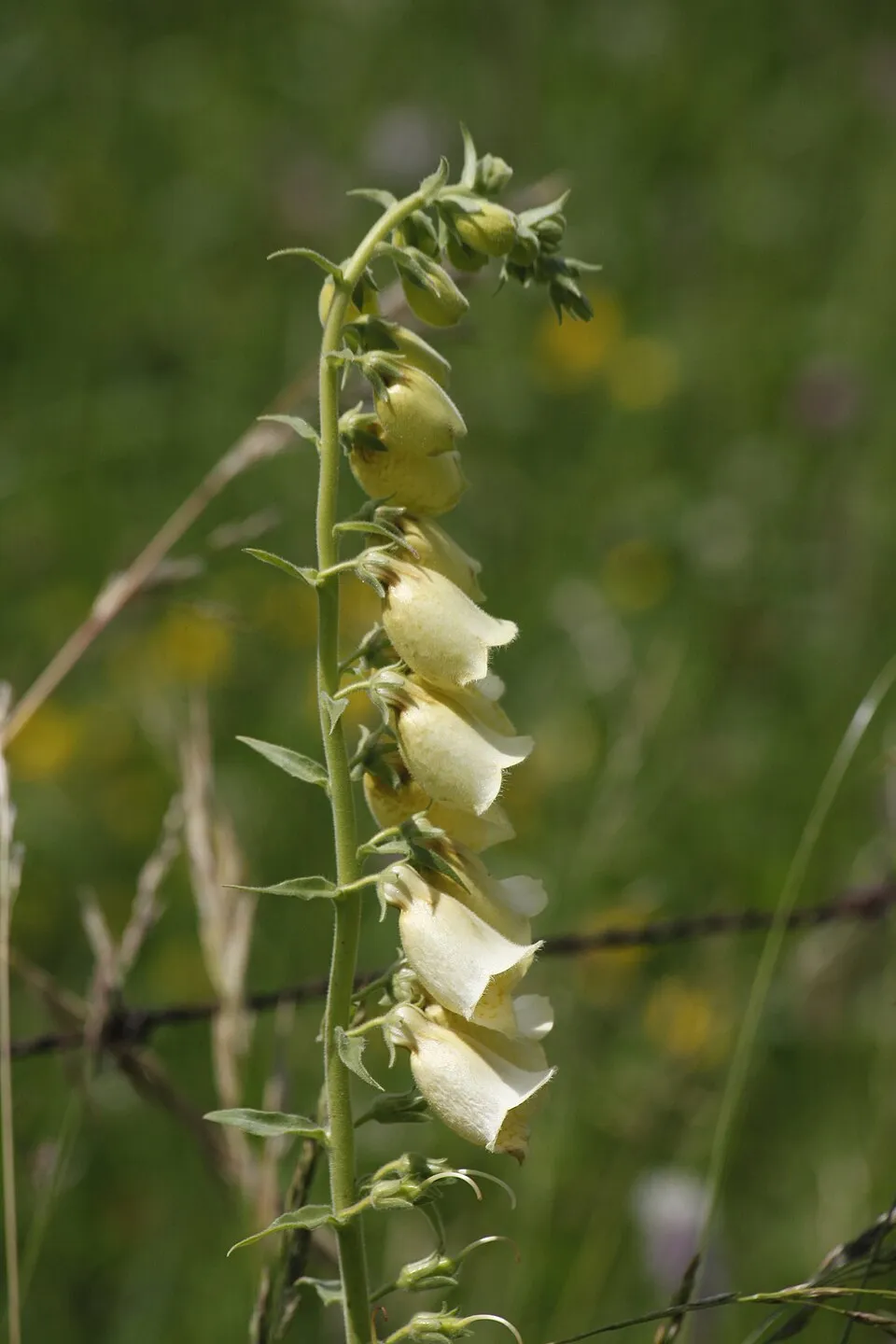
Digitalis lutea, commonly known as the straw foxglove or yellow foxglove, is an elegant herbaceous species typically functioning as a biennial or short-lived perennial within the Plantaginaceae family, a taxonomic reassignment from its former placement in the Scrophulariaceae. This resilient plant initiates its life cycle by forming a robust basal rosette of leaves in its inaugural year.
In its second year, it produces an impressive, unbranched flowering stalk that can ascend to heights of 90 to 120 centimeters, occasionally exceeding this under ideal growing conditions. Its root system is fibrous and moderately spreading, providing stable anchorage in various substrates.
The leaves are a distinctive feature: elongated and narrowly lanceolate, tapering gracefully to a pointed apex, and often reaching lengths of up to 30 centimeters. They possess a soft, subtly velvety texture attributed to a fine indumentum of hairs, and their margins are typically entire or delicately serrated. These vibrant green basal leaves establish an attractive mound before the emergence of the erect, robust, and smooth flowering stem.
This stem, often displaying strong green coloration with occasional purplish tinges, supports a striking raceme of pale yellow, bell-shaped flowers. These tubular blooms, measuring 2 to 3 centimeters, unfurl profusely from late spring through early summer (typically May to July), revealing delicate, often speckled markings of a deeper yellow or brownish hue within the corolla, which serve as crucial nectar guides for pollinators.
Native to Western and Central Europe, Digitalis lutea’s natural range spans from the Iberian Peninsula across France, Germany, and into parts of Eastern Europe. It demonstrates remarkable adaptability, thriving in a diverse array of habitats including sun-dappled woodland edges, open clearings, rocky slopes, meadows, and uncultivated fields, particularly favoring siliceous soils.
This adaptability allows it to flourish in conditions ranging from semi-shade to full sun, provided the soil retains adequate moisture.
Trusted Scientific References
1. Authoritative external sources for Digitalis lutea
1.1 Wikipedia — Digitalis lutea
1.2 Kew POWO (Plants of the World Online)
1.3 PubMed — peer-reviewed research
1.4 NCBI Taxonomy Browser
1.5 GBIF — Global Biodiversity
1.1.Digitalis Lutea — Key Features
- ✓ <strong>Species Name</strong> — Digitalis lutea (Straw Foxglove or Yellow Foxglove).
- ✓ <strong>Botanical Family</strong> — Plantaginaceae (formerly Scrophulariaceae).
- ✓ <strong>Life Cycle</strong> — Herbaceous biennial or short-lived perennial.
- ✓ <strong>Flower Color</strong> — Pale yellow, bell-shaped with inner speckles.
- ✓ <strong>Primary Active Compounds</strong> — Cardiac glycosides (cardenolides).
- ✓ <strong>Medicinal Action</strong> — Cardiotonic, diuretic, stimulant, tonic (with extreme caution).
- ✓ <strong>Toxicity Level</strong> — Highly poisonous; all plant parts are toxic.
- ✓ <strong>Native Range</strong> — Western and Central Europe.
- ✓ <strong>Habitat</strong> — Woodland edges, clearings, rocky slopes, meadows.
- ✓ <strong>Growth Habit</strong> — Erect flowering stalk up to 120 cm, basal rosette.
1.2.Digitalis Lutea — Quick Summary
- ✓ Potent Cardiotonic — Contains cardiac glycosides affecting heart function.
- ✓ Highly Toxic — All parts are poisonous; never self-administer.
- ✓ Natural Diuretic — Aids in reducing fluid retention and blood pressure.
- ✓ Less Cumulative Risk — Compared to other foxgloves, its effects are less cumulative.
- ✓ European Native — Found in woodlands and clearings across Western and Central Europe.
- ✓ Ornamental Appeal — Appreciated for its elegant yellow bell-shaped flowers.
2.Digitalis Lutea — Scientific Identity
3.Digitalis Lutea — Quick Facts
4.Digitalis Lutea — Appearance & Identification
5.Digitalis Lutea — Native Habitat
6.Digitalis Lutea — Water Requirements
- ✓ Soil Preference — Thrives in ordinary garden soil, particularly if it is rich in organic matter, but also tolerates dry soils once established.
- ✓ Light Requirements — Prefers semi-shade conditions, but can succeed in full sun if the soil is consistently kept moist.
- ✓ Drought Tolerance — Once established, Digitalis lutea exhibits good drought tolerance, making it suitable for dry garden environments.
- ✓ Pest Resistance — Members of the Digitalis genus, including the yellow foxglove, are generally not troubled by browsing deer or rabbits.
- ✓ Companion Planting — Considered a beneficial companion plant, known to stimulate the growth of nearby plants and improve the storage quality of root crops grown in proximity.
- ✓ Propagation from Seed — Seeds should be surface-sown in early spring within a cold frame; germination typically occurs in 2-4 weeks at around 20°C.
- ✓ Transplanting Seedlings — Once seedlings are large enough to handle, prick them out into individual pots before planting them out into their final positions in the summer.
Reviewed by the Flora Medical Global Botanical Review Panel
Multi-disciplinary editorial group · Botany · Ethnobotany · Herbal-medicine literature
Who reviewed this: This page was checked by the Flora Medical Global Botanical Review Panel — an in-house editorial group of botany graduates, ethnobotany researchers, and horticulture practitioners who collectively maintain our 7,000+ plant encyclopedia. Meet the team.
Our 4-step verification process
1. Taxonomic verification
Scientific names and synonyms cross-checked against Kew POWO, World Flora Online, and The Plant List.
2. Phytochemical & medicinal cross-reference
Active compounds, traditional uses, and reported activities are cross-referenced with PubMed, USDA Dr. Duke's database, and peer-reviewed ethnobotanical literature.
3. Conservation & distribution check
Distribution, ecology, and conservation status confirmed against GBIF occurrence records and the IUCN Red List.
4. Editorial & safety review
Every entry passes an editorial pass for clarity, originality, and safety notices (toxicity, contraindications, dosage caveats) before publication.
Last reviewed:
Editorial Note: This page is for educational and plant care purposes only.
Written by: Flora Medical Global Editorial Team
Reviewed by: Flora Medical Global Botanical Review Panel
Last Updated: June 16, 2026







Digitalis Lutea — Comments & Community Reviews
Rate this plant