
Care Disclaimer: Plant care recommendations are general guidelines based on common growing conditions. Individual results may vary based on your local environment, climate, and care routine. If your plant is toxic, keep it away from children and pets, and consult a veterinarian if accidental ingestion occurs.
1.Eichhornia Crassipes — Overview
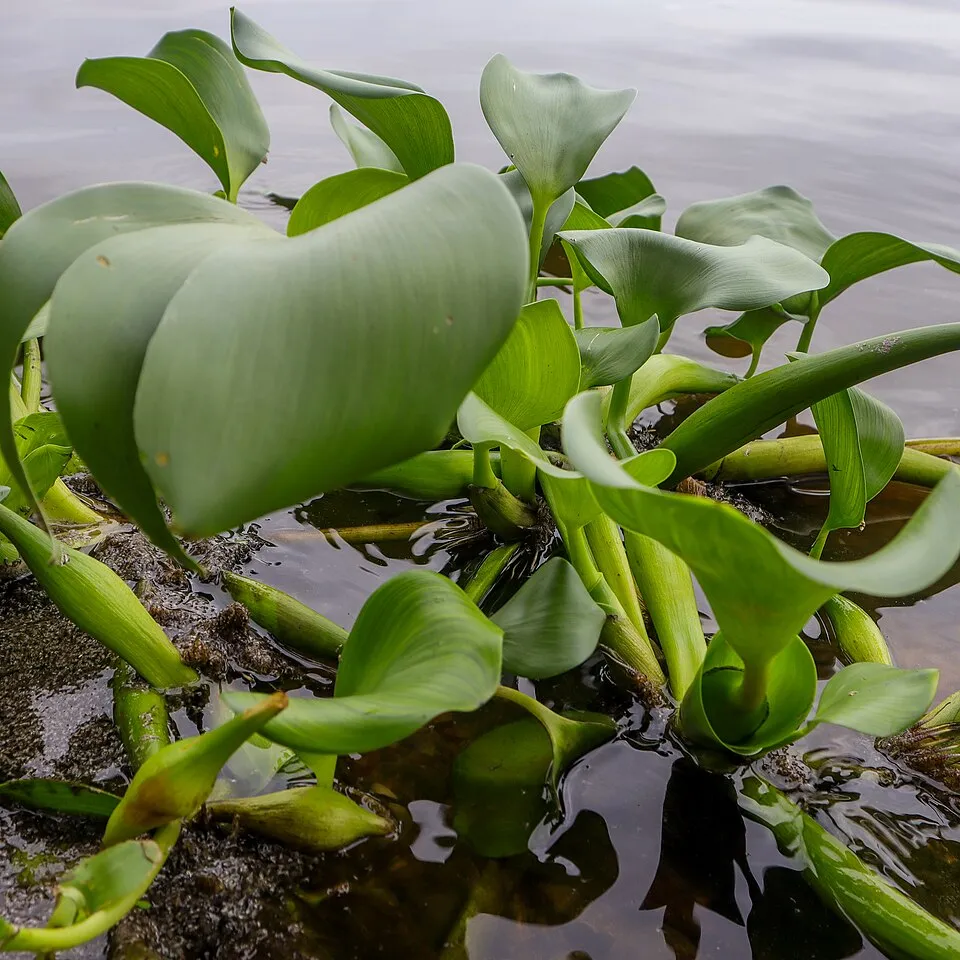
Eichhornia crassipes, commonly known as water hyacinth, is a free-floating perennial aquatic plant native to the Amazon Basin in South America, belonging to the Pontederiaceae family. This species is characterized by its remarkable rosettes of thick, glossy, dark green leaves, each supported by a bulbous, spongy petiole that aids in buoyancy. The plant produces striking inflorescences of lavender to blue flowers, often with a distinctive yellow blotch on the uppermost petal, arranged in a spike.
These showy flowers, reaching up to 30 cm in length, are highly attractive to various pollinators. Water hyacinth thrives in a wide range of aquatic environments, particularly slow-moving or stagnant freshwaters, demonstrating exceptional tolerance to varied nutrient levels, pH, and temperatures. Its rapid vegetative propagation and prolific seed production enable it to form dense, sprawling mats that can cover vast expanses of water bodies.
While visually appealing, this aggressive growth has led to its classification as one of the world's most invasive aquatic weeds by the International Union for Conservation of Nature (IUCN), causing significant ecological and socioeconomic issues such as reduced water flow, oxygen depletion, blockage of waterways, and adverse impacts on aquatic biodiversity. Despite its invasive nature, Eichhornia crassipes is also recognized for its impressive phytoremediation capabilities, absorbing excess nutrients and heavy metals from polluted waters, making it a subject of research for bioremediation and wastewater treatment applications.
Trusted Scientific References
1. Authoritative external sources for Eichhornia crassipes
1.1 Wikipedia — Eichhornia crassipes
1.2 Kew POWO (Plants of the World Online)
1.3 PubMed — peer-reviewed research
1.4 NCBI Taxonomy Browser
1.5 GBIF — Global Biodiversity
1.6Eichhornia Crassipes should be interpreted through verified botanical identity, practical care, and responsible safety language. This recovery note adds the missing context needed for a complete profile: match light to the plant's habit, use well-drained soil, water according to season, and avoid unsupported medicinal or edible claims. For publishing, the plant can be presented as a source-backed garden plant with clear care guidance, common problem diagnosis, and conservative safety wording.
1.1.Eichhornia Crassipes — Key Features
- ✓ <strong>Free</strong> — floating aquatic plant with buoyant, spongy petioles.
- ✓ <strong>Striking lavender to</strong> — Striking lavender to blue flowers with a yellow blotch.
- ✓ <strong>Native to the</strong> — Native to the Amazon Basin, now a global invasive species.
- ✓ <strong>Rapid vegetative propagation</strong> — Rapid vegetative propagation and high biomass production.
- ✓ <strong>Strong capacity for</strong> — Strong capacity for absorbing heavy metals and excess nutrients (phytoremediation).
- ✓ <strong>Rich in diverse</strong> — Rich in diverse secondary metabolites including flavonoids, phenolics, and saponins.
- ✓ <strong>Exhibited preclinical antioxidant, anti</strong> — inflammatory, and antimicrobial activities.
- ✓ <strong>Traditional uses for</strong> — Traditional uses for gastrointestinal issues in some cultures.
- ✓ <strong>Utilized in bioenergy,</strong> — Utilized in bioenergy, biofertilizer, and animal feed research.
- ✓ <strong>Requires careful management</strong> — Requires careful management to prevent ecological damage due to overgrowth.
1.2.Eichhornia Crassipes — Quick Summary
- ✓ Eichhornia crassipes is a highly invasive yet beautiful aquatic plant.
- ✓ Native to the Amazon, it's globally recognized as a problematic weed.
- ✓ Rich in bioactive compounds like flavonoids and phenolics with medicinal potential.
- ✓ Exhibits antioxidant, anti-inflammatory, and antimicrobial properties.
- ✓ Known for excellent phytoremediation capabilities, absorbing pollutants.
- ✓ Caution is paramount due to heavy metal accumulation and lack of human safety data.
2.Eichhornia Crassipes — Scientific Identity
3.Eichhornia Crassipes — Quick Facts
4.Eichhornia Crassipes — Appearance & Identification
5.Eichhornia Crassipes — Native Habitat
6.Eichhornia Crassipes — Water Requirements
- ✓ Habitat Preference — Thrives in shallow, slow-moving, or stagnant freshwaters, ideally with abundant organic nutrients.
- ✓ Light Requirements — Prefers full sunlight for optimal growth, but can tolerate partial shade, though growth may be reduced.
- ✓ Temperature Range — Best growth occurs in tropical and subtropical climates, typically between 20-35°C (68-95°F).
- ✓ Propagation — Primarily propagates vegetatively through stolons that produce new plantlets, and also by seeds.
- ✓ Nutrient Uptake — Highly efficient at absorbing nutrients, especially nitrogen and phosphorus, from the water column.
- ✓ Invasive Management — Due to its rapid growth, regular harvesting and removal of biomass are crucial to prevent overgrowth and ecological damage.
- ✓ Controlled Environments — For research or specific applications like phytoremediation, cultivation can be managed in controlled ponds or tanks to monitor growth and uptake efficiency.
- ✓ Soil/Substrate — As a free-floating plant, it does not require soil attachment, but nutrient-rich water is essential for vigorous growth.
Reviewed by the Flora Medical Global Botanical Review Panel
Multi-disciplinary editorial group · Botany · Ethnobotany · Herbal-medicine literature
Who reviewed this: This page was checked by the Flora Medical Global Botanical Review Panel — an in-house editorial group of botany graduates, ethnobotany researchers, and horticulture practitioners who collectively maintain our 7,000+ plant encyclopedia. Meet the team.
Our 4-step verification process
1. Taxonomic verification
Scientific names and synonyms cross-checked against Kew POWO, World Flora Online, and The Plant List.
2. Phytochemical & medicinal cross-reference
Active compounds, traditional uses, and reported activities are cross-referenced with PubMed, USDA Dr. Duke's database, and peer-reviewed ethnobotanical literature.
3. Conservation & distribution check
Distribution, ecology, and conservation status confirmed against GBIF occurrence records and the IUCN Red List.
4. Editorial & safety review
Every entry passes an editorial pass for clarity, originality, and safety notices (toxicity, contraindications, dosage caveats) before publication.
Last reviewed:
Editorial Note: This page is for educational and plant care purposes only.
Written by: Flora Medical Global Editorial Team
Reviewed by: Flora Medical Global Botanical Review Panel
Last Updated: June 16, 2026







Eichhornia Crassipes — Comments & Community Reviews
Rate this plant