
Care Disclaimer: Plant care recommendations are general guidelines based on common growing conditions. Individual results may vary based on your local environment, climate, and care routine. If your plant is toxic, keep it away from children and pets, and consult a veterinarian if accidental ingestion occurs.
1.Gaura Lindheimeri — Overview
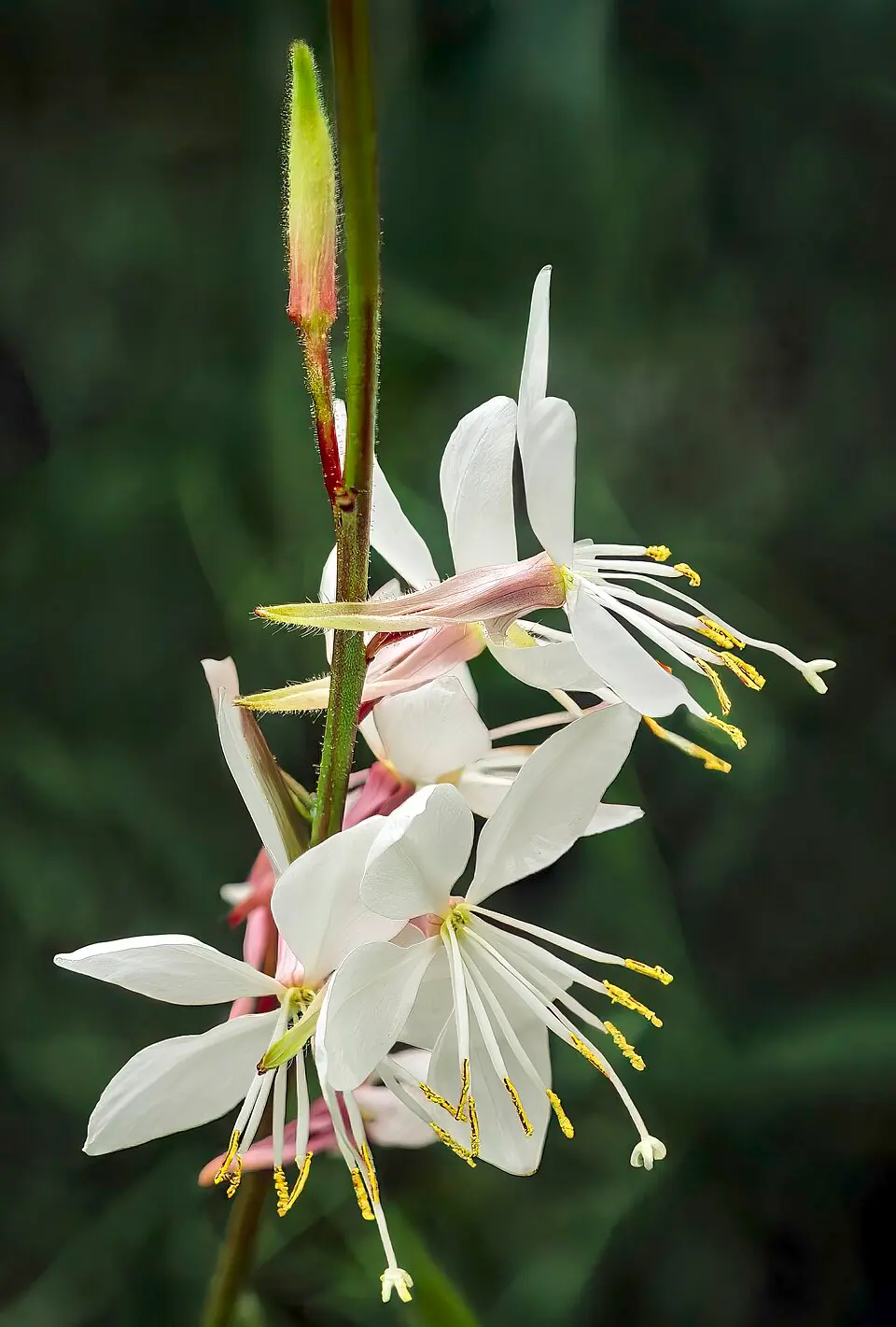
Gaura lindheimeri, commonly known as White Gaura, Beeblossom, or Whirling Butterflies, is a captivating herbaceous perennial belonging to the Onagraceae family. This graceful plant is characterized by its delicate, four-petaled flowers, which are typically white or pink and borne on long, slender, wiry stems, giving the appearance of butterflies fluttering in the breeze. The foliage consists of narrow, lance-shaped leaves, often green but sometimes mottled with burgundy.
Native to the grasslands and prairies of Texas, Louisiana, and northern Mexico, Gaura lindheimeri thrives in open, sunny environments. It exhibits an open, airy growth habit, reaching heights of 1 to 4 feet and spreading equally wide, blooming profusely from late spring until the first hard frost. A key characteristic for its survival in arid conditions is its deep, carrot-like taproot, which enables it to establish remarkable drought tolerance once mature.
Beyond its ornamental appeal, attracting a host of pollinators like bees, butterflies, and hummingbirds, the plant is gaining recognition for its potential botanical properties rooted in its rich phytochemical profile. Its classification has seen it sometimes referred to as Oenothera lindheimeri, reflecting its close phylogenetic relationship within the evening primrose family.
Trusted Scientific References
1. Authoritative external sources for Gaura lindheimeri
1.1 Wikipedia — Gaura lindheimeri
1.2 Kew POWO (Plants of the World Online)
1.3 PubMed — peer-reviewed research
1.4 NCBI Taxonomy Browser
1.5 GBIF — Global Biodiversity
1.6Gaura Lindheimeri should be interpreted through verified botanical identity, practical care, and responsible safety language. This recovery note adds the missing context needed for a complete profile: match light to the plant's habit, use well-drained soil, water according to season, and avoid unsupported medicinal or edible claims. For publishing, the plant can be presented as a source-backed garden plant with clear care guidance, common problem diagnosis, and conservative safety wording.
1.1.Gaura Lindheimeri — Key Features
- ✓ <strong>Botanical Name</strong> — Gaura lindheimeri (syn. Oenothera lindheimeri).
- ✓ <strong>Common Names</strong> — White Gaura, Beeblossom, Whirling Butterflies, Lindheimer's Gaura.
- ✓ <strong>Family</strong> — Onagraceae (Evening Primrose family).
- ✓ <strong>Native Region</strong> — Grasslands of Texas, Louisiana, and northern Mexico.
- ✓ <strong>Bloom Time</strong> — Extended period from late spring through fall until frost.
- ✓ <strong>Flower Color</strong> — Typically white or pink, appearing on slender, airy stems.
- ✓ <strong>Key Constituents</strong> — Flavonoids (quercetin, kaempferol), phenolic acids, and tannins.
- ✓ <strong>Primary Actions</strong> — Antioxidant, anti-inflammatory, astringent, and potentially wound healing.
- ✓ <strong>Habitat Preference</strong> — Requires full sun and well-draining, lean soil; highly drought-tolerant.
- ✓ <strong>Pollinator Attractor</strong> — Attracts bees, butterflies, and hummingbirds, enhancing garden biodiversity.
1.2.Gaura Lindheimeri — Quick Summary
- ✓ Gaura lindheimeri is a graceful perennial known for its butterfly-like flowers and airy habit.
- ✓ Rich in antioxidants, anti-inflammatory flavonoids, and astringent tannins.
- ✓ Traditionally recognized for supporting skin health, wound healing, and digestive comfort.
- ✓ Thrives in full sun, well-draining soil, and is highly drought-tolerant once established.
- ✓ Generally safe for ornamental use; medicinal application requires caution and professional guidance.
2.Gaura Lindheimeri — Scientific Identity
3.Gaura Lindheimeri — Quick Facts
4.Gaura Lindheimeri — Appearance & Identification
5.Gaura Lindheimeri — Native Habitat
6.Gaura Lindheimeri — Water Requirements
- ✓ Site Selection — Requires full sun exposure for at least 6 hours daily, though some afternoon shade is beneficial in hotter climates to prevent scorching.
- ✓ Soil Requirements — Prefers lean, well-draining soil, ideally sandy or loamy, with a slightly acidic to slightly alkaline pH range of 6.1-7.8; poor drainage can lead to root rot.
- ✓ Planting Time — Best planted in spring after the last frost; in warmer zones, perennial varieties can also be planted in fall.
- ✓ Watering — Water regularly until established, then deeply but infrequently to encourage the development of its drought-tolerant taproot system.
- ✓ Fertilization — Minimal to no supplemental fertilizer is needed; over-fertilizing can lead to leggy growth and reduced flowering.
- ✓ Spacing — Space plants 2 to 3 feet apart to allow for their mature spread and airy growth habit.
- ✓ Pests and Diseases — Generally resistant when grown in optimal conditions, but watch for aphids, flea beetles, and powdery mildew in overly humid or shaded environments.
- ✓ Transplanting — Difficult to transplant once established due to its deep taproot, so choose a permanent location carefully.
Reviewed by the Flora Medical Global Botanical Review Panel
Multi-disciplinary editorial group · Botany · Ethnobotany · Herbal-medicine literature
Who reviewed this: This page was checked by the Flora Medical Global Botanical Review Panel — an in-house editorial group of botany graduates, ethnobotany researchers, and horticulture practitioners who collectively maintain our 7,000+ plant encyclopedia. Meet the team.
Our 4-step verification process
1. Taxonomic verification
Scientific names and synonyms cross-checked against Kew POWO, World Flora Online, and The Plant List.
2. Phytochemical & medicinal cross-reference
Active compounds, traditional uses, and reported activities are cross-referenced with PubMed, USDA Dr. Duke's database, and peer-reviewed ethnobotanical literature.
3. Conservation & distribution check
Distribution, ecology, and conservation status confirmed against GBIF occurrence records and the IUCN Red List.
4. Editorial & safety review
Every entry passes an editorial pass for clarity, originality, and safety notices (toxicity, contraindications, dosage caveats) before publication.
Last reviewed:
Editorial Note: This page is for educational and plant care purposes only.
Written by: Flora Medical Global Editorial Team
Reviewed by: Flora Medical Global Botanical Review Panel
Last Updated: June 16, 2026







Gaura Lindheimeri — Comments & Community Reviews
Rate this plant