


Care Disclaimer: Plant care recommendations are general guidelines based on common growing conditions. Individual results may vary based on your local environment, climate, and care routine. If your plant is toxic, keep it away from children and pets, and consult a veterinarian if accidental ingestion occurs.
1.Heliotrope — Overview
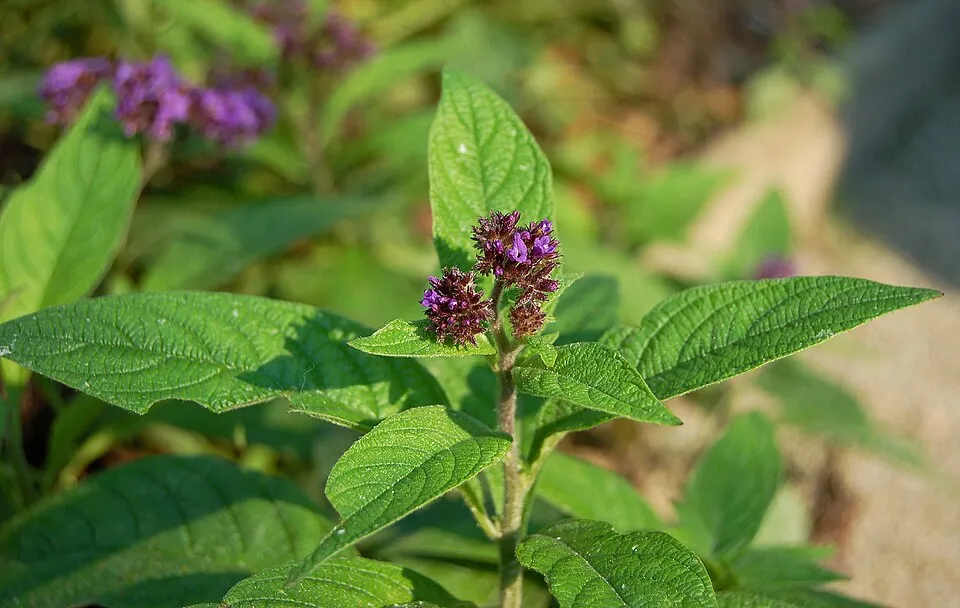
Heliotropium arborescens, commonly known as Heliotrope or Garden Heliotrope, is a charming tender perennial often cultivated as an annual in temperate regions, belonging to the Boraginaceae family. Native to the warm climates of Peru, this bushy sub-shrub typically grows to a height of 1 to 3 feet (30-90 cm) with a spread of 1 to 1.5 feet. Its distinctive foliage consists of dark green, deeply wrinkled, oval-shaped leaves that can sometimes exhibit a purplish cast.
The plant is most renowned for its dense clusters of small, exquisitely fragrant flowers, which range in color from deep purple to violet-blue, and occasionally white, blooming from mid-summer through early fall. These blossoms emit a captivating vanilla-like or cherry pie scent, particularly noticeable and intensifying on warm evenings, making Heliotrope a highly sought-after plant for scented gardens, borders, and containers. Beyond its aromatic appeal, the striking flowers also serve as an excellent attractant for butterflies and other beneficial pollinators, adding vibrant life and ecological value to garden spaces.
Despite its ornamental beauty, it is critical to note its inherent toxicity due to the presence of pyrrolizidine alkaloids.
Trusted Scientific References
1. Authoritative external sources for Heliotropium arborescens
1.1 Wikipedia — Heliotropium arborescens
1.2 Kew POWO (Plants of the World Online)
1.3 PubMed — peer-reviewed research
1.4 NCBI Taxonomy Browser
1.5 GBIF — Global Biodiversity
1.6Heliotrope should be interpreted through verified botanical identity, practical care, and responsible safety language. This recovery note adds the missing context needed for a complete profile: match light to the plant's habit, use well-drained soil, water according to season, and avoid unsupported medicinal or edible claims. For publishing, the plant can be presented as a source-backed garden plant with clear care guidance, common problem diagnosis, and conservative safety wording.
1.1.Heliotrope — Key Features
- ✓ <strong>Exquisite vanilla</strong> — like or cherry pie fragrance, intensifying in the evening.
- ✓ <strong>Clusters of small, vibrant deep purple to violet</strong> — blue flowers.
- ✓ <strong>Tender perennial, widely</strong> — Tender perennial, widely cultivated as an annual in cooler climates.
- ✓ <strong>Contains potent pyrrolizidine</strong> — Contains potent pyrrolizidine alkaloids (PAs), rendering it highly toxic.
- ✓ <strong>Strictly ornamental plant,</strong> — Strictly ornamental plant, unsuitable for any medicinal or culinary application.
- ✓ <strong>Attractive to butterflies</strong> — Attractive to butterflies and other pollinators, enhancing garden biodiversity.
- ✓ <strong>Bushy sub</strong> — shrub growth habit, typically reaching 1 to 3 feet in height.
- ✓ <strong>Features dark green, distinctly wrinkled, oval</strong> — shaped leaves.
- ✓ <strong>Excellent choice for</strong> — Excellent choice for container gardening, borders, and scented gardens.
- ✓ <strong>Native to the</strong> — Native to the warm climates of Peru, thriving in full sun to partial shade.
1.2.Heliotrope — Quick Summary
- ✓ Heliotropium arborescens is a popular ornamental plant known for its fragrant, purple-blue flowers and vanilla-like scent.
- ✓ The plant contains highly toxic pyrrolizidine alkaloids (PAs), including heliotrine and lasiocarpine, in all its parts.
- ✓ Ingestion of any part of Heliotrope can cause severe and irreversible liver damage, liver failure, and can be fatal to humans and animals.
- ✓ It is strictly NOT recommended for any internal or external medicinal use due to the significant risk of systemic toxicity and skin absorption.
- ✓ Cultivate solely for its aesthetic and aromatic qualities, ensuring it is kept out of reach of children and pets.
- ✓ Modern herbalism strongly advises against its use for any therapeutic purpose due to its extreme hepatotoxicity.
2.Heliotrope — Scientific Identity
3.Heliotrope — Quick Facts
4.Heliotrope — Appearance & Identification
5.Heliotrope — Native Habitat
6.Heliotrope — Water Requirements
- ✓ Sunlight — Plant Heliotrope in a location that receives full sun (at least 6 hours of direct sunlight daily); in hotter climates, provide some afternoon shade to prevent wilting.
- ✓ Soil Requirements — Ensure well-draining, fertile soil, ideally amended with compost or other organic matter to enhance nutrient content and drainage.
- ✓ Planting Timing — If cultivating as an annual, plant outdoors after the last spring frost when soil temperatures consistently reach at least 60°F (15°C); for perennials, early spring is optimal.
- ✓ Spacing — Space individual plants approximately 12 to 18 inches (30-45 cm) apart to allow for proper air circulation and adequate growth.
- ✓ Watering — Maintain consistently moist soil, but avoid waterlogging; deep watering is recommended to encourage robust root development, as Heliotrope does not tolerate drought well.
- ✓ Fertilizing — Feed your Heliotrope every 4-6 weeks with a balanced, water-soluble fertilizer (e.g., 10-10-10 formula) or a slow-release organic option to support vigorous growth and abundant flowering.
- ✓ Pruning and Deadheading — Regularly deadhead spent flowers to promote continuous blooming and maintain a tidy appearance; lightly prune the plant to shape it and remove any leggy or damaged growth, improving air circulation.
- ✓ Overwintering — In colder climates, bring potted plants indoors before the first frost, placing them in a sunny window and reducing watering; alternatively, take cuttings in late summer for overwintering indoors, as cuttings often produce stronger plants.
Reviewed by the Flora Medical Global Botanical Review Panel
Multi-disciplinary editorial group · Botany · Ethnobotany · Herbal-medicine literature
Who reviewed this: This page was checked by the Flora Medical Global Botanical Review Panel — an in-house editorial group of botany graduates, ethnobotany researchers, and horticulture practitioners who collectively maintain our 7,000+ plant encyclopedia. Meet the team.
Our 4-step verification process
1. Taxonomic verification
Scientific names and synonyms cross-checked against Kew POWO, World Flora Online, and The Plant List.
2. Phytochemical & medicinal cross-reference
Active compounds, traditional uses, and reported activities are cross-referenced with PubMed, USDA Dr. Duke's database, and peer-reviewed ethnobotanical literature.
3. Conservation & distribution check
Distribution, ecology, and conservation status confirmed against GBIF occurrence records and the IUCN Red List.
4. Editorial & safety review
Every entry passes an editorial pass for clarity, originality, and safety notices (toxicity, contraindications, dosage caveats) before publication.
Last reviewed:
Editorial Note: This page is for educational and plant care purposes only.
Written by: Flora Medical Global Editorial Team
Reviewed by: Flora Medical Global Botanical Review Panel
Last Updated: June 16, 2026







Heliotrope — Comments & Community Reviews
Rate this plant