

Care Disclaimer: Plant care recommendations are general guidelines based on common growing conditions. Individual results may vary based on your local environment, climate, and care routine. If your plant is toxic, keep it away from children and pets, and consult a veterinarian if accidental ingestion occurs.
1.Hypericum — Overview
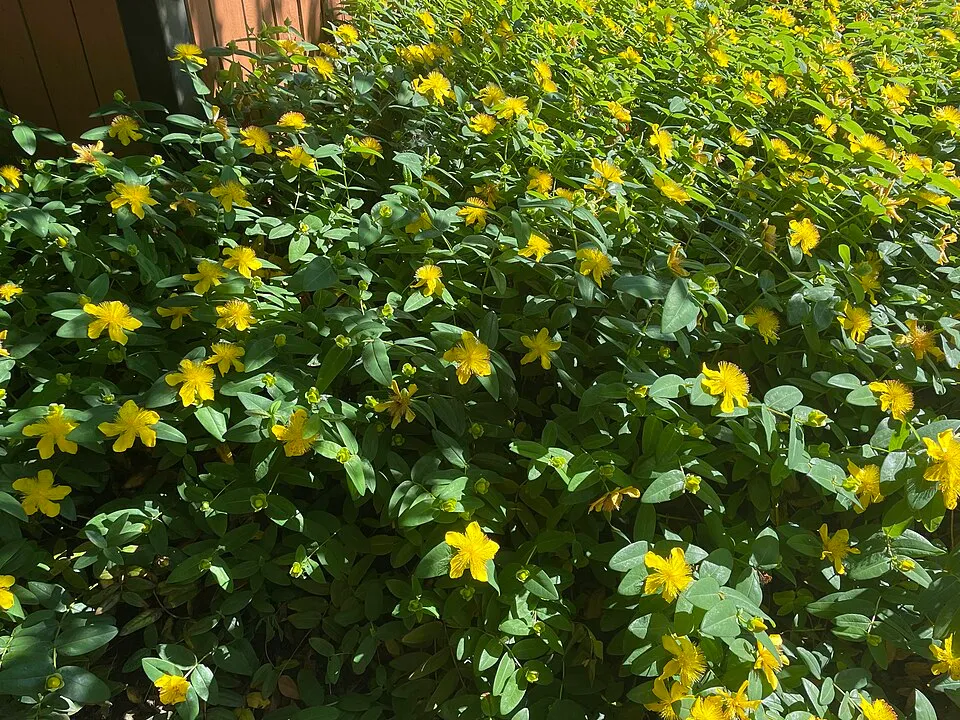
Hypericum calycinum, commonly known as Rose of Sharon, Aaron's Beard, or Creeping St. John's Wort, is a resilient, low-growing, and spreading evergreen shrub belonging to the Hypericaceae family. Native to southeastern Europe and southwestern Asia, it is highly valued for its ornamental appeal, particularly its striking, large, golden-yellow flowers that bloom profusely from mid-summer into autumn. Each flower measures approximately 5-8 cm in diameter, featuring five distinct, often crinkled petals surrounding a prominent, bushy tuft of golden stamens, giving it a characteristic 'shaggy' or 'rose-like' appearance.
The foliage consists of ovate to oblong, leathery leaves that transition from chartreuse-bronze to a rich dark green or bluish-green. When held against light, these leaves reveal numerous small, translucent dots, which are oil glands contributing to the plant's subtle aromatic quality. This species forms a dense mat of foliage, making it an excellent groundcover, especially effective for erosion control on banks and slopes due to its robust, spreading root system. Its woody, reddish-brown stems readily root where they contact the soil, facilitating its rapid spread.
While primarily cultivated for its aesthetic beauty and ecological benefits, H. calycinum shares its genus with Hypericum perforatum, the well-known medicinal St. John's Wort, hinting at a potential, albeit less studied, phytochemistry that warrants further research.
Trusted Scientific References
1. Authoritative external sources for Hypericum calycinum
1.1 Wikipedia — Hypericum calycinum
1.2 Kew POWO (Plants of the World Online)
1.3 PubMed — peer-reviewed research
1.4 NCBI Taxonomy Browser
1.5 GBIF — Global Biodiversity
1.6Hypericum should be interpreted through verified botanical identity, practical care, and responsible safety language. This recovery note adds the missing context needed for a complete profile: match light to the plant's habit, use well-drained soil, water according to season, and avoid unsupported medicinal or edible claims. For publishing, the plant can be presented as a source-backed garden plant with clear care guidance, common problem diagnosis, and conservative safety wording.
1.1.Hypericum — Key Features
- ✓ <strong>Botanical Name</strong> — Hypericum calycinum.
- ✓ <strong>Common Names</strong> — Rose of Sharon, Aaron's Beard, Creeping St. John's Wort.
- ✓ <strong>Family</strong> — Hypericaceae.
- ✓ <strong>Native Region</strong> — Southeastern Europe, Southwestern Asia.
- ✓ <strong>Flower Characteristics</strong> — Large, golden-yellow, 5-8 cm diameter, with bushy stamens.
- ✓ <strong>Growth Habit</strong> — Low-growing, spreading evergreen shrub, excellent groundcover.
- ✓ <strong>Leaf Characteristics</strong> — Ovate to oblong, leathery, dark green, with translucent oil glands.
- ✓ <strong>Medicinal Potential</strong> — Traditional uses for mood, anxiety, and nerve pain, similar to other Hypericum species.
- ✓ <strong>Cultivation</strong> — Low maintenance, deer resistant, drought-tolerant once established.
- ✓ <strong>Ecological Role</strong> — Effective for erosion control on banks and slopes.
1.2.Hypericum — Quick Summary
- ✓ Ornamental groundcover with potential medicinal properties.
- ✓ Known for mood support, anxiolytic, and nerve pain relief (similar to H. perforatum).
- ✓ Rich in hypericin, hyperforin, flavonoids, and tannins.
- ✓ Thrives in full sun to partial shade, well-drained soil, and is drought-tolerant.
- ✓ Significant drug interaction potential and risk of photosensitivity.
- ✓ Primarily cultivated for aesthetic appeal and effective erosion control.
2.Hypericum — Scientific Identity
3.Hypericum — Quick Facts
4.Hypericum — Appearance & Identification
5.Hypericum — Native Habitat
6.Hypericum — Water Requirements
- ✓ Site Selection — Thrives in full sun to partial shade; full sun promotes the most abundant flowering.
- ✓ Soil Requirements — Adaptable to a wide range of well-drained soils, including chalk, clay, loam, and sand, with a preference for sandy soils.
- ✓ Watering — Requires medium moisture initially but becomes highly drought-tolerant once established.
- ✓ Propagation — Spreads vigorously by underground stems and can also be propagated by division or semi-hardwood cuttings.
- ✓ Pruning — To rejuvenate growth and maintain vigor, plants should be clipped or mowed in late winter or early spring every 2-3 years.
- ✓ Pest and Disease — Generally low maintenance and exhibits strong resistance to most common pests and diseases, as well as being deer resistant.
- ✓ Landscape Use — Ideal for use as a groundcover, on banks and slopes for erosion control, in rock gardens, or along borders.
Reviewed by the Flora Medical Global Botanical Review Panel
Multi-disciplinary editorial group · Botany · Ethnobotany · Herbal-medicine literature
Who reviewed this: This page was checked by the Flora Medical Global Botanical Review Panel — an in-house editorial group of botany graduates, ethnobotany researchers, and horticulture practitioners who collectively maintain our 7,000+ plant encyclopedia. Meet the team.
Our 4-step verification process
1. Taxonomic verification
Scientific names and synonyms cross-checked against Kew POWO, World Flora Online, and The Plant List.
2. Phytochemical & medicinal cross-reference
Active compounds, traditional uses, and reported activities are cross-referenced with PubMed, USDA Dr. Duke's database, and peer-reviewed ethnobotanical literature.
3. Conservation & distribution check
Distribution, ecology, and conservation status confirmed against GBIF occurrence records and the IUCN Red List.
4. Editorial & safety review
Every entry passes an editorial pass for clarity, originality, and safety notices (toxicity, contraindications, dosage caveats) before publication.
Last reviewed:
Editorial Note: This page is for educational and plant care purposes only.
Written by: Flora Medical Global Editorial Team
Reviewed by: Flora Medical Global Botanical Review Panel
Last Updated: June 16, 2026







Hypericum — Comments & Community Reviews
Rate this plant