
Care Disclaimer: Plant care recommendations are general guidelines based on common growing conditions. Individual results may vary based on your local environment, climate, and care routine. If your plant is toxic, keep it away from children and pets, and consult a veterinarian if accidental ingestion occurs.
1.Jack in the Pulpit — Overview
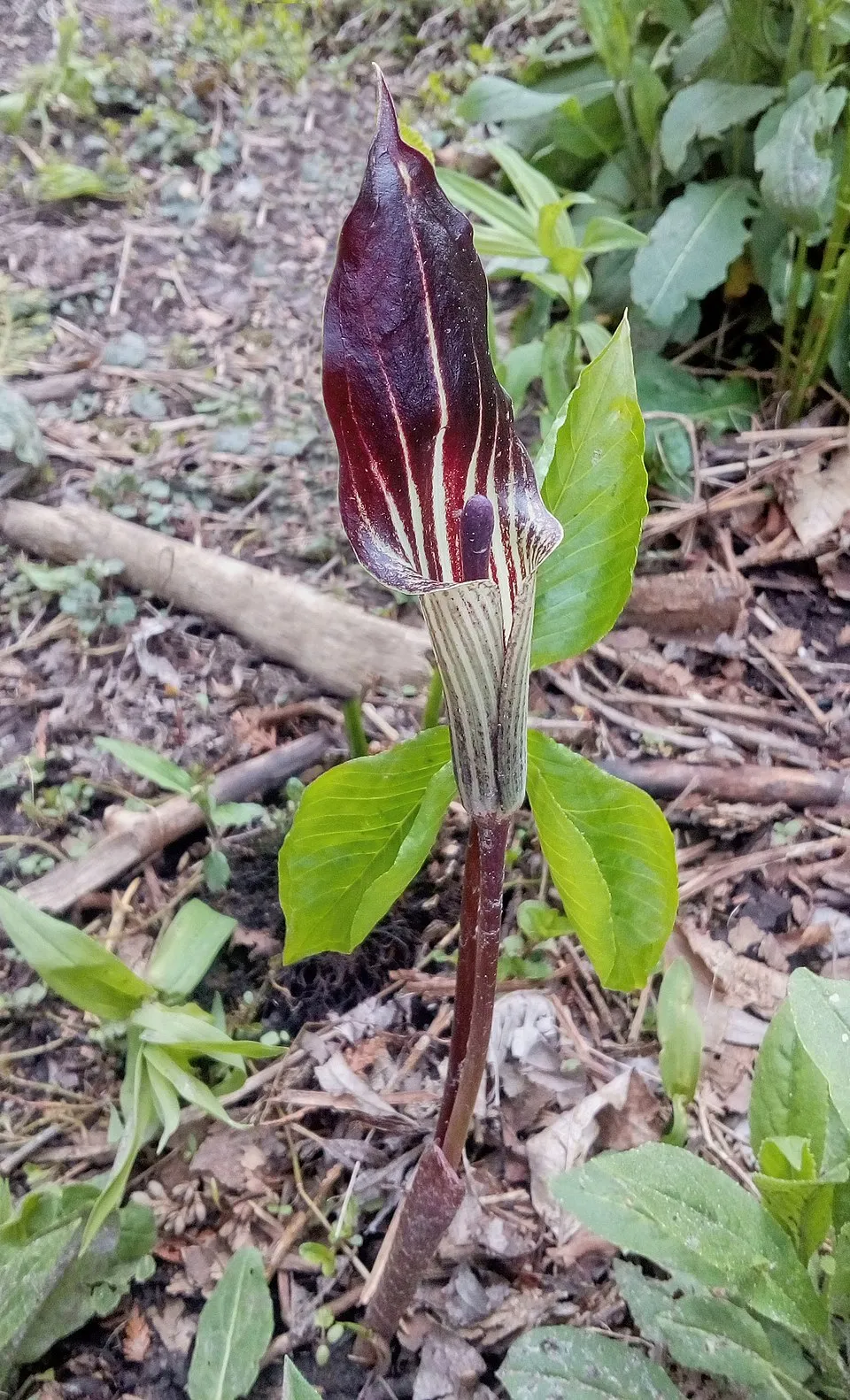
Arisaema triphyllum, commonly known as Jack-in-the-Pulpit, is a distinctive perennial herbaceous plant belonging to the Araceae family, native to the eastern regions of North America. It thrives predominantly in moist, shaded woodland environments, swamps, and along stream banks, often forming localized colonies. This fascinating plant is botanically characterized by its unique inflorescence, which comprises a spathe and a spadix.
The spathe is a modified leaf, hood-like in appearance, typically green with intricate purple or brownish venation, curving over the central spadix to form the 'pulpit'. The spadix, or 'Jack', is a club-shaped structure enclosed within the spathe, bearing the plant's true, inconspicuous flowers. These flowers are monoecious, meaning both male and female reproductive organs are present on the same plant, usually segregated along the spadix.
Emerging from an underground corm, the plant typically produces one or two trifoliate leaves, each composed of three ovate to elliptical leaflets that can be glossy or dull green. The petioles are long and slender, allowing the plant to reach heights of 30 to 90 cm (1 to 3 feet). Flowering occurs from late spring to early summer, after which the spadix develops into a striking cluster of bright red to scarlet berries in late summer and fall.
These berries, while visually appealing and attractive to wildlife, are highly toxic to humans if ingested raw due to the presence of calcium oxalate crystals. The corm also contains these irritant crystals, making all raw parts of the plant poisonous. The plant's lifecycle sees its aerial parts die back in autumn, with the corm overwintering to sprout anew the following spring.
Trusted Scientific References
1. Authoritative external sources for Arisaema triphyllum
1.1 Wikipedia — Arisaema triphyllum
1.2 Kew POWO (Plants of the World Online)
1.3 PubMed — peer-reviewed research
1.4 NCBI Taxonomy Browser
1.5 GBIF — Global Biodiversity
1.6Jack in the Pulpit should be interpreted through verified botanical identity, practical care, and responsible safety language. This recovery note adds the missing context needed for a complete profile: match light to the plant's habit, use well-drained soil, water according to season, and avoid unsupported medicinal or edible claims. For publishing, the plant can be presented as a source-backed garden plant with clear care guidance, common problem diagnosis, and conservative safety wording.
1.1.Jack in the Pulpit — Key Features
- ✓ <strong>Unique 'Jack and</strong> — Unique 'Jack and Pulpit' inflorescence structure.
- ✓ <strong>Native to eastern</strong> — Native to eastern North American woodlands.
- ✓ <strong>Perennial herbaceous plant</strong> — Perennial herbaceous plant growing from a corm.
- ✓ <strong>Produces bright red,</strong> — Produces bright red, toxic berries in late summer.
- ✓ <strong>All parts contain</strong> — All parts contain toxic calcium oxalate crystals.
- ✓ <strong>Prefers moist, shady, humus</strong> — rich, acidic soil.
- ✓ <strong>Historically used medicinally</strong> — Historically used medicinally after rigorous detoxification.
- ✓ <strong>Grows 1 to</strong> — Grows 1 to 3 feet tall with trifoliate leaves.
- ✓ <strong>Aesthetically valued for</strong> — Aesthetically valued for its striking, unusual form.
- ✓ <strong>Attracts certain pollinators</strong> — Attracts certain pollinators and wildlife (birds eat berries, dispersing seeds).
1.2.Jack in the Pulpit — Quick Summary
- ✓ Jack-in-the-Pulpit (Arisaema triphyllum) is a toxic North American woodland perennial.
- ✓ Contains needle-like calcium oxalate crystals causing severe irritation if ingested.
- ✓ Historically used by Native Americans after extensive detoxification processes for various ailments.
- ✓ Modern use is primarily ornamental due to its unique appearance and high toxicity.
- ✓ Thrives in moist, shaded environments with rich, acidic soil.
- ✓ Produces distinctive spathe-and-spadix inflorescence and toxic red berries.
2.Jack in the Pulpit — Scientific Identity
3.Jack in the Pulpit — Quick Facts
4.Jack in the Pulpit — Appearance & Identification
5.Jack in the Pulpit — Native Habitat
6.Jack in the Pulpit — Water Requirements
- ✓ Plant corms in fall, 6 inches deep, in well-drained, humus-rich soil.
- ✓ Ensure a location with partial to full shade; direct sunlight is detrimental.
- ✓ Maintain consistently moist soil conditions, mimicking its native boggy habitat.
- ✓ Mulch around plants with 2-3 inches of organic matter to retain moisture and provide nutrients.
- ✓ Amend soil with compost annually to ensure rich, acidic conditions.
- ✓ Propagate by splitting cormlets from parent plants in fall or by seed.
- ✓ Growing from seed requires cold stratification and takes 2-5 years to reach maturity and bloom.
- ✓ Protect from slugs, which are one of the few pests attracted to Jack-in-the-Pulpit.
Reviewed by the Flora Medical Global Botanical Review Panel
Multi-disciplinary editorial group · Botany · Ethnobotany · Herbal-medicine literature
Who reviewed this: This page was checked by the Flora Medical Global Botanical Review Panel — an in-house editorial group of botany graduates, ethnobotany researchers, and horticulture practitioners who collectively maintain our 7,000+ plant encyclopedia. Meet the team.
Our 4-step verification process
1. Taxonomic verification
Scientific names and synonyms cross-checked against Kew POWO, World Flora Online, and The Plant List.
2. Phytochemical & medicinal cross-reference
Active compounds, traditional uses, and reported activities are cross-referenced with PubMed, USDA Dr. Duke's database, and peer-reviewed ethnobotanical literature.
3. Conservation & distribution check
Distribution, ecology, and conservation status confirmed against GBIF occurrence records and the IUCN Red List.
4. Editorial & safety review
Every entry passes an editorial pass for clarity, originality, and safety notices (toxicity, contraindications, dosage caveats) before publication.
Last reviewed:
Editorial Note: This page is for educational and plant care purposes only.
Written by: Flora Medical Global Editorial Team
Reviewed by: Flora Medical Global Botanical Review Panel
Last Updated: June 16, 2026







Jack in the Pulpit — Comments & Community Reviews
Rate this plant