
Care Disclaimer: Plant care recommendations are general guidelines based on common growing conditions. Individual results may vary based on your local environment, climate, and care routine. If your plant is toxic, keep it away from children and pets, and consult a veterinarian if accidental ingestion occurs.
1.Lantana Montevidensis — Overview
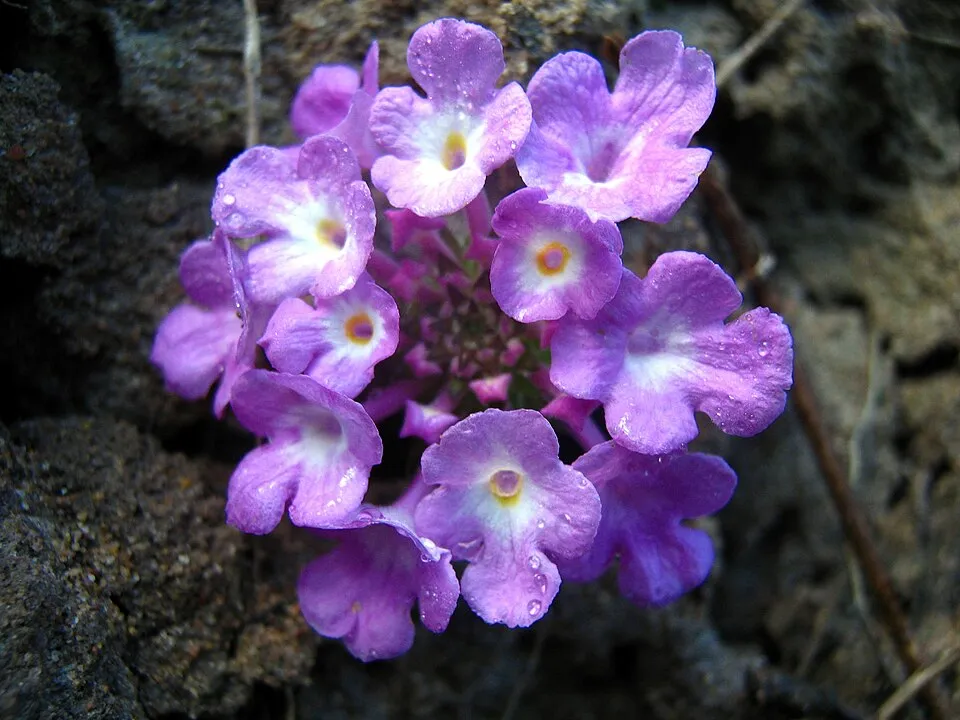
Lantana montevidensis, commonly known as trailing lantana or purple lantana, is a charming, low-growing perennial shrub belonging to the Verbenaceae family. Native to South America, specifically Uruguay and Brazil, this species is widely cultivated globally for its ornamental value and resilient nature. It typically forms a dense, sprawling groundcover, reaching heights of 1 to 2 feet (30-60 cm) but spreading outwards significantly, often cascading gracefully over walls, rockeries, or containers.
The plant's slender, often wiry stems are arching, contributing to its characteristic mounding habit. Its foliage consists of opposite or occasionally whorled, simple, ovate to elliptic leaves, measuring approximately 1-2 inches (2.5-5 cm) in length and 0.5-1 inch (1.2-2.5 cm) in width. These dark green leaves have a slightly rough, textured surface and emit a distinctive, somewhat pungent aroma when crushed, a common trait across many Lantana species.
The leaf margins are typically serrated or finely toothed.
The most striking feature of Lantana montevidensis is its exceptionally long and abundant blooming period. Small, tubular flowers are arranged in dense, flattened cymes, usually 1-2 inches (2.5-5 cm) in diameter, appearing at the terminal ends of branches. While vibrant purple or lavender-pink flowers are most common, white and other color variations exist.
Each tiny flower possesses four lobes and often a contrasting yellow or lighter-colored throat, adding to its visual appeal. This profusion of blooms extends from spring through fall, and in warmer, frost-free climates, it can flower continuously year-round, making it a significant attractor for various pollinators, particularly butterflies and bees. Following successful pollination, small, dark purple to black, berry-like drupes develop, though these are generally less noticeable than the flowers and are considered mildly toxic if ingested.
Trusted Scientific References
1. Authoritative external sources for Lantana montevidensis
1.1 Wikipedia — Lantana montevidensis
1.2 Kew POWO (Plants of the World Online)
1.3 PubMed — peer-reviewed research
1.4 NCBI Taxonomy Browser
1.5 GBIF — Global Biodiversity
1.1.Lantana Montevidensis — Key Features
- ✓ <strong>Prolific purple</strong> — pink to lavender flowers.
- ✓ <strong>Trailing, sprawling growth</strong> — Trailing, sprawling growth habit, ideal for groundcover or hanging baskets.
- ✓ <strong>Long blooming season, often year</strong> — round in warm climates.
- ✓ <strong>Attracts butterflies and</strong> — Attracts butterflies and bees, enhancing garden biodiversity.
- ✓ <strong>Distinctive, pungent aroma</strong> — Distinctive, pungent aroma when leaves are crushed.
- ✓ <strong>Highly drought</strong> — tolerant and thrives in full sun.
- ✓ <strong>Low maintenance and generally pest</strong> — resistant.
- ✓ <strong>All parts, especially</strong> — All parts, especially berries, are toxic if ingested.
- ✓ <strong>Evergreen in frost</strong> — free regions.
- ✓ <strong>Adaptable to various well</strong> — drained soil types.
1.2.Lantana Montevidensis — Quick Summary
- ✓ Trailing perennial shrub native to South America, known for prolific purple flowers.
- ✓ Primarily ornamental, attracting pollinators like butterflies and bees.
- ✓ All plant parts, especially berries, are toxic if ingested.
- ✓ Contains triterpenoids and flavonoids with traditional anti-inflammatory and antioxidant uses.
- ✓ Requires full sun and well-draining soil; drought-tolerant and low maintenance.
- ✓ Used topically for minor skin issues and as an insect repellent.
2.Lantana Montevidensis — Scientific Identity
3.Lantana Montevidensis — Quick Facts
4.Lantana Montevidensis — Appearance & Identification
5.Lantana Montevidensis — Native Habitat
6.Lantana Montevidensis — Water Requirements
- ✓ Sunlight — Requires full sun exposure (at least 6 hours daily) for optimal growth and abundant flowering.
- ✓ Soil — Thrives in well-draining soil; adaptable to various soil types including sandy, loamy, or clay, with a pH range from acidic to slightly alkaline.
- ✓ Watering — Drought-tolerant once established, but benefits from moderate watering, especially during prolonged dry spells; avoid overwatering.
- ✓ Temperature — Hardy in USDA Zones 8-11; not frost-tolerant, may be grown as an annual or brought indoors in colder climates.
- ✓ Fertilization — Generally low-maintenance; a balanced, slow-release fertilizer in spring can encourage vigorous growth and blooming.
- ✓ Pruning — Prune in late winter or early spring to shape the plant, remove dead wood, and promote bushier growth and more flowers.
- ✓ Propagation — Easily propagated from semi-hardwood cuttings taken in spring or summer.
- ✓ Pests and Diseases — Generally resistant to most pests and diseases, though occasional issues with whiteflies or spider mites can occur.
Reviewed by the Flora Medical Global Botanical Review Panel
Multi-disciplinary editorial group · Botany · Ethnobotany · Herbal-medicine literature
Who reviewed this: This page was checked by the Flora Medical Global Botanical Review Panel — an in-house editorial group of botany graduates, ethnobotany researchers, and horticulture practitioners who collectively maintain our 7,000+ plant encyclopedia. Meet the team.
Our 4-step verification process
1. Taxonomic verification
Scientific names and synonyms cross-checked against Kew POWO, World Flora Online, and The Plant List.
2. Phytochemical & medicinal cross-reference
Active compounds, traditional uses, and reported activities are cross-referenced with PubMed, USDA Dr. Duke's database, and peer-reviewed ethnobotanical literature.
3. Conservation & distribution check
Distribution, ecology, and conservation status confirmed against GBIF occurrence records and the IUCN Red List.
4. Editorial & safety review
Every entry passes an editorial pass for clarity, originality, and safety notices (toxicity, contraindications, dosage caveats) before publication.
Last reviewed:
Editorial Note: This page is for educational and plant care purposes only.
Written by: Flora Medical Global Editorial Team
Reviewed by: Flora Medical Global Botanical Review Panel
Last Updated: June 16, 2026







Lantana Montevidensis — Comments & Community Reviews
Rate this plant