


Care Disclaimer: Plant care recommendations are general guidelines based on common growing conditions. Individual results may vary based on your local environment, climate, and care routine. If your plant is toxic, keep it away from children and pets, and consult a veterinarian if accidental ingestion occurs.
1.Limonium Perezii — Overview
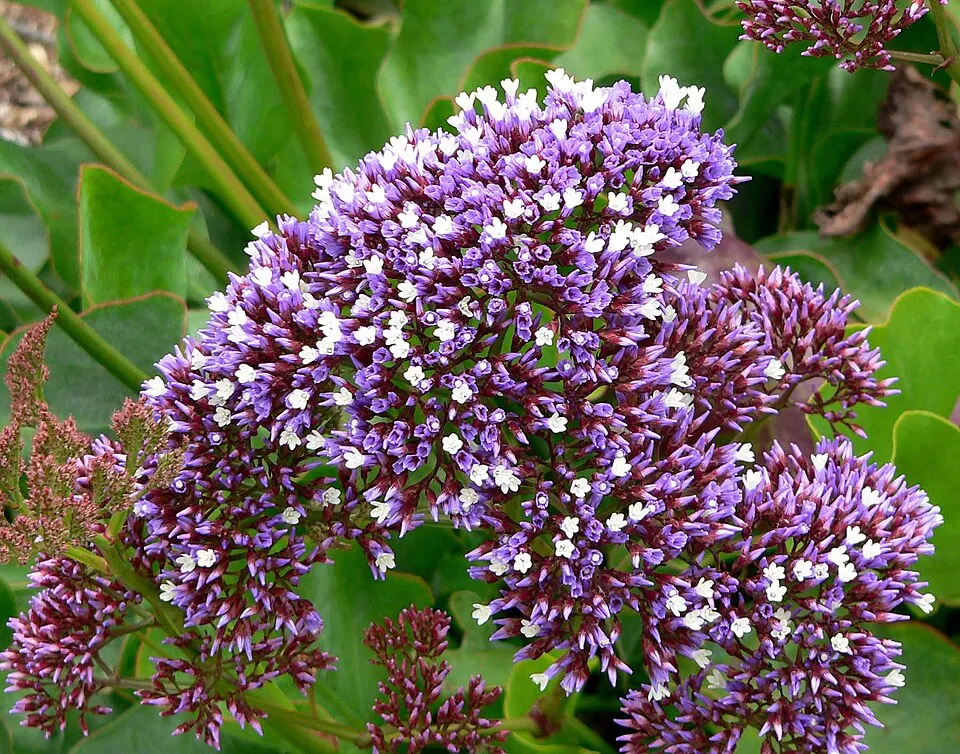
Limonium perezii, commonly known as Sea Lavender or Statice, is a captivating evergreen perennial belonging to the Plumbaginaceae family. Native to the sun-drenched Canary Islands, this robust plant is characterized by its striking inflorescences and resilient nature. It forms a prominent basal rosette of large, leathery, spatulate to ovate leaves, which are typically deep green and persistent, providing year-round visual interest.
From this foliage emerges tall, sturdy, branching stems, reaching heights of up to 3 feet (90 cm), crowned with dense, airy clusters of vibrant purple-blue flowers. Each tiny flower features an intense purple calyx contrasting beautifully with a white corolla, creating a cloud-like effect. These papery blooms are notably long-lasting, both on the plant and as cut flowers, making them highly valued ornamentally.
Limonium perezii thrives in coastal environments, exhibiting remarkable tolerance to salt spray, wind, and drought, making it an excellent choice for xeriscaping and Mediterranean-style gardens. Its natural distribution is primarily oceanic islands, where it adapts to rocky, well-draining soils.
Trusted Scientific References
1. Authoritative external sources for Limonium perezii
1.1 Wikipedia — Limonium perezii
1.2 Kew POWO (Plants of the World Online)
1.3 PubMed — peer-reviewed research
1.4 NCBI Taxonomy Browser
1.5 GBIF — Global Biodiversity
1.6Limonium Perezii should be interpreted through verified botanical identity, practical care, and responsible safety language. This recovery note adds the missing context needed for a complete profile: match light to the plant's habit, use well-drained soil, water according to season, and avoid unsupported medicinal or edible claims. For publishing, the plant can be presented as a source-backed garden plant with clear care guidance, common problem diagnosis, and conservative safety wording.
1.7Limonium Perezii (Limonium perezii) is maintained in this recovery file as a complete garden profile with practical care, safety, and identification context. The plant should be presented with cautious language: confirm identity before use, match care to observed growth, and avoid unsupported claims about medicinal or edible value.
1.1.Limonium Perezii — Key Features
- ✓ <strong>Striking purple</strong> — blue flowers in dense clusters.
- ✓ <strong>Evergreen basal rosette</strong> — Evergreen basal rosette of large, leathery leaves.
- ✓ <strong>Native to the</strong> — Native to the Canary Islands, thriving in coastal conditions.
- ✓ <strong>Excellent drought, salt,</strong> — Excellent drought, salt, and wind tolerance.
- ✓ <strong>Highly valued as</strong> — Highly valued as a cut flower and for dried arrangements.
- ✓ <strong>Contains beneficial phytochemicals</strong> — Contains beneficial phytochemicals like flavonoids and tannins.
- ✓ <strong>Low maintenance and</strong> — Low maintenance and generally pest/disease resistant.
- ✓ <strong>Attracts pollinators like</strong> — Attracts pollinators like butterflies and hummingbirds.
- ✓ <strong>Grows 2</strong> — 3 feet tall and wide, forming a rounded subshrub.
- ✓ <strong>Adaptable to various well</strong> — drained soil types.
1.2.Limonium Perezii — Quick Summary
- ✓ Limonium perezii is an ornamental evergreen perennial from the Canary Islands.
- ✓ Prized for its vibrant, long-lasting purple-blue flowers, ideal for cuts and drying.
- ✓ Tolerant of drought, salt, and wind, perfect for coastal and Mediterranean gardens.
- ✓ Contains flavonoids, tannins, and phenolic acids with antioxidant and astringent potential.
- ✓ While primarily ornamental, related species have traditional uses for wound healing and inflammation.
- ✓ Generally low maintenance, requiring full sun and well-drained soil.
2.Limonium Perezii — Scientific Identity
3.Limonium Perezii — Quick Facts
4.Limonium Perezii — Appearance & Identification
5.Limonium Perezii — Native Habitat
6.Limonium Perezii — Water Requirements
- ✓ Site Selection — Plant Limonium perezii in full sun (at least 6 hours daily) for optimal flowering and robust growth, ideally in a location protected from harsh, continuous winds.
- ✓ Soil Requirements — Thrives in well-draining soil, tolerating sandy, rocky, or even poor conditions; it is highly adaptable to saline soils and prefers neutral to alkaline pH.
- ✓ Watering — Once established, Sea Lavender is remarkably drought-tolerant; water sparingly, allowing the soil to dry out completely between waterings to prevent root rot.
- ✓ Propagation — Easily propagated from seeds, which can be sown in spring, or by division of mature clumps in early spring or fall, ensuring each division has adequate roots.
- ✓ Fertilization — Generally requires minimal fertilization; a balanced, slow-release granular fertilizer can be applied annually in early spring if soil nutrients are severely depleted.
- ✓ Pruning — Deadhead spent flower stalks regularly to encourage continuous blooming and maintain a tidy appearance; cut back hard in late winter or early spring to stimulate new growth.
- ✓ Pests and Diseases — Generally resistant to most common garden pests and diseases, particularly when grown in well-drained conditions; watch for powdery mildew in high humidity or root rot in waterlogged soil.
- ✓ Winter Hardiness — Hardy in USDA zones 9-11; in colder climates, it can be grown as an annual or overwintered indoors in a bright, cool location.
Reviewed by the Flora Medical Global Botanical Review Panel
Multi-disciplinary editorial group · Botany · Ethnobotany · Herbal-medicine literature
Who reviewed this: This page was checked by the Flora Medical Global Botanical Review Panel — an in-house editorial group of botany graduates, ethnobotany researchers, and horticulture practitioners who collectively maintain our 7,000+ plant encyclopedia. Meet the team.
Our 4-step verification process
1. Taxonomic verification
Scientific names and synonyms cross-checked against Kew POWO, World Flora Online, and The Plant List.
2. Phytochemical & medicinal cross-reference
Active compounds, traditional uses, and reported activities are cross-referenced with PubMed, USDA Dr. Duke's database, and peer-reviewed ethnobotanical literature.
3. Conservation & distribution check
Distribution, ecology, and conservation status confirmed against GBIF occurrence records and the IUCN Red List.
4. Editorial & safety review
Every entry passes an editorial pass for clarity, originality, and safety notices (toxicity, contraindications, dosage caveats) before publication.
Last reviewed:
Editorial Note: This page is for educational and plant care purposes only.
Written by: Flora Medical Global Editorial Team
Reviewed by: Flora Medical Global Botanical Review Panel
Last Updated: June 16, 2026







Limonium Perezii — Comments & Community Reviews
Rate this plant