

Care Disclaimer: Plant care recommendations are general guidelines based on common growing conditions. Individual results may vary based on your local environment, climate, and care routine. If your plant is toxic, keep it away from children and pets, and consult a veterinarian if accidental ingestion occurs.
1.Loquat — Overview
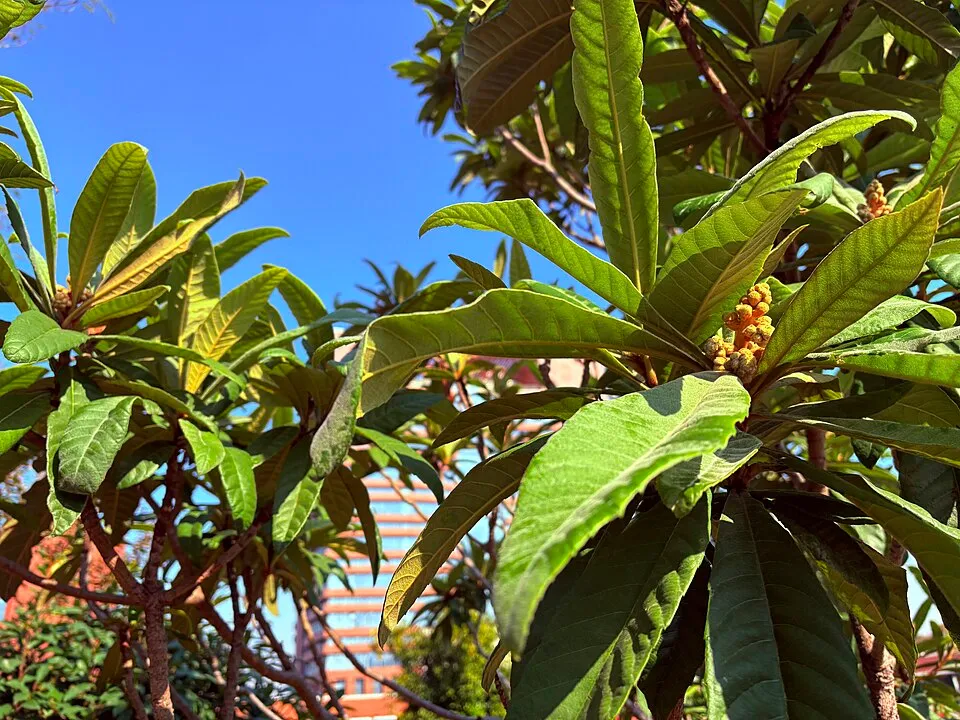
Eriobotrya japonica, commonly known as Loquat, is an elegant evergreen shrub or small tree belonging to the Rosaceae family. Native to the cooler, subtropical hillside regions of south-central China, it can reach heights of 5–10 meters (16–33 ft) with a characteristic rounded crown and a short, stout trunk. Its new branches are notably woolly. The distinctive leaves are alternate, simple, and substantial, measuring 10–25 cm (4–10 in) long.
They present a dark green, tough, and leathery texture with a serrated margin, while their undersides are densely covered in rusty-brown hairs, providing a unique tactile and visual appeal. Loquat trees produce delicate, fragrant, five-petaled flowers, approximately 2 cm (1 in) in diameter, arranged in stiff panicles of three to ten flowers at the branch tips during autumn or early winter. The fruit, also referred to as loquat, is a small, typically round or pear-shaped pome, 3–5 cm (1–2 in) long. Its skin is smooth or downy, ranging in color from yellow to orange, often with a blush of red.
The succulent, tangy, and sweet flesh offers a delightful flavor profile reminiscent of peach, citrus, and mild mango. Each fruit typically encases one to five large, dark brown seeds. This species is remarkably cold-hardy, tolerating temperatures down to about -10°C (14°F) once established, making it suitable for cultivation in various subtropical and warm temperate climates globally. Beyond its edible fruit, its attractive foliage and fragrant blossoms contribute to its significant ornamental value.
Trusted Scientific References
1. Authoritative external sources for Eriobotrya japonica
1.1 Wikipedia — Eriobotrya japonica
1.2 Kew POWO (Plants of the World Online)
1.3 PubMed — peer-reviewed research
1.4 NCBI Taxonomy Browser
1.5 GBIF — Global Biodiversity
1.6Loquat should be interpreted through verified botanical identity, practical care, and responsible safety language. This recovery note adds the missing context needed for a complete profile: match light to the plant's habit, use well-drained soil, water according to season, and avoid unsupported medicinal or edible claims. For publishing, the plant can be presented as a source-backed garden plant with clear care guidance, common problem diagnosis, and conservative safety wording.
1.1.Loquat — Key Features
- ✓ <strong>Evergreen ornamental tree</strong> — Evergreen ornamental tree with edible fruit.
- ✓ <strong>Native to south</strong> — central China.
- ✓ <strong>Leaves are rich</strong> — Leaves are rich in medicinal compounds like triterpenoids and flavonoids.
- ✓ <strong>Fruit is sweet,</strong> — Fruit is sweet, tangy, and high in fiber, vitamins, and minerals.
- ✓ <strong>Used traditionally for</strong> — Used traditionally for respiratory ailments, diabetes, and inflammation.
- ✓ <strong>Exhibits antioxidant, anti</strong> — inflammatory, and hypoglycemic properties.
- ✓ <strong>Cold</strong> — hardy for a subtropical fruit tree.
- ✓ <strong>Seeds are toxic</strong> — Seeds are toxic due to cyanogenic glycosides.
- ✓ <strong>Attractive foliage with rusty</strong> — brown hairy undersides.
- ✓ <strong>Flowers are fragrant</strong> — Flowers are fragrant and bloom in autumn/early winter.
1.2.Loquat — Quick Summary
- ✓ Eriobotrya japonica is a subtropical fruit tree native to China.
- ✓ Leaves and fruit offer significant medicinal benefits, especially for metabolism and respiratory health.
- ✓ Rich in triterpenoids, flavonoids, and carotenoids with antioxidant and anti-inflammatory actions.
- ✓ Seeds are toxic and should never be consumed.
- ✓ Widely cultivated for both edible fruit and ornamental value.
- ✓ Traditional uses include treating coughs, diabetes, and inflammation.
2.Loquat — Scientific Identity
3.Loquat — Quick Facts
4.Loquat — Appearance & Identification
5.Loquat — Native Habitat
6.Loquat — Water Requirements
- ✓ Climate Preference — Thrives in subtropical to warm temperate climates, tolerating mild frosts once established.
- ✓ Soil Requirements — Prefers well-drained, fertile loamy soils with a pH between 6.0 and 7.0.
- ✓ Sun Exposure — Requires full sun exposure for optimal fruit production, though it can tolerate partial shade.
- ✓ Watering — Young trees need regular watering; mature trees are drought-tolerant but benefit from irrigation during dry periods.
- ✓ Pruning — Prune to shape the tree, remove dead or diseased branches, and thin fruit for larger size.
- ✓ Fertilization — Apply balanced fertilizer in early spring and mid-summer, adjusting based on soil tests.
- ✓ Pests and Diseases — Generally robust, but watch for common fruit tree pests like aphids and fruit flies, and diseases such as fire blight and leaf spot.
- ✓ Propagation — Primarily propagated by seeds (sown fresh) or grafting for specific cultivars to ensure desired fruit quality.
Reviewed by the Flora Medical Global Botanical Review Panel
Multi-disciplinary editorial group · Botany · Ethnobotany · Herbal-medicine literature
Who reviewed this: This page was checked by the Flora Medical Global Botanical Review Panel — an in-house editorial group of botany graduates, ethnobotany researchers, and horticulture practitioners who collectively maintain our 7,000+ plant encyclopedia. Meet the team.
Our 4-step verification process
1. Taxonomic verification
Scientific names and synonyms cross-checked against Kew POWO, World Flora Online, and The Plant List.
2. Phytochemical & medicinal cross-reference
Active compounds, traditional uses, and reported activities are cross-referenced with PubMed, USDA Dr. Duke's database, and peer-reviewed ethnobotanical literature.
3. Conservation & distribution check
Distribution, ecology, and conservation status confirmed against GBIF occurrence records and the IUCN Red List.
4. Editorial & safety review
Every entry passes an editorial pass for clarity, originality, and safety notices (toxicity, contraindications, dosage caveats) before publication.
Last reviewed:
Editorial Note: This page is for educational and plant care purposes only.
Written by: Flora Medical Global Editorial Team
Reviewed by: Flora Medical Global Botanical Review Panel
Last Updated: June 16, 2026







Loquat — Comments & Community Reviews
Rate this plant