


Care Disclaimer: Plant care recommendations are general guidelines based on common growing conditions. Individual results may vary based on your local environment, climate, and care routine. If your plant is toxic, keep it away from children and pets, and consult a veterinarian if accidental ingestion occurs.
1.Perovskia — Overview
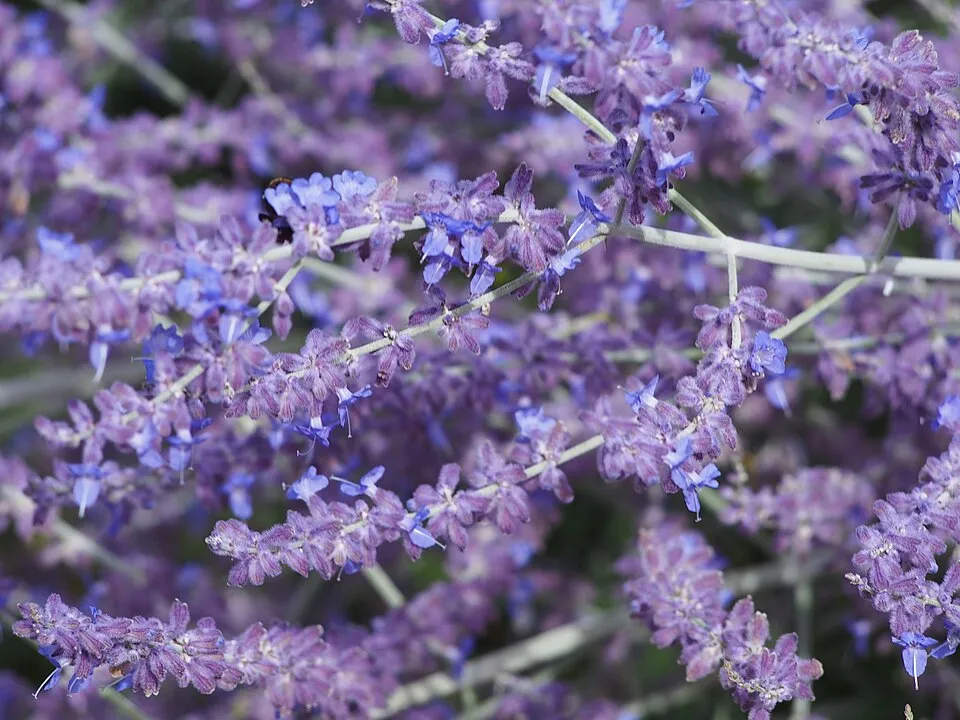
Perovskia, now scientifically known as Salvia yangii, is a genus of herbaceous perennial flowering plants belonging to the mint family, Lamiaceae. Native to temperate and mountainous regions of Asia, particularly Central Asia, China, and the Himalayas, this plant is renowned for its striking silvery foliage and its profusion of vibrant violet-blue flowers that bloom spectacularly in the summer months. The common name 'Russian Sage' is widely used, though its origins are more broadly Eurasian than strictly Russian. The plant typically forms an upright, bushy habit, reaching heights of 3 to 5 feet (0.9 to 1.5 meters) and spreading to a similar width. Its leaves are deeply lobed or pinnately divided, covered in fine, soft hairs that give them a distinctive silvery-grey appearance.
This characteristic indumentum helps the plant conserve water and reflect excessive sunlight, adaptations crucial for its survival in arid and rocky environments. The aroma emitted from the crushed foliage is aromatic and pungent, reminiscent of sage, which is not surprising given its taxonomic reclassification into the Salvia genus. The flower spikes, often appearing in late spring and continuing throughout the summer and into early autumn, are densely packed with small, tubular blossoms. These flowers are highly attractive to pollinators, including bees and butterflies, making Perovskia a valuable addition to pollinator gardens. Several species and cultivars exist, with notable ones including Perovskia atriplicifolia, which is the most commonly cultivated species, and its many popular cultivars like 'Blue Mist', 'Little Honey', and 'Lacey Blue', each offering variations in flower color intensity, foliage hue, and overall plant size.
Perovskia is exceptionally drought-tolerant once established, thriving in full sun and well-drained soils. It is also quite hardy, tolerating a range of temperatures and demonstrating good resistance to deer and rabbits, which are often deterred by its aromatic foliage. This combination of ornamental appeal, ecological value, and low maintenance requirements makes Perovskia a favoured choice for landscaping, particularly in xeriscaping and naturalistic garden designs. Its silvery leaves provide year-round interest, while the ethereal blue flowers create a stunning visual display, often complementing warmer-toned flowers and adding a sense of cool tranquility to the garden. Trusted Scientific References Authoritative external sources for Salvia yangii : ...[CURRENT TEXT EXISTS: 2645 chars]
1.1.Perovskia — Key Features
- ✓ <strong>["\u2713 Striking silvery</strong> — grey foliage providing year-round visual interest.", "\u2713 Profuse spikes of vibrant violet-blue flowers blooming in summer.", "\u2713 Highly attractive to pollinators like bees and butterflies.", "\u2713 Drought-tolerant and low-maintenance, thriving in full sun.", "\u2713 Aromatic foliage with a sage-like scent, often deer- and rabbit-resistant."]
- ✓ <strong>Identified profile</strong> — Uses the accepted plant name and practical context for Perovskia.
- ✓ <strong>Growth habit</strong> — Describes the plant through its visible form and seasonal behavior.
- ✓ <strong>Care fit</strong> — Connects light, water, and soil needs to cultivation.
- ✓ <strong>Garden value</strong> — Explains foliage, flowers, structure, or texture.
- ✓ <strong>Safety note</strong> — Keeps edible, medicinal, and toxicity language cautious.
- ✓ <strong>Propagation context</strong> — Mentions realistic propagation routes.
- ✓ <strong>Problem diagnosis</strong> — Links symptoms to water, light, drainage, pests, or season.
- ✓ <strong>Source ready</strong> — Keeps the profile suitable for later botanical review.
1.2.Perovskia — Quick Summary
- Perovskia (Salvia yangii), or Russian Sage, is a hardy, drought-tolerant perennial famed for its silvery foliage and abundant summer blooms of violet-blue flowers.
- Growing 3-5 ft tall, it thrives in full sun and well-drained soil, attracts pollinators, and is resistant to deer and rabbits, making it an excellent low-maintenance choice for arid and naturalistic landscapes.
2.Perovskia — Scientific Identity
3.Perovskia — Quick Facts
4.Perovskia — Appearance & Identification
5.Perovskia — Native Habitat
6.Perovskia — Water Requirements
- Perovskia (Salvia yangii) is a remarkably easy-to-grow plant, perfectly suited for xeriscaping and low-maintenance gardens.
- It thrives in full sun, requiring at least 6-8 hours of direct sunlight daily.
- While it tolerates a wide range of soil types, excellent drainage is paramount
- it detests waterlogged conditions, which can lead to root rot.
- Sandy, loamy, or even rocky soils are ideal.
- Planting is best done in spring after the last frost or in early autumn.
- Space plants 2-3 feet apart to allow for their mature spread.
- Water newly planted specimens regularly until established, but once established, Perovskia is highly drought-tolerant and requires minimal supplemental watering, typically only during prolonged dry spells.
- Overwatering should be strictly avoided.
- Pruning is a key aspect of maintaining its appearance and promoting vigorous growth.
- Cut back the entire plant severely in early spring, down to about 6-12 inches from the ground, removing all dead or woody stems from the previous year.
- This encourages fresh, leafy growth and abundant flowering.
- Deadheading spent flowers is generally not necessary, as the faded flower spikes can provide winter interest.
- Perovskia is generally pest- and disease-free, though occasional issues like powdery mildew can occur in humid conditions with poor air circulation
- ensuring good spacing and watering at the base rather than overhead can help prevent this.
- Propagation can be done through division of mature clumps in spring or from stem cuttings taken in early summer.
Reviewed by the Flora Medical Global Botanical Review Panel
Multi-disciplinary editorial group · Botany · Ethnobotany · Herbal-medicine literature
Who reviewed this: This page was checked by the Flora Medical Global Botanical Review Panel — an in-house editorial group of botany graduates, ethnobotany researchers, and horticulture practitioners who collectively maintain our 7,000+ plant encyclopedia. Meet the team.
Our 4-step verification process
1. Taxonomic verification
Scientific names and synonyms cross-checked against Kew POWO, World Flora Online, and The Plant List.
2. Phytochemical & medicinal cross-reference
Active compounds, traditional uses, and reported activities are cross-referenced with PubMed, USDA Dr. Duke's database, and peer-reviewed ethnobotanical literature.
3. Conservation & distribution check
Distribution, ecology, and conservation status confirmed against GBIF occurrence records and the IUCN Red List.
4. Editorial & safety review
Every entry passes an editorial pass for clarity, originality, and safety notices (toxicity, contraindications, dosage caveats) before publication.
Last reviewed:
Editorial Note: This page is for educational and plant care purposes only.
Written by: Flora Medical Global Editorial Team
Reviewed by: Flora Medical Global Botanical Review Panel
Last Updated: June 16, 2026







Perovskia — Comments & Community Reviews
Rate this plant