

Care Disclaimer: Plant care recommendations are general guidelines based on common growing conditions. Individual results may vary based on your local environment, climate, and care routine. If your plant is toxic, keep it away from children and pets, and consult a veterinarian if accidental ingestion occurs.
1.Pontederia Cordata — Overview
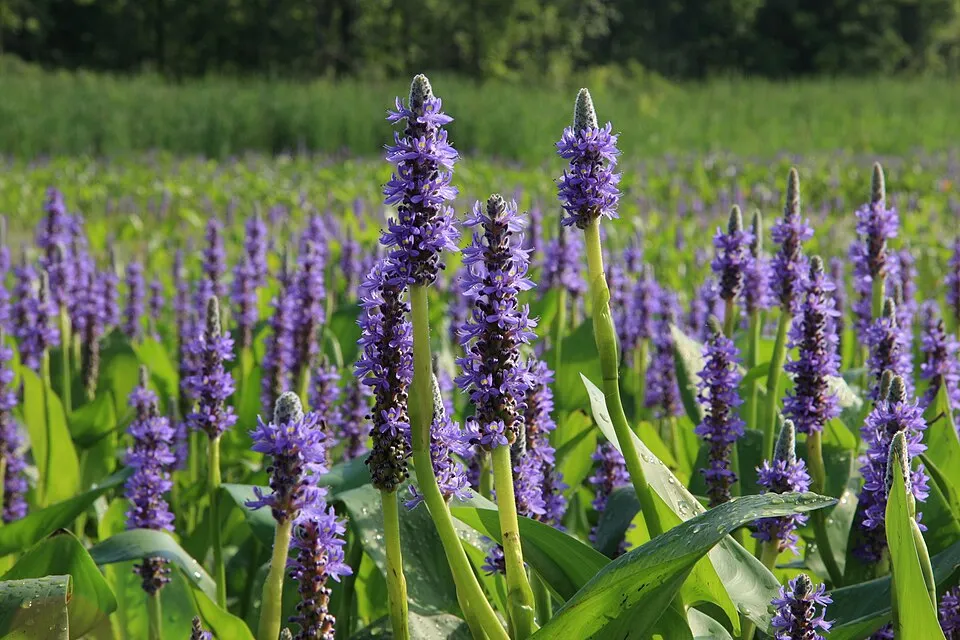
Pontederia cordata, universally known as Pickerelweed, is a captivating emergent aquatic perennial indigenous to the Americas, flourishing in the shallow margins of freshwater ecosystems such as ponds, lakes, and languid streams. This member of the Pontederiaceae family is distinguished by its prominent, glossy green leaves, which can range from heart-shaped to lance-shaped, gracefully rising above the water's surface. Its most striking feature is the production of dense, showy spikes of vibrant blue-purple flowers, blooming profusely from late spring through early autumn, though less common white and pink variants also exist.
These floral displays are not only aesthetically pleasing but also serve as vital attractants for a diverse array of pollinators, including bees and butterflies, underscoring its ecological importance. Typically reaching heights of 2-4 feet, Pickerelweed forms extensive, robust clumps that contribute significantly to wetland biodiversity by offering crucial habitat and shelter for various aquatic fauna, while simultaneously playing a role in natural water filtration and shoreline stabilization. The species exhibits a wide native distribution across eastern North America, extending from Canada south to Florida and west to states like Missouri and Oklahoma, thriving in full sun to partial shade conditions with consistently moist or wet soil.
Trusted Scientific References
1. Authoritative external sources for Pontederia cordata
1.1 Wikipedia — Pontederia cordata
1.2 Kew POWO (Plants of the World Online)
1.3 PubMed — peer-reviewed research
1.4 NCBI Taxonomy Browser
1.5 GBIF — Global Biodiversity
1.6Pontederia Cordata should be interpreted through verified botanical identity, practical care, and responsible safety language. This recovery note adds the missing context needed for a complete profile: match light to the plant's habit, use well-drained soil, water according to season, and avoid unsupported medicinal or edible claims. For publishing, the plant can be presented as a source-backed garden plant with clear care guidance, common problem diagnosis, and conservative safety wording.
1.1.Pontederia Cordata — Key Features
- ✓ <strong>Striking blue</strong> — purple flower spikes.
- ✓ <strong>Heart</strong> — shaped to lance-shaped glossy leaves.
- ✓ <strong>Native to the</strong> — Native to the Americas, thriving in shallow waters.
- ✓ <strong>Important ecological role</strong> — Important ecological role in wetland ecosystems.
- ✓ <strong>Edible seeds and</strong> — Edible seeds and young shoots (traditional use).
- ✓ <strong>Attracts pollinators like</strong> — Attracts pollinators like bees and butterflies.
- ✓ <strong>Forms dense clumps,</strong> — Forms dense clumps, stabilizing shorelines.
- ✓ <strong>Grows 2</strong> — 4 feet tall, perennial.
- ✓ <strong>Low maintenance, robust</strong> — Low maintenance, robust aquatic plant.
- ✓ <strong>Natural water filter</strong> — Natural water filter and nutrient absorber.
1.2.Pontederia Cordata — Quick Summary
- ✓ Aquatic ornamental and ecological powerhouse.
- ✓ Traditional edible uses for seeds and young shoots.
- ✓ Limited scientific research on medicinal properties.
- ✓ Potential for mild anti-inflammatory and antioxidant benefits.
- ✓ Important for wetland habitat and water quality.
- ✓ Requires clean water source for safe consumption.
2.Pontederia Cordata — Scientific Identity
3.Pontederia Cordata — Quick Facts
4.Pontederia Cordata — Appearance & Identification
5.Pontederia Cordata — Native Habitat
6.Pontederia Cordata — Water Requirements
- ✓ Site Selection — Choose a location with full sun to part shade exposure, ideally where water levels are consistently shallow.
- ✓ Water Depth — Plant in water that is 3 to 12 inches deep; it can tolerate up to 18 inches but thrives in shallower conditions.
- ✓ Soil Type — Prefers rich, mucky soil at the bottom of ponds or in wetland areas; can also be planted in containers submerged in water.
- ✓ Propagation — Primarily propagated by dividing rhizomes in spring or by seeds, which can be sown in moist soil.
- ✓ Maintenance — Requires minimal maintenance once established, but occasional removal of spent flower spikes can encourage more blooms.
- ✓ Winter Hardiness — Fully hardy in its native range; the foliage will die back in winter but the rhizomes will regrow in spring.
- ✓ Pest and Disease — Generally resistant to most pests and diseases, making it a robust choice for water gardens.
- ✓ Spreading Control — Can spread vigorously via rhizomes; contain in pots or root barriers if spread is undesirable.
Reviewed by the Flora Medical Global Botanical Review Panel
Multi-disciplinary editorial group · Botany · Ethnobotany · Herbal-medicine literature
Who reviewed this: This page was checked by the Flora Medical Global Botanical Review Panel — an in-house editorial group of botany graduates, ethnobotany researchers, and horticulture practitioners who collectively maintain our 7,000+ plant encyclopedia. Meet the team.
Our 4-step verification process
1. Taxonomic verification
Scientific names and synonyms cross-checked against Kew POWO, World Flora Online, and The Plant List.
2. Phytochemical & medicinal cross-reference
Active compounds, traditional uses, and reported activities are cross-referenced with PubMed, USDA Dr. Duke's database, and peer-reviewed ethnobotanical literature.
3. Conservation & distribution check
Distribution, ecology, and conservation status confirmed against GBIF occurrence records and the IUCN Red List.
4. Editorial & safety review
Every entry passes an editorial pass for clarity, originality, and safety notices (toxicity, contraindications, dosage caveats) before publication.
Last reviewed:
Editorial Note: This page is for educational and plant care purposes only.
Written by: Flora Medical Global Editorial Team
Reviewed by: Flora Medical Global Botanical Review Panel
Last Updated: June 16, 2026







Pontederia Cordata — Comments & Community Reviews
Rate this plant