
Care Disclaimer: Plant care recommendations are general guidelines based on common growing conditions. Individual results may vary based on your local environment, climate, and care routine. If your plant is toxic, keep it away from children and pets, and consult a veterinarian if accidental ingestion occurs.
1.Radhachura — Overview
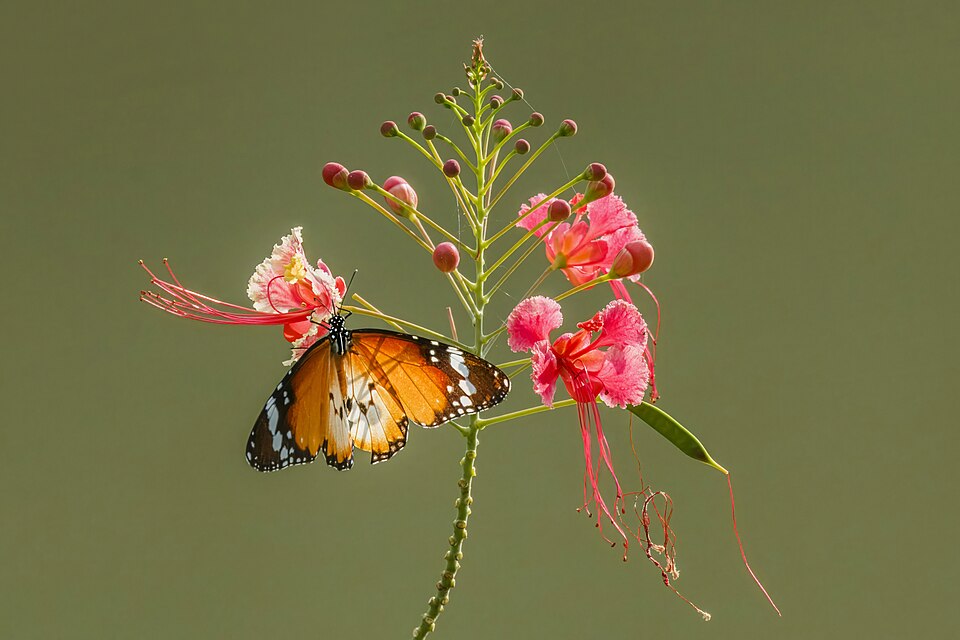
Radhachura, scientifically known as Caesalpinia pulcherrima, is an exquisite ornamental shrub or small tree belonging to the Fabaceae family. Native to the tropical and subtropical regions of the Americas, this fast-growing plant is widely admired for its spectacular, vivid inflorescence. It typically grows to a height of 3 to 5 meters, featuring a spreading crown and delicate, fern-like bipinnate leaves that fold inward at night.
The striking flowers, which bloom in showy clusters, display a vibrant spectrum of red, orange, and yellow hues, often with prominent stamens that extend beyond the petals, contributing to its common names like Peacock Flower, Red Bird of Paradise, and Pride of Barbados. These nectar-rich blossoms are a magnet for hummingbirds and butterflies, enhancing its appeal in tropical gardens, parks, and as an attractive roadside planting. Following the flowering period, the plant produces flattened, oblong seed pods that mature from green to brown.
Its natural distribution spans from Mexico through Central America and the Caribbean, extending into parts of South America, where it thrives in warm, sunny environments. The species is recognized taxonomically within the genus Caesalpinia, which includes a diverse group of flowering plants.
Trusted Scientific References
1. Authoritative external sources for Caesalpinia pulcherrima
1.1 Wikipedia — Caesalpinia pulcherrima
1.2 Kew POWO (Plants of the World Online)
1.3 PubMed — peer-reviewed research
1.4 NCBI Taxonomy Browser
1.5 GBIF — Global Biodiversity
1.6Radhachura should be interpreted through verified botanical identity, practical care, and responsible safety language. This recovery note adds the missing context needed for a complete profile: match light to the plant's habit, use well-drained soil, water according to season, and avoid unsupported medicinal or edible claims. For publishing, the plant can be presented as a source-backed garden plant with clear care guidance, common problem diagnosis, and conservative safety wording.
1.1.Radhachura — Key Features
- ✓ <strong>Vibrant Ornamental</strong> — Showy red, orange, and yellow flowers.
- ✓ <strong>Tropical Native</strong> — Indigenous to the Americas' warm regions.
- ✓ <strong>Fast</strong> — Growing Shrub/Small Tree — Reaches 3-5 meters tall.
- ✓ <strong>Bipinnate Leaves</strong> — Delicate, fern-like foliage.
- ✓ <strong>Nectar</strong> — Rich Flowers — Attracts pollinators like hummingbirds and butterflies.
- ✓ <strong>Traditional Medicinal Uses</strong> — Employed in folk medicine for various ailments.
- ✓ <strong>Phytochemically Rich</strong> — Contains flavonoids, tannins, terpenoids.
- ✓ <strong>Potential Toxicity</strong> — All plant parts, especially seeds, are considered toxic.
- ✓ <strong>Drought Tolerant</strong> — Once established, it can withstand dry periods.
- ✓ <strong>Easy Propagation</strong> — Primarily by scarified seeds.
1.2.Radhachura — Quick Summary
- ✓ Caesalpinia pulcherrima is a vibrant ornamental plant with traditional medicinal uses.
- ✓ Known for anti-inflammatory, antioxidant, and antimicrobial properties.
- ✓ Contains diverse phytochemicals including flavonoids, tannins, and terpenoids.
- ✓ All parts, especially seeds, are considered toxic and require careful handling.
- ✓ Contraindicated in pregnancy, lactation, and not recommended for children.
- ✓ Thrives in full sun and well-drained soil, propagated by scarified seeds.
2.Radhachura — Scientific Identity
3.Radhachura — Quick Facts
4.Radhachura — Appearance & Identification
5.Radhachura — Native Habitat
6.Radhachura — Water Requirements
- ✓ Sunlight — Thrives in full sun exposure, requiring at least 6-8 hours of direct sunlight daily for optimal flowering.
- ✓ Soil — Prefers well-drained soil, tolerating a range from slightly acidic to neutral pH (6.0-7.0).
- ✓ Watering — Requires regular watering, especially during dry periods and establishment, but avoid waterlogging to prevent root rot.
- ✓ Propagation — Primarily by seeds; scarification (nicking the seed coat) or soaking in warm water overnight significantly improves germination rates.
- ✓ Temperature — Best suited for USDA hardiness zones 9-11, intolerant of frost, requiring protection or indoor cultivation in colder climates.
- ✓ Fertilization — Benefits from a balanced fertilizer application during the growing season to support vigorous growth and abundant blooms.
- ✓ Pruning — Prune annually in late winter or early spring to maintain shape, promote bushier growth, and encourage more flowers.
- ✓ Pests/Diseases — Generally robust but can be susceptible to aphids, whiteflies, and spider mites; occasional fungal spots might occur in humid conditions.
Reviewed by the Flora Medical Global Botanical Review Panel
Multi-disciplinary editorial group · Botany · Ethnobotany · Herbal-medicine literature
Who reviewed this: This page was checked by the Flora Medical Global Botanical Review Panel — an in-house editorial group of botany graduates, ethnobotany researchers, and horticulture practitioners who collectively maintain our 7,000+ plant encyclopedia. Meet the team.
Our 4-step verification process
1. Taxonomic verification
Scientific names and synonyms cross-checked against Kew POWO, World Flora Online, and The Plant List.
2. Phytochemical & medicinal cross-reference
Active compounds, traditional uses, and reported activities are cross-referenced with PubMed, USDA Dr. Duke's database, and peer-reviewed ethnobotanical literature.
3. Conservation & distribution check
Distribution, ecology, and conservation status confirmed against GBIF occurrence records and the IUCN Red List.
4. Editorial & safety review
Every entry passes an editorial pass for clarity, originality, and safety notices (toxicity, contraindications, dosage caveats) before publication.
Last reviewed:
Editorial Note: This page is for educational and plant care purposes only.
Written by: Flora Medical Global Editorial Team
Reviewed by: Flora Medical Global Botanical Review Panel
Last Updated: June 16, 2026







Radhachura — Comments & Community Reviews
Rate this plant