
Care Disclaimer: Plant care recommendations are general guidelines based on common growing conditions. Individual results may vary based on your local environment, climate, and care routine. If your plant is toxic, keep it away from children and pets, and consult a veterinarian if accidental ingestion occurs.
1.Radish — Overview
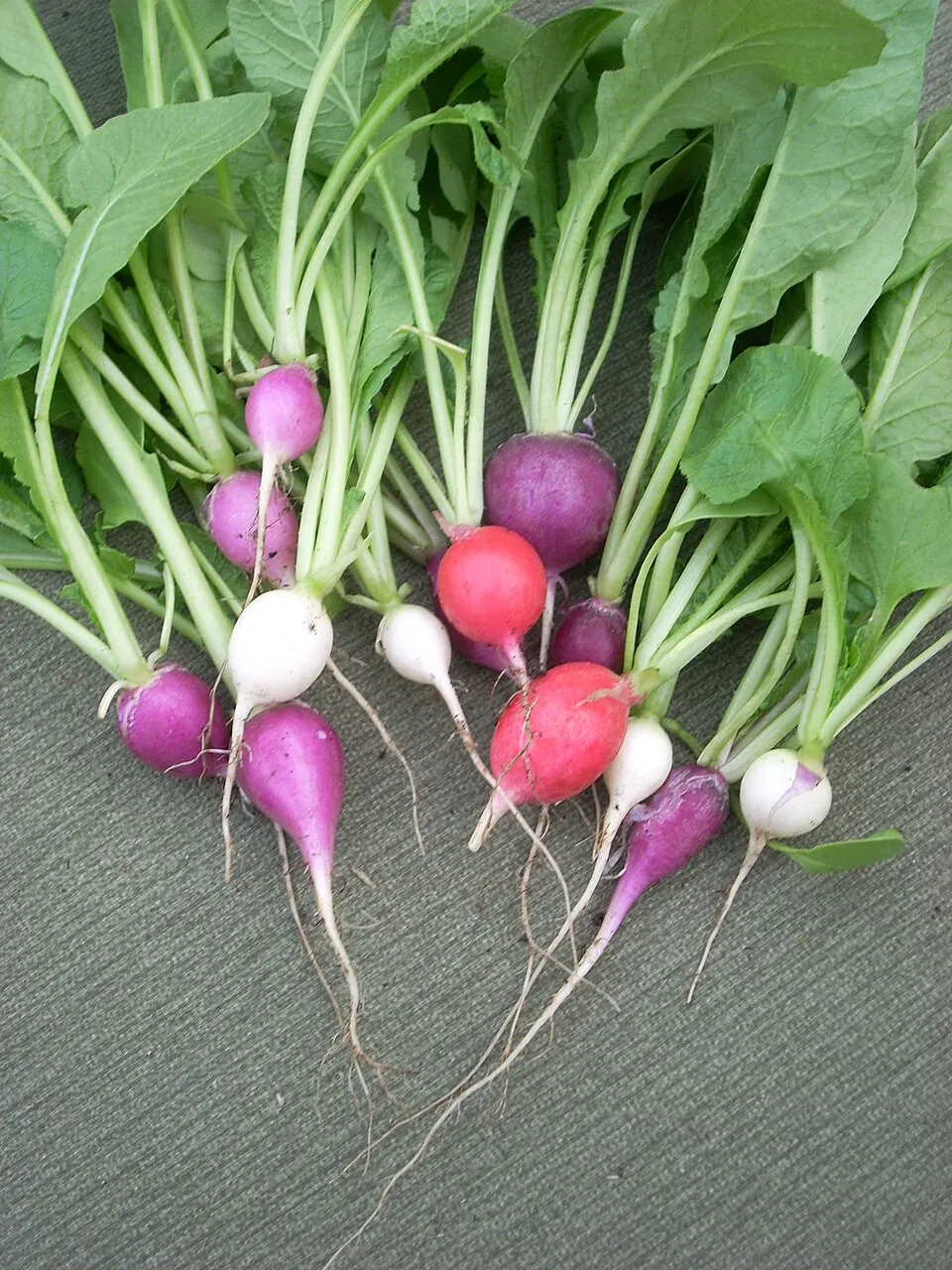
Radish, scientifically known as Raphanus sativus, is an annual or biennial herb belonging to the diverse Brassicaceae family, which also includes mustard, cabbage, and broccoli. This widely cultivated root vegetable is characterized by its swollen taproot, which serves as the primary edible portion. Morphologically, radishes exhibit a diverse range of forms; roots can be globose, conical, or cylindrical, with skin colors varying from red, pink, purple, and white to black.
The leaves are typically lobed or pinnatifid, forming a rosette at the base, and are also edible. Small, four-petaled flowers, usually white to purple, are borne on erect stems, leading to the development of unique, often edible, seed pods (siliques). Native to Asia, specifically thought to originate in Southeast Asia, Raphanus sativus has been cultivated for thousands of years and is now globally distributed, thriving in temperate climates.
It is known for its rapid growth cycle, making it a popular choice for quick harvests in home gardens and commercial agriculture. The distinctive pungent flavor, a hallmark of many Brassicaceae members, is attributed to sulfur-containing compounds.
Trusted Scientific References
1. Authoritative external sources for Raphanus sativus
1.1 Wikipedia — Raphanus sativus
1.2 Kew POWO (Plants of the World Online)
1.3 PubMed — peer-reviewed research
1.4 NCBI Taxonomy Browser
1.5 GBIF — Global Biodiversity
1.6Radish should be interpreted through verified botanical identity, practical care, and responsible safety language. This recovery note adds the missing context needed for a complete profile: match light to the plant's habit, use well-drained soil, water according to season, and avoid unsupported medicinal or edible claims. For publishing, the plant can be presented as a source-backed garden plant with clear care guidance, common problem diagnosis, and conservative safety wording.
1.7Radish (Raphanus sativus) is maintained in this recovery file as a complete garden profile with practical care, safety, and identification context. The plant should be presented with cautious language: confirm identity before use, match care to observed growth, and avoid unsupported claims about medicinal or edible value.
1.1.Radish — Key Features
- ✓ <strong>Rapid Growth Cycle</strong> — Matures quickly, often within 3-4 weeks.
- ✓ <strong>Diverse Varieties</strong> — Wide range of shapes, sizes, and colors (red, white, black, pink).
- ✓ <strong>Pungent Flavor Profile</strong> — Attributed to glucosinolates and isothiocyanates.
- ✓ <strong>Nutritional Density</strong> — Rich source of Vitamin C, fiber, and essential minerals.
- ✓ <strong>Versatile Edibility</strong> — Roots, leaves, and seed pods are all edible.
- ✓ <strong>Detoxification Support</strong> — Known for diuretic and liver-supporting properties.
- ✓ <strong>Antioxidant Powerhouse</strong> — Contains powerful compounds like anthocyanins and Vitamin C.
- ✓ <strong>Anti</strong> — inflammatory Action — Bioactive compounds help reduce inflammation.
- ✓ <strong>Easy to Cultivate</strong> — Popular with home gardeners due to minimal care requirements.
- ✓ <strong>Global Culinary Staple</strong> — Integrated into cuisines worldwide.
1.2.Radish — Quick Summary
- ✓ Raphanus sativus is an edible root vegetable from the Brassicaceae family.
- ✓ Valued for its pungent flavor and crisp texture.
- ✓ Rich in vitamins, minerals, fiber, and potent phytonutrients like isothiocyanates.
- ✓ Offers diuretic, digestive, antioxidant, and anti-inflammatory benefits.
- ✓ Commonly consumed raw, but leaves and seed pods are also edible.
- ✓ Generally safe in moderate amounts, with some precautions for specific health conditions.
2.Radish — Scientific Identity
3.Radish — Quick Facts
4.Radish — Appearance & Identification
5.Radish — Native Habitat
6.Radish — Water Requirements
- ✓ Soil Preparation — Plant in well-drained, loose, sandy loam soil with a pH between 6.0 and 7.0 for optimal root development.
- ✓ Sunlight Requirements — Radishes thrive in full sun to partial shade, requiring at least 6 hours of direct sunlight daily.
- ✓ Planting Depth and Spacing — Sow seeds ½ inch deep and 1 inch apart, in rows spaced about 1 foot apart.
- ✓ Watering — Maintain consistent soil moisture, ensuring the soil is damp but not waterlogged, especially during germination and root development.
- ✓ Thinning Seedlings — Once seedlings emerge, thin them to 2-3 inches apart to allow sufficient space for roots to swell and prevent overcrowding.
- ✓ Harvesting — Harvest roots when they reach about 1 inch in diameter, typically 3-4 weeks after planting, by gently pulling them from the soil.
- ✓ Succession Planting — For a continuous supply, plant small batches of seeds every 1-2 weeks throughout the growing season.
- ✓ Pest and Disease Management — Monitor for common pests like flea beetles and root maggots, and ensure good air circulation to prevent fungal diseases.
Reviewed by the Flora Medical Global Botanical Review Panel
Multi-disciplinary editorial group · Botany · Ethnobotany · Herbal-medicine literature
Who reviewed this: This page was checked by the Flora Medical Global Botanical Review Panel — an in-house editorial group of botany graduates, ethnobotany researchers, and horticulture practitioners who collectively maintain our 7,000+ plant encyclopedia. Meet the team.
Our 4-step verification process
1. Taxonomic verification
Scientific names and synonyms cross-checked against Kew POWO, World Flora Online, and The Plant List.
2. Phytochemical & medicinal cross-reference
Active compounds, traditional uses, and reported activities are cross-referenced with PubMed, USDA Dr. Duke's database, and peer-reviewed ethnobotanical literature.
3. Conservation & distribution check
Distribution, ecology, and conservation status confirmed against GBIF occurrence records and the IUCN Red List.
4. Editorial & safety review
Every entry passes an editorial pass for clarity, originality, and safety notices (toxicity, contraindications, dosage caveats) before publication.
Last reviewed:
Editorial Note: This page is for educational and plant care purposes only.
Written by: Flora Medical Global Editorial Team
Reviewed by: Flora Medical Global Botanical Review Panel
Last Updated: June 16, 2026







Radish — Comments & Community Reviews
Rate this plant