
Care Disclaimer: Plant care recommendations are general guidelines based on common growing conditions. Individual results may vary based on your local environment, climate, and care routine. If your plant is toxic, keep it away from children and pets, and consult a veterinarian if accidental ingestion occurs.
1.Salvia Splendens — Overview
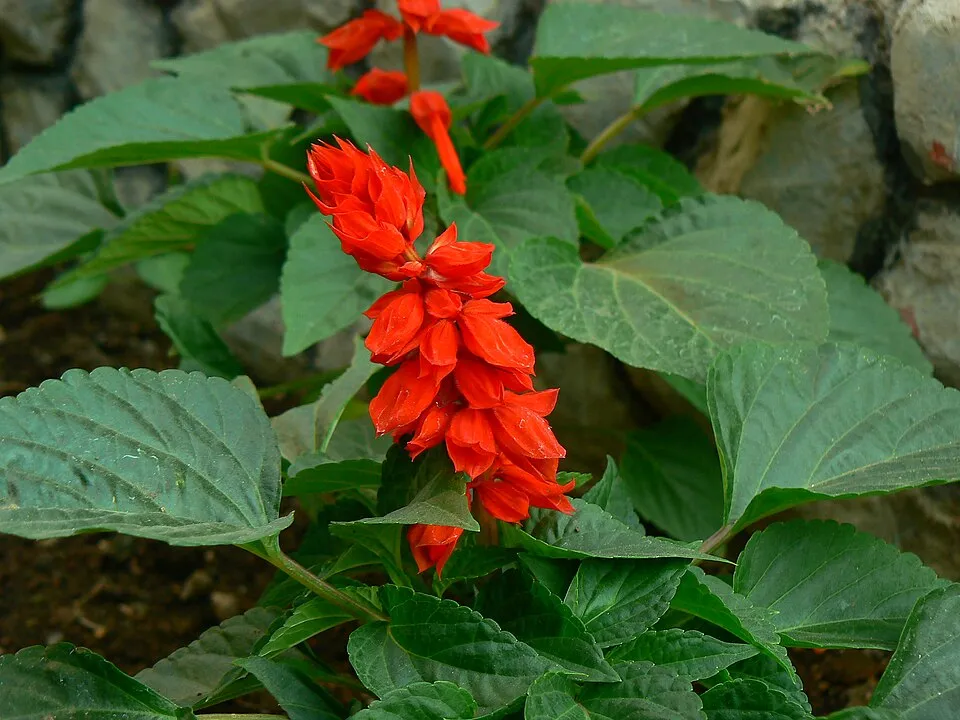
Salvia splendens, widely recognized as Scarlet Sage or Scarlet-flowered Sage, is a captivating and highly favored ornamental species within the Lamiaceae family, which notably includes many aromatic herbs such as rosemary and thyme. Originating from the tropical highlands of Brazil, this tender perennial is celebrated globally for its spectacular display of fiery red, tubular flowers that bloom abundantly throughout the warmer seasons. While it behaves as a perennial in its native warm habitat, it is frequently cultivated as an annual in regions with cooler climates. The plant exhibits an upright, bushy growth habit, typically reaching heights of 60 to 120 cm (2 to 4 feet) with a similar spread.
Its stems are distinctly square, a hallmark feature of the mint family, and are adorned with opposite, ovate to triangular leaves. These leaves present a rich, deep green hue, often featuring toothed or serrated margins, and emit a mild, herbaceous scent when gently bruised. The most striking aspect of Salvia splendens is its inflorescences, which are dense spikes or racemes composed of numerous bright scarlet, velvety bracts and flowers. The vibrant bracts frequently overshadow the actual flowers, which are smaller and typically deep red, though modern cultivars showcase a spectrum of colors including orange, pink, purple, and white.
The flowers are zygomorphic, displaying bilateral symmetry, and are perfectly adapted for pollination by hummingbirds and butterflies, which are drawn to their rich nectar and vivid coloration. These dense clusters of blooms create a visually stunning effect, making Scarlet Sage an excellent choice for adding a bold splash of color to garden beds, borders, containers, and hanging baskets. Its extended blooming period ensures continuous visual interest from late spring or early summer until the first frost. Beyond its ornamental appeal, Salvia splendens holds a place in traditional medicine, although its therapeutic uses are less extensively documented compared to some other Salvia species.
Trusted Scientific References
1. Authoritative external sources for Salvia splendens
1.1 Wikipedia — Salvia splendens
1.2 Kew POWO (Plants of the World Online)
1.3 PubMed — peer-reviewed research
1.4 NCBI Taxonomy Browser
1.5 GBIF — Global Biodiversity
1.1.Salvia Splendens — Key Features
- ✓ <strong>Botanical Name</strong> — Salvia splendens Sellow ex Schult.
- ✓ <strong>Common Names</strong> — Scarlet Sage, Bonfire Salvia, Red Salvia.
- ✓ <strong>Family</strong> — Lamiaceae (Mint Family).
- ✓ <strong>Native Region</strong> — Tropical highlands of Brazil.
- ✓ <strong>Flower Color</strong> — Predominantly vivid scarlet red, with various cultivars offering orange, pink, purple, and white.
- ✓ <strong>Growth Habit</strong> — Upright, bushy tender perennial, commonly cultivated as an annual in temperate zones.
- ✓ <strong>Medicinal Uses</strong> — Antihyperglycemic, wound healing, anti-inflammatory, antimicrobial.
- ✓ <strong>Key Constituents</strong> — Diterpenoids (splendidin, splenolides), flavonoids, phenolic acids, anthocyanins.
- ✓ <strong>Pollinator Attraction</strong> — Highly attractive to hummingbirds and butterflies, supporting local ecosystems.
- ✓ <strong>Ornamental Value</strong> — Extremely popular for its striking visual impact in garden beds, borders, and containers.
1.2.Salvia Splendens — Quick Summary
- ✓ Salvia splendens, or Scarlet Sage, is a vibrant ornamental native to Brazil, known for its fiery red flowers.
- ✓ It holds traditional medicinal uses for conditions like diabetes, wounds, and respiratory ailments.
- ✓ The plant is rich in diverse phytochemicals, including diterpenes, flavonoids, and phenolic acids.
- ✓ Scientific research supports its antihyperglycemic, anti-inflammatory, antimicrobial, and wound-healing properties.
- ✓ Potential side effects include toxicity at high doses and anticoagulant interactions; caution is advised.
- ✓ Cultivated globally, it thrives in full sun and well-drained soil, often grown as an annual in cooler climates.
2.Salvia Splendens — Scientific Identity
3.Salvia Splendens — Quick Facts
4.Salvia Splendens — Appearance & Identification
5.Salvia Splendens — Native Habitat
6.Salvia Splendens — Water Requirements
- ✓ Climate Preference — Thrives as a tender perennial in warm, tropical climates, but is widely cultivated as an annual in cooler regions where it cannot survive frost.
- ✓ Soil Requirements — Prefers well-draining, fertile soil enriched with organic matter, ideally maintaining a slightly acidic to neutral pH range of 6.0 to 7.0 for optimal growth.
- ✓ Sun Exposure — Requires full sun exposure, meaning at least six hours of direct sunlight daily, to ensure vigorous growth and abundant flowering.
- ✓ Watering — Needs consistent moisture, especially during dry spells, but it is crucial to avoid waterlogging to prevent root rot.
- ✓ Propagation — Primarily propagated from seeds, which should be sown indoors 8-10 weeks before the last expected frost, or from vegetative cuttings taken in spring or summer.
- ✓ Fertilization — Benefits from regular feeding with a balanced liquid fertilizer every 2-4 weeks throughout its active growing and blooming season.
- ✓ Pruning — Deadheading spent blooms encourages continuous flowering and maintains the plant’s bushy habit and overall vigor.
- ✓ Pest Management — Generally robust, but occasional issues with aphids or spider mites may arise, particularly in hot, dry conditions; inspect regularly and treat as needed.
Reviewed by the Flora Medical Global Botanical Review Panel
Multi-disciplinary editorial group · Botany · Ethnobotany · Herbal-medicine literature
Who reviewed this: This page was checked by the Flora Medical Global Botanical Review Panel — an in-house editorial group of botany graduates, ethnobotany researchers, and horticulture practitioners who collectively maintain our 7,000+ plant encyclopedia. Meet the team.
Our 4-step verification process
1. Taxonomic verification
Scientific names and synonyms cross-checked against Kew POWO, World Flora Online, and The Plant List.
2. Phytochemical & medicinal cross-reference
Active compounds, traditional uses, and reported activities are cross-referenced with PubMed, USDA Dr. Duke's database, and peer-reviewed ethnobotanical literature.
3. Conservation & distribution check
Distribution, ecology, and conservation status confirmed against GBIF occurrence records and the IUCN Red List.
4. Editorial & safety review
Every entry passes an editorial pass for clarity, originality, and safety notices (toxicity, contraindications, dosage caveats) before publication.
Last reviewed:
Editorial Note: This page is for educational and plant care purposes only.
Written by: Flora Medical Global Editorial Team
Reviewed by: Flora Medical Global Botanical Review Panel
Last Updated: June 16, 2026







Salvia Splendens — Comments & Community Reviews
Rate this plant