
Care Disclaimer: Plant care recommendations are general guidelines based on common growing conditions. Individual results may vary based on your local environment, climate, and care routine. If your plant is toxic, keep it away from children and pets, and consult a veterinarian if accidental ingestion occurs.
1.Solanum Rantonnetii — Overview
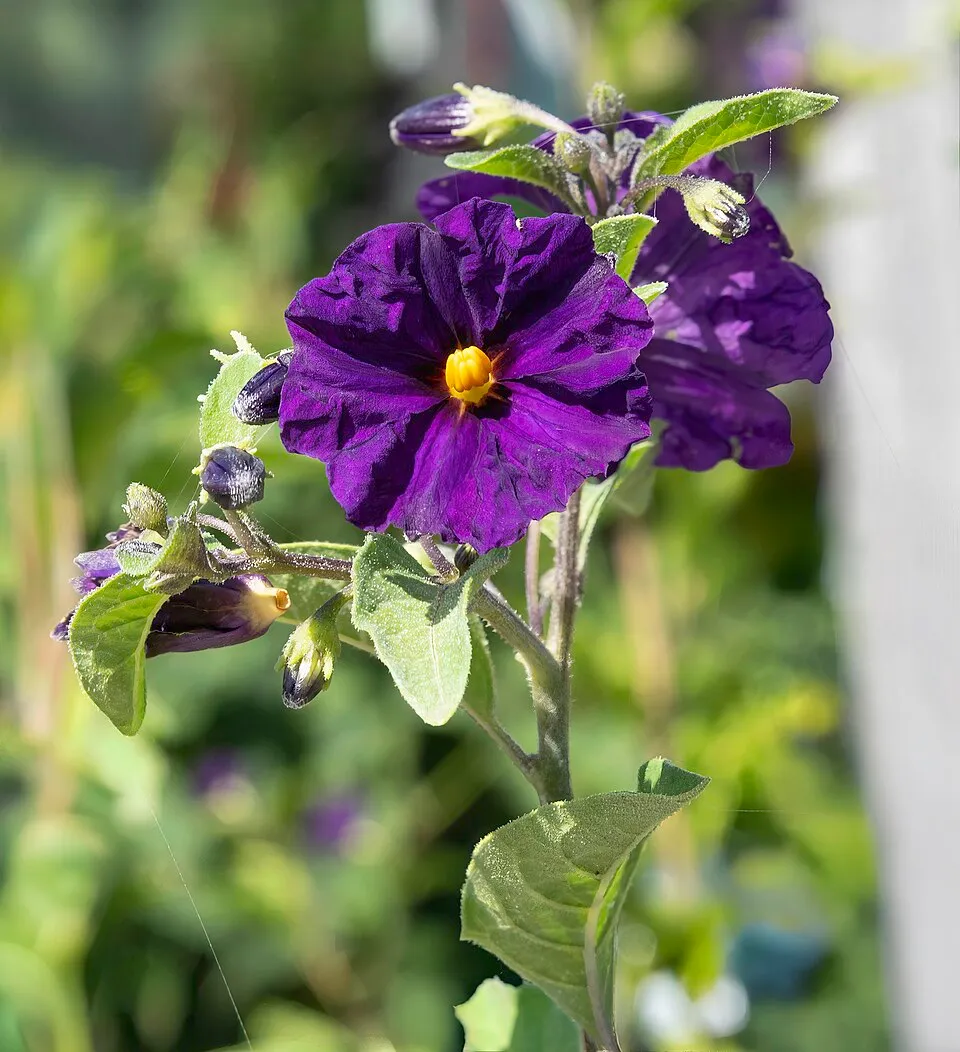
Lycianthes rantonnetii, commonly known as Blue Potato Bush or Paraguay Nightshade, is an enchanting, fast-growing evergreen shrub or small tree native to South America, particularly Paraguay and Brazil. Belonging to the vast Solanaceae family, it is primarily admired for its ornamental appeal, gracing gardens and landscapes with its prolific bloom. The plant typically reaches a height and spread of 6 to 10 feet, exhibiting a versatile growth habit that can be sprawling, upright, or even trained as a standard or espalier.
Its striking features include abundant, showy, violet-blue flowers, each adorned with a prominent yellow center, bearing a charming resemblance to miniature potato blossoms. These vibrant flowers appear profusely from spring through fall, and in warmer, frost-free climates, they can bloom almost continuously throughout the year, adding a splash of enduring color. The foliage consists of ovate to lanceolate, bright green leaves that are typically slightly hairy to the touch.
While historically recognized for its aesthetic value, recent scientific investigations are beginning to unveil a more complex biochemical profile for this species, revealing a notable presence of antioxidant compounds, essential vitamins, and various minerals, which prompts a re-evaluation of its potential beyond pure ornamentation.
Trusted Scientific References
1. Authoritative external sources for Lycianthes rantonnetii
1.1 Wikipedia — Lycianthes rantonnetii
1.2 Kew POWO (Plants of the World Online)
1.3 PubMed — peer-reviewed research
1.4 NCBI Taxonomy Browser
1.5 GBIF — Global Biodiversity
1.6Solanum Rantonnetii should be interpreted through verified botanical identity, practical care, and responsible safety language. This recovery note adds the missing context needed for a complete profile: match light to the plant's habit, use well-drained soil, water according to season, and avoid unsupported medicinal or edible claims. For publishing, the plant can be presented as a source-backed garden plant with clear care guidance, common problem diagnosis, and conservative safety wording.
1.1.Solanum Rantonnetii — Key Features
- ✓ <strong>Botanical Name</strong> — Lycianthes rantonnetii
- ✓ <strong>Common Names</strong> — Blue Potato Bush, Paraguay Nightshade
- ✓ <strong>Family</strong> — Solanaceae (Nightshade family)
- ✓ <strong>Ornamental Value</strong> — Highly prized for its showy, prolific blue-violet flowers.
- ✓ <strong>Growth Habit</strong> — Fast-growing evergreen shrub or small tree, 6-10 feet tall/wide.
- ✓ <strong>Flowering Season</strong> — Profuse blooming from spring to fall, often year-round in warm climates.
- ✓ <strong>Toxic Nature</strong> — Contains potentially toxic solanaceous alkaloids; not for consumption.
- ✓ <strong>Antioxidant Richness</strong> — Recent studies reveal high levels of vitamins A, E, C, phenols, and flavonoids.
- ✓ <strong>Mineral Content</strong> — A source of essential minerals like copper, zinc, magnesium, and phosphorus.
- ✓ <strong>Habitat</strong> — Native to South America, particularly Paraguay and Brazil.
1.2.Solanum Rantonnetii — Quick Summary
- ✓ Blue Potato Bush (Lycianthes rantonnetii) is an ornamental shrub.
- ✓ Features vibrant violet-blue flowers with yellow centers.
- ✓ Contains solanaceous alkaloids, making it toxic for ingestion.
- ✓ Recent research highlights high levels of antioxidant vitamins (A, E, C) and essential minerals.
- ✓ Also rich in phenolic compounds and flavonoids, contributing to antioxidant activity.
- ✓ Strictly an ornamental plant; not safe for human or animal consumption.
2.Solanum Rantonnetii — Scientific Identity
3.Solanum Rantonnetii — Quick Facts
4.Solanum Rantonnetii — Appearance & Identification
5.Solanum Rantonnetii — Native Habitat
6.Solanum Rantonnetii — Water Requirements
- ✓ Sunlight — Prefers full sun to partial shade for optimal growth and flowering; at least 6 hours of direct sunlight is ideal.
- ✓ Soil Requirements — Thrives in well-drained, fertile soil, tolerating a range of soil types but performing best in moist, organically rich substrates.
- ✓ Watering — Requires regular watering, especially during dry periods and active growth, to keep the soil consistently moist but not waterlogged.
- ✓ Pruning — Regular pruning is essential to maintain shape, encourage bushier growth, and promote a continuous abundance of flowers.
- ✓ Fertilization — Benefits from fertilization during the growing season (spring and summer) with a balanced, slow-release granular fertilizer or liquid feed.
- ✓ Winter Protection — In colder climates (below USDA Zone 9), Lycianthes rantonnetii should be overwintered indoors or treated as an annual, as it is sensitive to frost.
- ✓ Propagation — Can be propagated by semi-hardwood cuttings taken in summer or by seeds, though germination can be variable.
- ✓ Pest and Disease Management — Generally robust, but monitor for common garden pests like aphids or whiteflies, and ensure good air circulation to prevent fungal issues.
Reviewed by the Flora Medical Global Botanical Review Panel
Multi-disciplinary editorial group · Botany · Ethnobotany · Herbal-medicine literature
Who reviewed this: This page was checked by the Flora Medical Global Botanical Review Panel — an in-house editorial group of botany graduates, ethnobotany researchers, and horticulture practitioners who collectively maintain our 7,000+ plant encyclopedia. Meet the team.
Our 4-step verification process
1. Taxonomic verification
Scientific names and synonyms cross-checked against Kew POWO, World Flora Online, and The Plant List.
2. Phytochemical & medicinal cross-reference
Active compounds, traditional uses, and reported activities are cross-referenced with PubMed, USDA Dr. Duke's database, and peer-reviewed ethnobotanical literature.
3. Conservation & distribution check
Distribution, ecology, and conservation status confirmed against GBIF occurrence records and the IUCN Red List.
4. Editorial & safety review
Every entry passes an editorial pass for clarity, originality, and safety notices (toxicity, contraindications, dosage caveats) before publication.
Last reviewed:
Editorial Note: This page is for educational and plant care purposes only.
Written by: Flora Medical Global Editorial Team
Reviewed by: Flora Medical Global Botanical Review Panel
Last Updated: June 16, 2026







Solanum Rantonnetii — Comments & Community Reviews
Rate this plant