
Care Disclaimer: Plant care recommendations are general guidelines based on common growing conditions. Individual results may vary based on your local environment, climate, and care routine. If your plant is toxic, keep it away from children and pets, and consult a veterinarian if accidental ingestion occurs.
1.Tamarind — Overview
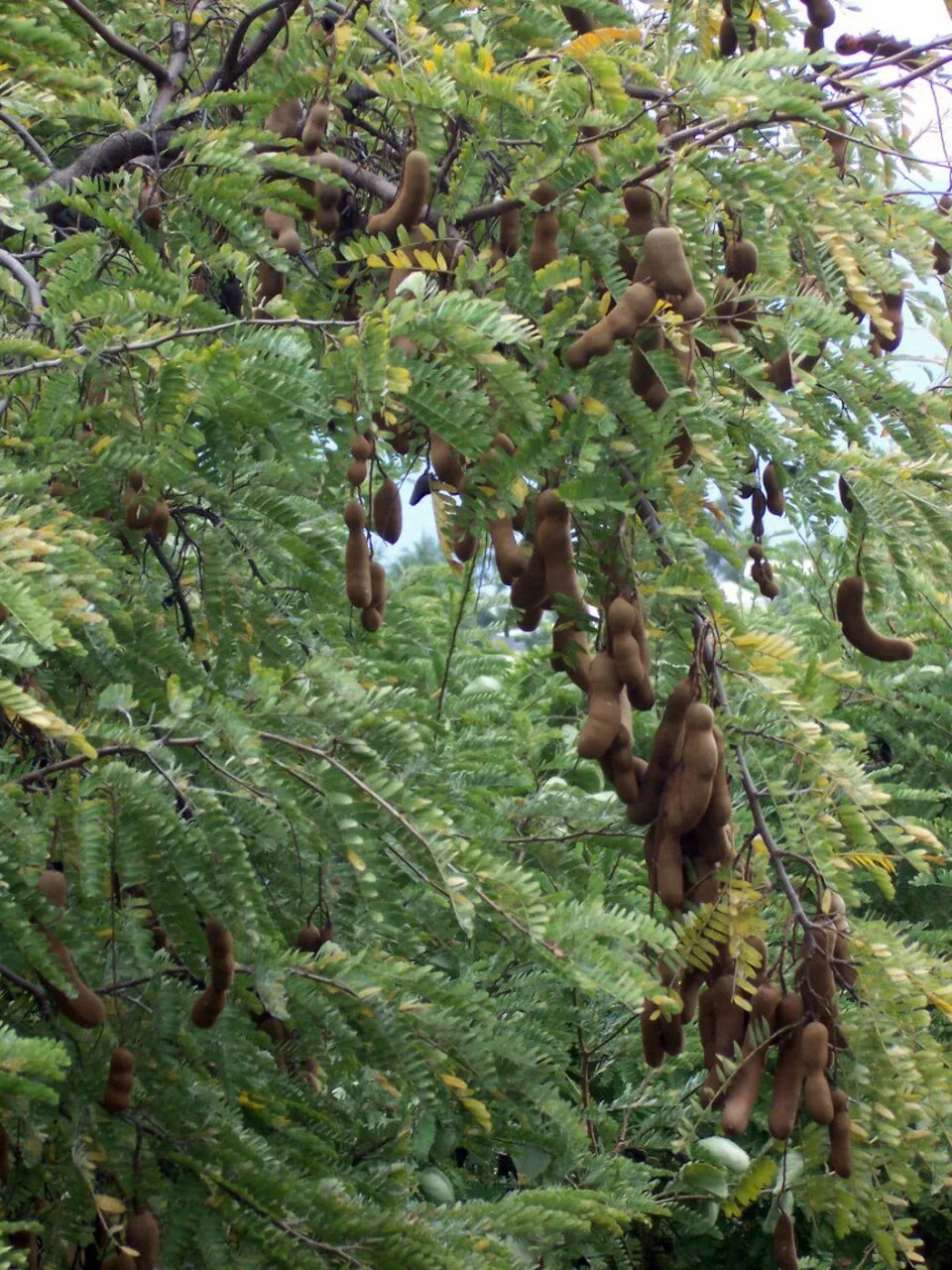
Tamarindus indica, universally known as tamarind, is a majestic, slow-growing, perennial tree belonging to the extensive Fabaceae family, also known as the legume family. Native to tropical Africa, its cultivation has spread across tropical and subtropical regions worldwide for centuries, valued primarily for its distinctive fruit. This large tree can reach impressive heights of up to 20 meters (66 feet), developing a broad, dense canopy that provides significant shade. Its pinnately compound leaves are composed of numerous small, oblong leaflets that exhibit nyctinastic movements, folding inward at night or during intense heat.
The flowers are relatively inconspicuous, appearing in racemes with yellowish-white petals delicately streaked with red. The tamarind's most recognizable feature is its fruit – a unique, elongated, flattened, and indehiscent pod, typically measuring 5-15 cm (2-6 inches) in length, encased in a hard, brittle, brown shell. Inside, a sticky, highly acidic, reddish-brown pulp encases several hardened, dark-brown seeds. This pulp is the cornerstone of tamarind's widespread culinary and medicinal applications.
Beyond its fruit, the tree yields hard, durable wood used in construction and furniture. Tamarind is remarkably resilient, thriving in full sun and well-drained soils, even tolerating poor soil conditions, and exhibiting excellent wind resistance, making it a valuable species in diverse ecological settings, including savannas and open woodlands.
Trusted Scientific References
1. Authoritative external sources for Tamarindus indica
1.1 Wikipedia — Tamarindus indica
1.2 Kew POWO (Plants of the World Online)
1.3 PubMed — peer-reviewed research
1.4 NCBI Taxonomy Browser
1.5 GBIF — Global Biodiversity
1.6Tamarind should be interpreted through verified botanical identity, practical care, and responsible safety language. This recovery note adds the missing context needed for a complete profile: match light to the plant's habit, use well-drained soil, water according to season, and avoid unsupported medicinal or edible claims. For publishing, the plant can be presented as a source-backed garden plant with clear care guidance, common problem diagnosis, and conservative safety wording.
1.1.Tamarind — Key Features
- ✓ <strong>Tropical Legume Tree</strong> — Member of the Fabaceae family, native to tropical Africa.
- ✓ <strong>Edible Fruit Pulp</strong> — Characterized by its sticky, acidic, and sweet-sour pulp.
- ✓ <strong>Rich in Organic Acids</strong> — High content of tartaric, citric, and malic acids.
- ✓ <strong>Excellent Source of Fiber</strong> — Aids in digestion and promotes bowel regularity.
- ✓ <strong>Potent Antioxidant</strong> — Abundant in polyphenols and Vitamin C.
- ✓ <strong>Versatile Culinary Ingredient</strong> — Used in drinks, sauces, chutneys, and desserts worldwide.
- ✓ <strong>Traditional Medicinal Plant</strong> — Valued for laxative, anti-inflammatory, and antimicrobial properties.
- ✓ <strong>Drought and Wind Tolerant</strong> — A resilient tree adaptable to various challenging environments.
- ✓ <strong>Long Shelf</strong> — Life — Dried tamarind fruit can be stored for extended periods.
- ✓ <strong>Dense Canopy</strong> — Provides significant shade, making it useful as an ornamental and street tree.
1.2.Tamarind — Quick Summary
- ✓ Tamarindus indica is a tropical tree native to Africa, widely cultivated for its versatile, acidic-sweet fruit pulp.
- ✓ Rich in organic acids, dietary fiber, vitamins, minerals, and potent antioxidants.
- ✓ Traditionally used as a natural laxative, digestive aid, and for its anti-inflammatory and antimicrobial properties.
- ✓ A culinary staple globally, enhancing flavor in drinks, sauces, and desserts.
- ✓ Generally safe for food consumption, but medicinal use requires caution due to potential side effects and drug interactions.
- ✓ Thrives in warm climates, tolerating drought and poor soils, making it a resilient and valuable plant.
2.Tamarind — Scientific Identity
3.Tamarind — Quick Facts
4.Tamarind — Appearance & Identification
5.Tamarind — Native Habitat
6.Tamarind — Water Requirements
- ✓ Site Selection — Plant in full sun exposure, as Tamarindus indica requires ample light for optimal growth and fruit production.
- ✓ Soil Requirements — Thrives in well-drained soils; it is highly adaptable to poor soils but intolerant of waterlogged conditions, so ensure good drainage.
- ✓ Watering — Young trees require regular watering; mature trees are drought-tolerant but benefit from irrigation during prolonged dry spells.
- ✓ Fertilization — Apply a balanced fruit tree formulation like 8-3-9 three times a year (e.g., March, July, September) to support vigorous growth and fruiting.
- ✓ Pruning — Prune young trees to establish three to five strong, well-spaced scaffold branches, forming the main structure; prune mature trees to remove dead or diseased wood and maintain shape.
- ✓ Propagation — Can be grown from seed, though quality is unknown; for specific varieties, purchase grafted or air-layered trees from reputable nurseries for consistent fruit quality.
- ✓ Wind Resistance — Its strong twigs and branches make it an excellent choice for breezy locations and areas prone to tropical storms.
- ✓ Harvesting — Fruit can be harvested by shaking branches when fully ripe and dry; hand-picking is necessary if rains have begun to sort ripe from unripe and remove decayed fruit.
Reviewed by the Flora Medical Global Botanical Review Panel
Multi-disciplinary editorial group · Botany · Ethnobotany · Herbal-medicine literature
Who reviewed this: This page was checked by the Flora Medical Global Botanical Review Panel — an in-house editorial group of botany graduates, ethnobotany researchers, and horticulture practitioners who collectively maintain our 7,000+ plant encyclopedia. Meet the team.
Our 4-step verification process
1. Taxonomic verification
Scientific names and synonyms cross-checked against Kew POWO, World Flora Online, and The Plant List.
2. Phytochemical & medicinal cross-reference
Active compounds, traditional uses, and reported activities are cross-referenced with PubMed, USDA Dr. Duke's database, and peer-reviewed ethnobotanical literature.
3. Conservation & distribution check
Distribution, ecology, and conservation status confirmed against GBIF occurrence records and the IUCN Red List.
4. Editorial & safety review
Every entry passes an editorial pass for clarity, originality, and safety notices (toxicity, contraindications, dosage caveats) before publication.
Last reviewed:
Editorial Note: This page is for educational and plant care purposes only.
Written by: Flora Medical Global Editorial Team
Reviewed by: Flora Medical Global Botanical Review Panel
Last Updated: June 16, 2026







Tamarind — Comments & Community Reviews
Rate this plant