


Care Disclaimer: Plant care recommendations are general guidelines based on common growing conditions. Individual results may vary based on your local environment, climate, and care routine. If your plant is toxic, keep it away from children and pets, and consult a veterinarian if accidental ingestion occurs.
1.Tuberose — Overview
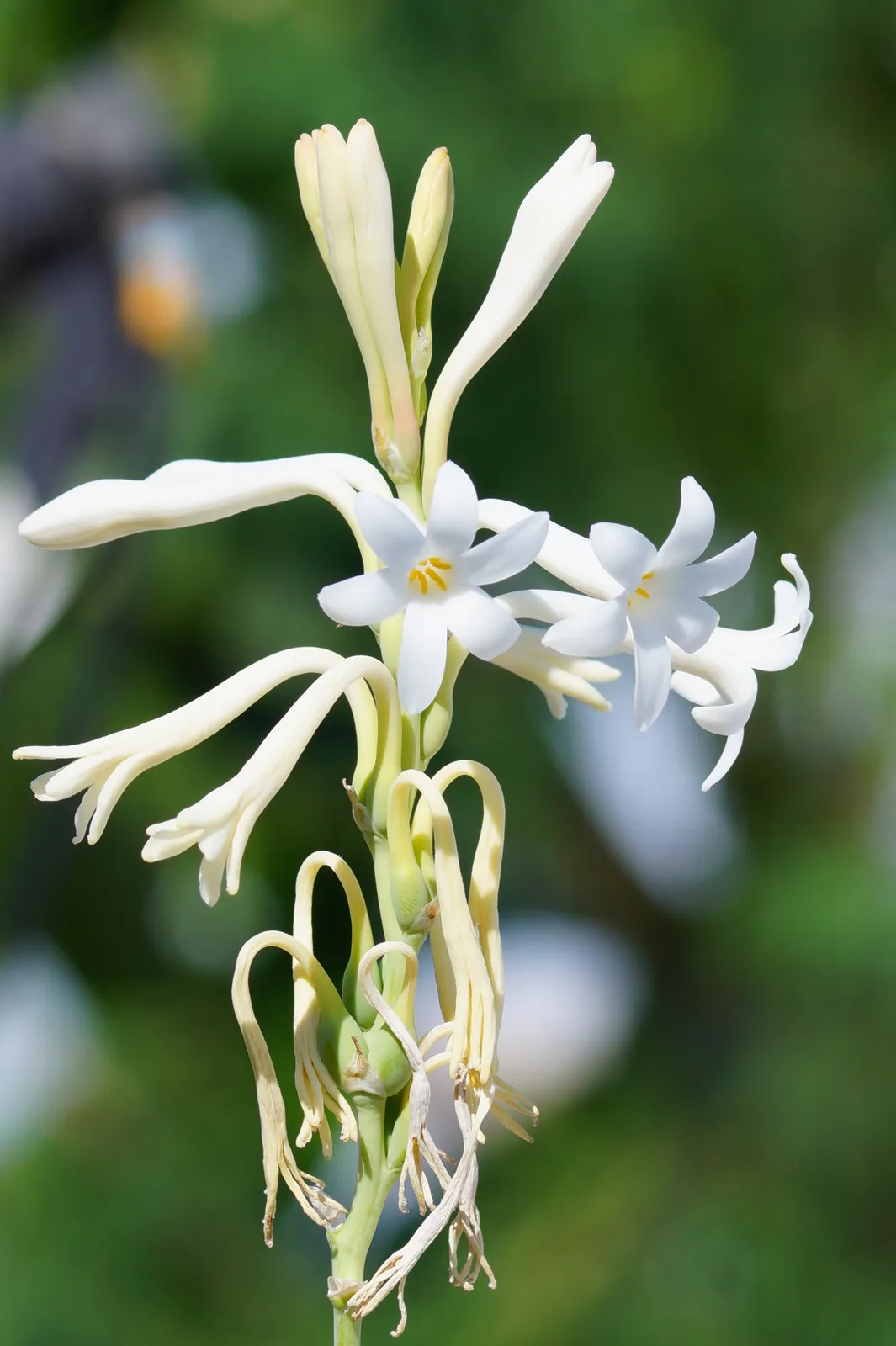
The Tuberose, scientifically designated as Polianthes tuberosa, is a strikingly beautiful and intensely fragrant perennial flowering plant originating from Mexico. This captivating species, a member of the Asparagaceae family and closely related to Agave, is celebrated globally for its intoxicatingly sweet, creamy aroma. Morphologically, Polianthes tuberosa emerges from a tuberous rootstock, producing a basal rosette of narrow, grass-like leaves up to 18 inches long.
From this base, tall, slender, unbranched stems ascend, typically reaching 24-36 inches in height, adorned with waxy, pure white, star-shaped flowers. These exquisite blooms are arranged in a vertical spike, opening sequentially from late summer into early autumn, ensuring an extended period of fragrance. Its most potent scent emanates during the night, a characteristic that has earned it evocative names such as 'Mistress of the Night' or 'Night Queen' in various cultures.
Historically cultivated by the Aztecs, Tuberose was later introduced to Europe and Asia, where its ornamental value, use as a cut flower, and its precious essential oil quickly became highly prized. The plant’s elegant appearance and powerful, complex scent make it a unique and sought-after ingredient in high-end perfumery and a staple in ceremonial traditions, embodying both profound beauty and mystique across diverse geographical and cultural landscapes.
Trusted Scientific References
1. Authoritative external sources for Polianthes tuberosa
1.1 Wikipedia — Polianthes tuberosa
1.2 Kew POWO (Plants of the World Online)
1.3 PubMed — peer-reviewed research
1.4 NCBI Taxonomy Browser
1.5 GBIF — Global Biodiversity
1.6Tuberose should be interpreted through verified botanical identity, practical care, and responsible safety language. This recovery note adds the missing context needed for a complete profile: match light to the plant's habit, use well-drained soil, water according to season, and avoid unsupported medicinal or edible claims. For publishing, the plant can be presented as a source-backed garden plant with clear care guidance, common problem diagnosis, and conservative safety wording.
1.1.Tuberose — Key Features
- ✓ <strong>Intensely sweet, intoxicating night</strong> — blooming fragrance.
- ✓ <strong>Tall, elegant flower spikes with waxy, white, star</strong> — shaped blooms.
- ✓ <strong>Native to Mexico,</strong> — Native to Mexico, thriving in warm, sunny climates.
- ✓ <strong>Perennial plant growing</strong> — Perennial plant growing from a tuberous rootstock.
- ✓ <strong>Highly prized and</strong> — Highly prized and costly ingredient in luxury perfumes and cosmetics.
- ✓ <strong>Valued in aromatherapy</strong> — Valued in aromatherapy for its calming, uplifting, and sensuous properties.
- ✓ <strong>Often called 'Mistress</strong> — Often called 'Mistress of the Night' due to its nocturnal fragrance.
- ✓ <strong>Moderately deer resistant</strong> — Moderately deer resistant due to its aromatic nature.
- ✓ <strong>Excellent and long</strong> — lasting as a cut flower for arrangements.
- ✓ <strong>Member of the</strong> — Member of the Asparagaceae family, related to Agave species.
1.2.Tuberose — Quick Summary
- ✓ Polianthes tuberosa is a highly fragrant perennial native to Mexico.
- ✓ Renowned for its intensely sweet, night-blooming aroma, prized in perfumery.
- ✓ Tuberose essential oil is valued in aromatherapy for calming and uplifting effects.
- ✓ Requires full sun, well-drained soil, and consistent moisture during growth.
- ✓ Essential oil must always be diluted for topical use and is not for internal consumption.
- ✓ Traditional uses include emotional support, relaxation, and ceremonial applications.
2.Tuberose — Scientific Identity
3.Tuberose — Quick Facts
4.Tuberose — Appearance & Identification
5.Tuberose — Native Habitat
6.Tuberose — Water Requirements
- ✓ Light — Tuberose thrives in full sun, requiring at least 6-8 hours of direct sunlight daily for optimal growth and prolific flowering.
- ✓ Soil — It prefers well-draining, sandy or loamy soil with a neutral pH (6.5-7.0), enriched with ample organic matter to enhance fertility and drainage.
- ✓ Watering — Keep the soil consistently moist but never waterlogged during the active growing season; reduce watering significantly once foliage begins to yellow in late autumn.
- ✓ Temperature and Humidity — Ideal temperatures range from 65-85°F (18-29°C); it prefers moderate humidity but requires good air circulation to prevent fungal issues.
- ✓ Fertilization — Apply a balanced, slow-release granular fertilizer every 4-6 weeks throughout the growing season, avoiding excessive nitrogen which can promote foliage over flowers.
- ✓ Pruning — Deadhead spent flower spikes to encourage the plant to put energy into developing new blooms or offsets, and trim yellowing leaves at the end of the season.
- ✓ Overwintering — In USDA Hardiness Zones 6 and colder, Tuberose bulbs must be lifted from the ground before the first frost, dried, and stored in a cool, dark, dry place over winter.
- ✓ Propagation — Tuberose is primarily propagated by dividing the tuberous rootstock (bulbs or offsets) in spring before new growth begins, ensuring each section has at least one 'eye' or growth point.
Reviewed by the Flora Medical Global Botanical Review Panel
Multi-disciplinary editorial group · Botany · Ethnobotany · Herbal-medicine literature
Who reviewed this: This page was checked by the Flora Medical Global Botanical Review Panel — an in-house editorial group of botany graduates, ethnobotany researchers, and horticulture practitioners who collectively maintain our 7,000+ plant encyclopedia. Meet the team.
Our 4-step verification process
1. Taxonomic verification
Scientific names and synonyms cross-checked against Kew POWO, World Flora Online, and The Plant List.
2. Phytochemical & medicinal cross-reference
Active compounds, traditional uses, and reported activities are cross-referenced with PubMed, USDA Dr. Duke's database, and peer-reviewed ethnobotanical literature.
3. Conservation & distribution check
Distribution, ecology, and conservation status confirmed against GBIF occurrence records and the IUCN Red List.
4. Editorial & safety review
Every entry passes an editorial pass for clarity, originality, and safety notices (toxicity, contraindications, dosage caveats) before publication.
Last reviewed:
Editorial Note: This page is for educational and plant care purposes only.
Written by: Flora Medical Global Editorial Team
Reviewed by: Flora Medical Global Botanical Review Panel
Last Updated: June 16, 2026







Tuberose — Comments & Community Reviews
Rate this plant