
Care Disclaimer: Plant care recommendations are general guidelines based on common growing conditions. Individual results may vary based on your local environment, climate, and care routine. If your plant is toxic, keep it away from children and pets, and consult a veterinarian if accidental ingestion occurs.
1.Typha Latifolia — Overview
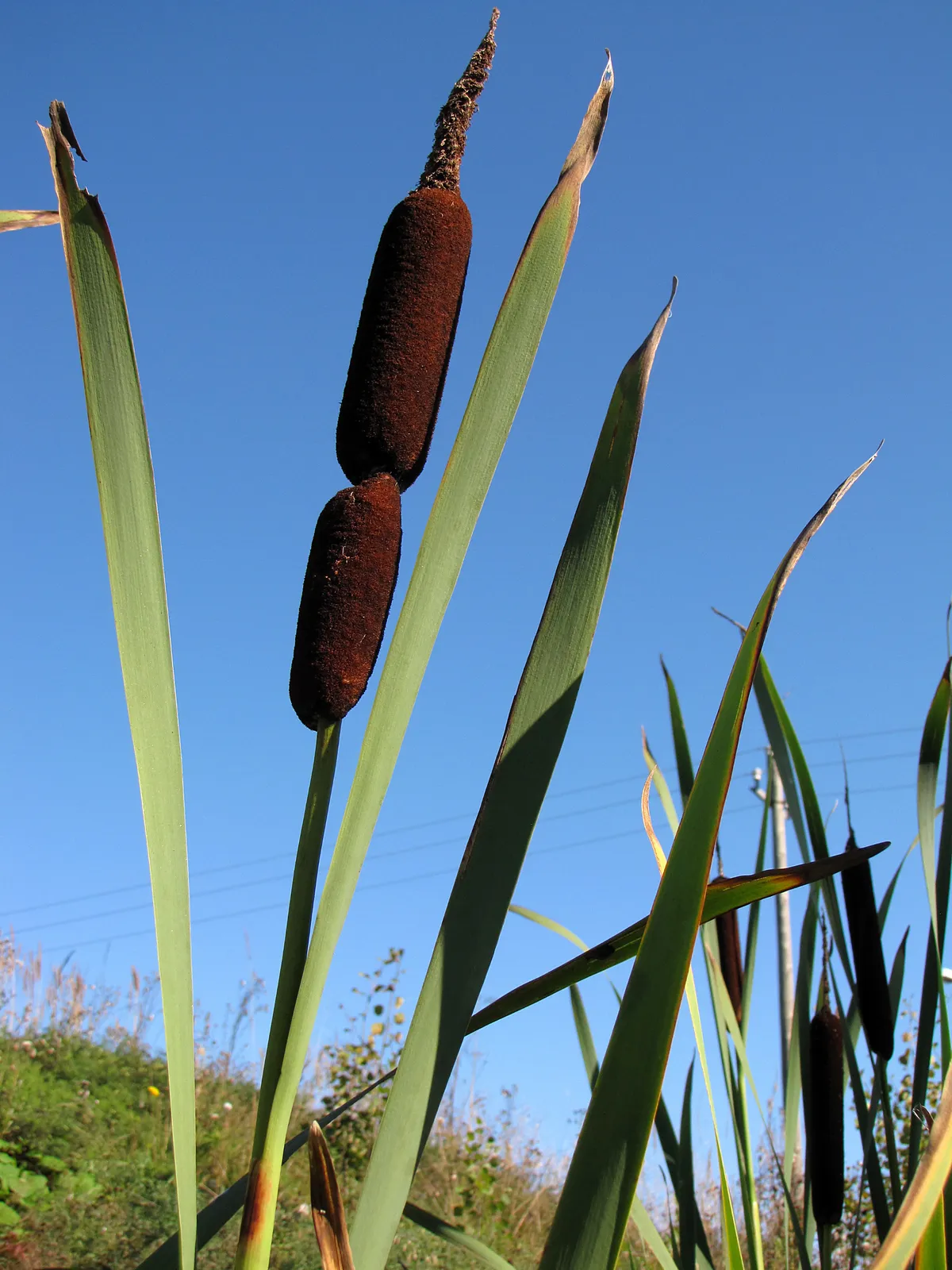
Typha latifolia, commonly known as broadleaf cattail or common cattail, is a ubiquitous herbaceous perennial aquatic plant thriving in temperate and subtropical regions across North America, Europe, and Asia. A member of the Typhaceae family, it is characterized by its robust, unbranched stems that typically reach heights of 1 to 3 meters, sometimes extending up to 10 feet under optimal conditions. The plant's long, linear, and flat leaves, measuring 2 to 4 cm wide, sheath the stem at their base, presenting a distinctive upright growth habit.
Its most iconic feature is the cylindrical flower spike, which is clearly segregated into two parts: a lower, dense, dark brown female inflorescence (the 'cattail' proper) and an upper, narrower, yellowish-brown male inflorescence, often separated by a short gap. The female spike, composed of thousands of minute flowers, matures into a velvety structure up to 40 cm long, eventually dispersing a cottony mass of seeds in autumn. Beneath the water or moist soil, Typha latifolia possesses an aggressive rhizomatous root system, which not only facilitates rapid vegetative propagation but also plays a vital role in ecosystem engineering by stabilizing wetland soils and creating crucial habitats for various wildlife.
This vigorous growth pattern, while ecologically beneficial, necessitates careful management in cultivated settings to prevent invasive spread.
Trusted Scientific References
1. Authoritative external sources for Typha latifolia
1.1 Wikipedia — Typha latifolia
1.2 Kew POWO (Plants of the World Online)
1.3 PubMed — peer-reviewed research
1.4 NCBI Taxonomy Browser
1.5 GBIF — Global Biodiversity
1.6Typha Latifolia should be interpreted through verified botanical identity, practical care, and responsible safety language. This recovery note adds the missing context needed for a complete profile: match light to the plant's habit, use well-drained soil, water according to season, and avoid unsupported medicinal or edible claims. For publishing, the plant can be presented as a source-backed garden plant with clear care guidance, common problem diagnosis, and conservative safety wording.
1.1.Typha Latifolia — Key Features
- ✓ <strong>Distinctive cylindrical flower</strong> — Distinctive cylindrical flower spike divided into male and female parts.
- ✓ <strong>Robust rhizomatous root</strong> — Robust rhizomatous root system enabling rapid spread and soil stabilization.
- ✓ <strong>Tall, stiff, unbranched stems reaching 1</strong> — 3 meters in height.
- ✓ <strong>Long, linear, flat</strong> — Long, linear, flat leaves sheathing the stem at their base.
- ✓ <strong>Found globally in</strong> — Found globally in temperate and subtropical wetlands, marshes, and pond margins.
- ✓ <strong>Pollen (Pu Huang)</strong> — Pollen (Pu Huang) recognized for its potent hemostatic action.
- ✓ <strong>Edible plant parts</strong> — Edible plant parts including young shoots, rhizomes, and pollen.
- ✓ <strong>Significant ecological role</strong> — Significant ecological role in wetland habitats, providing food and shelter for wildlife.
- ✓ <strong>Contains a rich</strong> — Contains a rich array of flavonoids, phenolic acids, and polysaccharides.
- ✓ <strong>Exhibits strong antioxidant, anti</strong> — inflammatory, and diuretic medicinal properties.
1.2.Typha Latifolia — Quick Summary
- ✓ Widespread aquatic perennial known as broadleaf cattail or bulrush.
- ✓ Pollen (Pu Huang) traditionally used for hemostasis in TCM.
- ✓ Exhibits anti-inflammatory, antioxidant, and diuretic properties.
- ✓ Rhizomes and young shoots are edible and nutritious.
- ✓ Requires careful management due to aggressive rhizomatous spread.
- ✓ Caution advised for pregnant individuals, children, and those on anticoagulants.
2.Typha Latifolia — Scientific Identity
3.Typha Latifolia — Quick Facts
4.Typha Latifolia — Appearance & Identification
5.Typha Latifolia — Native Habitat
6.Typha Latifolia — Water Requirements
- ✓ Light Requirements — Typha latifolia thrives in full sun to partial shade, requiring ample light exposure to achieve optimal growth and stem height.
- ✓ Soil Preferences — It prefers rich, loamy soil with a high organic matter content, though it can adapt to most soil types, provided they are consistently wet.
- ✓ Water Conditions — As an aquatic plant, cattail necessitates abundant moisture, ideally in boggy environments or standing water up to 12 inches deep, making it suitable for pond margins or wetlands.
- ✓ Containment for Control — Due to its aggressive rhizomatous spread, planting in bottomless containers or similar barriers is crucial to prevent it from overtaking desired areas.
- ✓ Minimal Fertilization — Fertilization is generally not required; if necessary, a balanced water garden fertilizer can be applied sparingly in spring.
- ✓ Pruning Practices — Prune back stems in the fall, cutting them about 8 inches above the water surface or to the ground in non-submerged areas, to encourage new growth in spring.
- ✓ Propagation — Easily propagated by dividing rhizomes in spring or by sowing seeds on the surface of consistently moist to soggy soil, requiring warmth for germination.
- ✓ Invasive Species Warning — Be aware that common cattail can be considered invasive in some areas, forming dense stands that can impede waterways and outcompete native vegetation, thus control is vital.
Reviewed by the Flora Medical Global Botanical Review Panel
Multi-disciplinary editorial group · Botany · Ethnobotany · Herbal-medicine literature
Who reviewed this: This page was checked by the Flora Medical Global Botanical Review Panel — an in-house editorial group of botany graduates, ethnobotany researchers, and horticulture practitioners who collectively maintain our 7,000+ plant encyclopedia. Meet the team.
Our 4-step verification process
1. Taxonomic verification
Scientific names and synonyms cross-checked against Kew POWO, World Flora Online, and The Plant List.
2. Phytochemical & medicinal cross-reference
Active compounds, traditional uses, and reported activities are cross-referenced with PubMed, USDA Dr. Duke's database, and peer-reviewed ethnobotanical literature.
3. Conservation & distribution check
Distribution, ecology, and conservation status confirmed against GBIF occurrence records and the IUCN Red List.
4. Editorial & safety review
Every entry passes an editorial pass for clarity, originality, and safety notices (toxicity, contraindications, dosage caveats) before publication.
Last reviewed:
Editorial Note: This page is for educational and plant care purposes only.
Written by: Flora Medical Global Editorial Team
Reviewed by: Flora Medical Global Botanical Review Panel
Last Updated: June 16, 2026







Typha Latifolia — Comments & Community Reviews
Rate this plant