
Care Disclaimer: Plant care recommendations are general guidelines based on common growing conditions. Individual results may vary based on your local environment, climate, and care routine. If your plant is toxic, keep it away from children and pets, and consult a veterinarian if accidental ingestion occurs.
1.Winter Jasmine — Overview
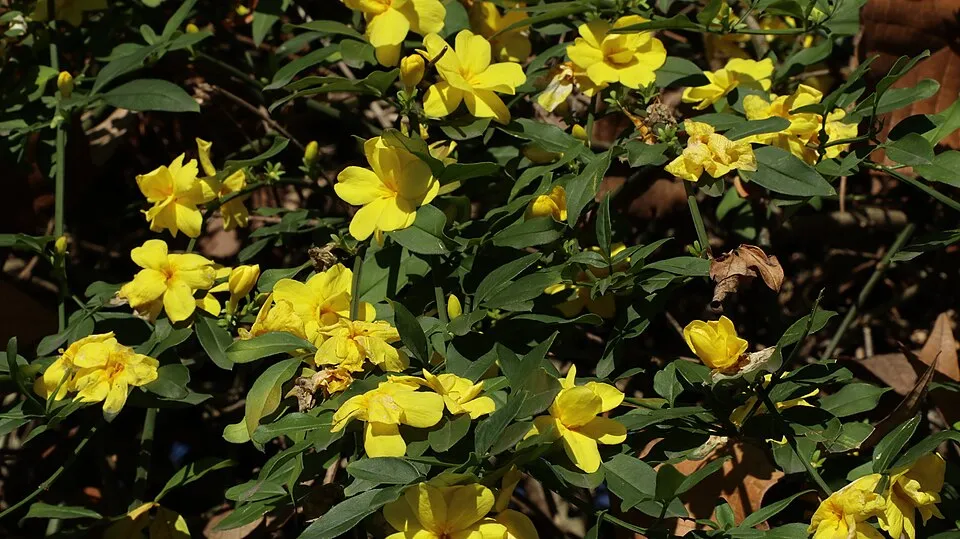
Jasminum nudiflorum, commonly known as Winter Jasmine, is a captivating deciduous shrub belonging to the Oleaceae family, renowned for its distinctive winter-blooming flowers. Indigenous to the mountainous regions of central and western China, particularly in provinces such as Gansu, Shaanxi, Sichuan, and Yunnan, it naturally flourishes on rocky slopes, within thickets, and along stream banks. This remarkably resilient plant typically achieves a height of 1 to 2 meters, often spreading wider than its vertical growth, characterized by its slender, arching, and strikingly bright green stems that maintain their verdant hue even throughout the winter months, contributing to its elegant, cascading habit. Its leaves are oppositely arranged and trifoliate, meaning they are composed of three (occasionally five) small, ovate to elliptic leaflets.
These present a dark green, glossy surface, offering an attractive backdrop during its active growing season. The most celebrated attribute of Winter Jasmine is its abundant display of bright yellow, funnel-shaped flowers, typically measuring 2-3 cm in diameter. These cheerful blooms emerge in late winter to early spring, often preceding the development of new foliage, adorning the otherwise bare branches with a vibrant splash of color, frequently appearing even through light snowfall. While not possessing the intense fragrance characteristic of some other jasmine species, its flowers emit a delicate, subtle aroma.
Globally, Jasminum nudiflorum is extensively cultivated as an ornamental plant owing to its exceptional hardiness, its capacity for early flowering, and its adaptability to various well-drained soil types, thriving best in locations ranging from full sun to partial shade. Its botanical classification places it within the genus Jasminum, a diverse group recognized for both its ornamental appeal and its established medicinal properties.
Trusted Scientific References
1. Authoritative external sources for Jasminum nudiflorum
1.1 Wikipedia — Jasminum nudiflorum
1.2 Kew POWO (Plants of the World Online)
1.3 PubMed — peer-reviewed research
1.4 NCBI Taxonomy Browser
1.5 GBIF — Global Biodiversity
1.1.Winter Jasmine — Key Features
- ✓ <strong>Winter Blooming</strong> — Known for vibrant yellow flowers appearing in late winter.
- ✓ <strong>Deciduous Shrub</strong> — Loses leaves in fall but stems remain green.
- ✓ <strong>Arching Stems</strong> — Slender, graceful green stems with a cascading habit.
- ✓ <strong>Trifoliate Leaves</strong> — Leaves composed of three small leaflets.
- ✓ <strong>High Hardiness</strong> — Tolerates cold temperatures and various growing conditions.
- ✓ <strong>Ornamental Value</strong> — Widely cultivated for its aesthetic appeal.
- ✓ <strong>Medicinal Properties</strong> — Used traditionally for anti-inflammatory, antioxidant, and antimicrobial effects.
- ✓ <strong>Native to China</strong> — Originates from mountainous regions of central and western China.
- ✓ <strong>Low Fragrance</strong> — Flowers have a delicate, subtle scent rather than strong perfume.
- ✓ <strong>Adaptable</strong> — Thrives in well-drained soils and sun to partial shade.
1.2.Winter Jasmine — Quick Summary
- ✓ Winter Jasmine is a hardy, winter-blooming ornamental shrub with traditional medicinal uses.
- ✓ Rich in flavonoids and iridoids, offering antioxidant, anti-inflammatory, and antimicrobial benefits.
- ✓ Historically used for respiratory issues, pain relief, and immune support.
- ✓ Cultivated for its early yellow flowers, adaptable to various climates.
- ✓ Requires well-drained soil and minimal maintenance, thriving in sun to partial shade.
- ✓ Caution advised for internal use, especially during pregnancy and with existing medications.
2.Winter Jasmine — Scientific Identity
3.Winter Jasmine — Quick Facts
4.Winter Jasmine — Appearance & Identification
5.Winter Jasmine — Native Habitat
6.Winter Jasmine — Water Requirements
- ✓ Site Selection — Choose a location with full sun to partial shade for optimal flowering and growth.
- ✓ Soil Requirements — Prefers well-drained loamy or sandy soil; tolerates a range of soil types but avoids waterlogging.
- ✓ Planting — Plant in spring or fall, ensuring the root ball is at soil level and spaced adequately for spreading.
- ✓ Watering — Water regularly during dry periods, especially in the first growing season, but is drought-tolerant once established.
- ✓ Fertilization — Generally low-maintenance; a balanced slow-release fertilizer in early spring can promote vigor.
- ✓ Pruning — Prune after flowering to maintain shape, remove dead or damaged branches, and encourage new growth.
- ✓ Propagation — Easily propagated by semi-hardwood cuttings taken in summer or by layering.
- ✓ Pest and Disease Control — Relatively pest and disease-free; monitor for common issues like powdery mildew or aphids.
Reviewed by the Flora Medical Global Botanical Review Panel
Multi-disciplinary editorial group · Botany · Ethnobotany · Herbal-medicine literature
Who reviewed this: This page was checked by the Flora Medical Global Botanical Review Panel — an in-house editorial group of botany graduates, ethnobotany researchers, and horticulture practitioners who collectively maintain our 7,000+ plant encyclopedia. Meet the team.
Our 4-step verification process
1. Taxonomic verification
Scientific names and synonyms cross-checked against Kew POWO, World Flora Online, and The Plant List.
2. Phytochemical & medicinal cross-reference
Active compounds, traditional uses, and reported activities are cross-referenced with PubMed, USDA Dr. Duke's database, and peer-reviewed ethnobotanical literature.
3. Conservation & distribution check
Distribution, ecology, and conservation status confirmed against GBIF occurrence records and the IUCN Red List.
4. Editorial & safety review
Every entry passes an editorial pass for clarity, originality, and safety notices (toxicity, contraindications, dosage caveats) before publication.
Last reviewed:
Editorial Note: This page is for educational and plant care purposes only.
Written by: Flora Medical Global Editorial Team
Reviewed by: Flora Medical Global Botanical Review Panel
Last Updated: June 16, 2026







Winter Jasmine — Comments & Community Reviews
Rate this plant