
Care Disclaimer: Plant care recommendations are general guidelines based on common growing conditions. Individual results may vary based on your local environment, climate, and care routine. If your plant is toxic, keep it away from children and pets, and consult a veterinarian if accidental ingestion occurs.
1.Acer Circinatum — Overview
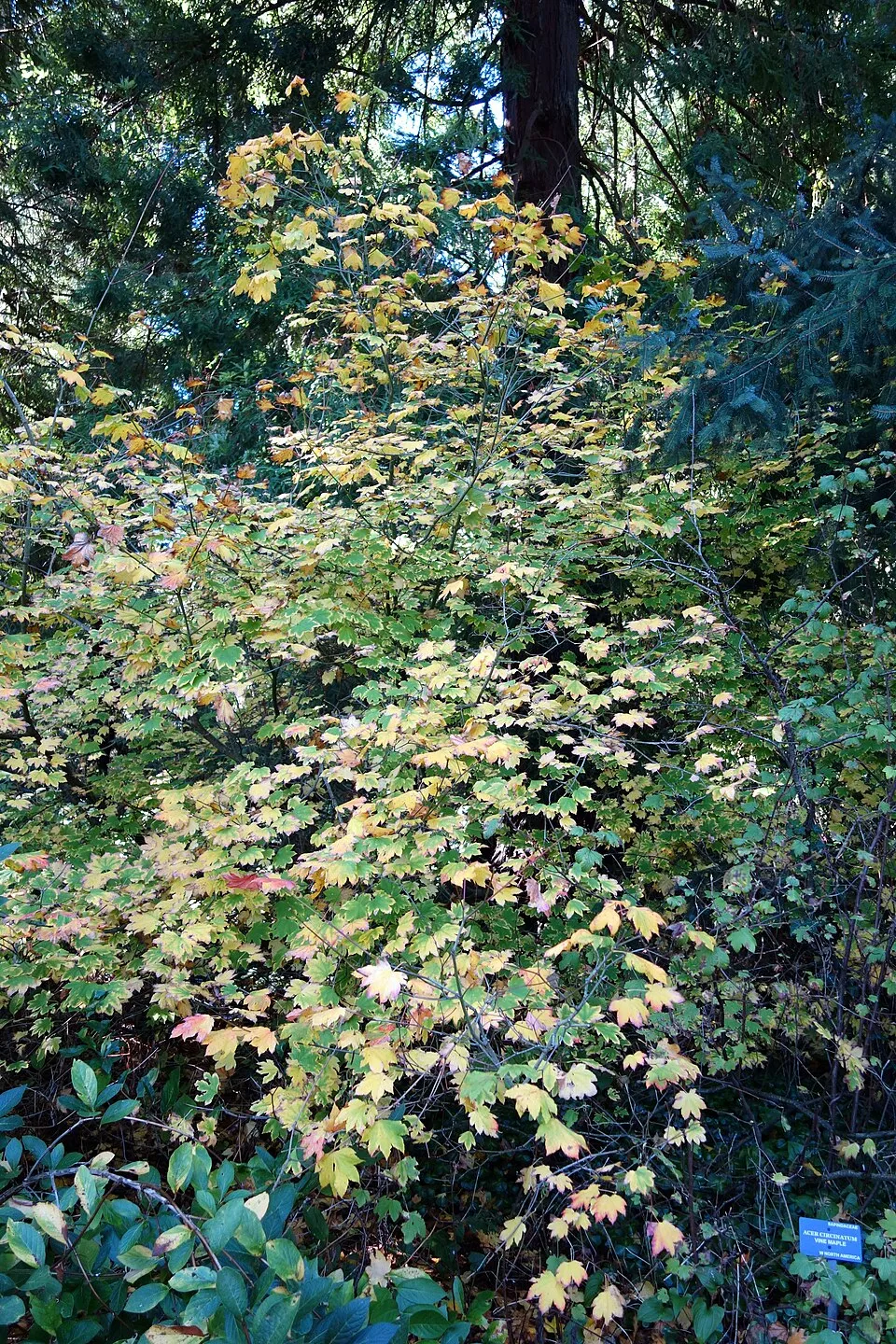
Acer circinatum, commonly known as Vine Maple, is a captivating deciduous shrub or small tree native to the Pacific Northwest region of North America. It belongs to the family Sapindaceae, within the genus Acer. This species is characterized by its distinctive growth habit, often appearing as a multi-stemmed shrub with slender, vine-like branches that can root where they touch the ground, or occasionally growing as a small tree up to 20 feet tall.
Its most striking feature is its leaves, which are opposite, palmately lobed with 7 to 11 lobes, and nearly circular in outline, hence the 'circinatum' epithet. These leaves transform into brilliant shades of orange, red, and yellow in autumn, making it a highly prized ornamental plant. Small, reddish-purple flowers emerge in spring, followed by winged fruits called samaras, typical of maples.
Vine Maple thrives in the understory of coniferous forests, particularly in moist, well-drained soils along stream banks, canyon bottoms, and on shaded slopes. Its natural distribution extends from southwestern British Columbia through Washington and Oregon, reaching northern California, predominantly on the western side of the Cascade Mountains. It is a common component of diverse ecosystems, including Douglas-fir, Western Hemlock, and Sitka Spruce forests.
Ecologically, it plays a vital role in providing cover and forage for various wildlife species, including black-tailed deer and elk, particularly during summer months. Despite its common name suggesting a vine, it is a true woody plant, contributing significantly to the biodiversity and aesthetic appeal of its native habitats.
Trusted Scientific References
1. Authoritative external sources for Acer circinatum
1.1 Wikipedia — Acer circinatum
1.2 Kew POWO (Plants of the World Online)
1.3 PubMed — peer-reviewed research
1.4 NCBI Taxonomy Browser
1.5 GBIF — Global Biodiversity
1.6Acer Circinatum should be interpreted through verified botanical identity, practical care, and responsible safety language. This recovery note adds the missing context needed for a complete profile: match light to the plant's habit, use well-drained soil, water according to season, and avoid unsupported medicinal or edible claims. For publishing, the plant can be presented as a source-backed garden plant with clear care guidance, common problem diagnosis, and conservative safety wording.
1.1.Acer Circinatum — Key Features
- ✓ <strong>Native to the</strong> — Native to the Pacific Northwest region of North America.
- ✓ <strong>Distinctive circular, palmately</strong> — Distinctive circular, palmately lobed leaves with vibrant autumn colors.
- ✓ <strong>Grows as a multi</strong> — stemmed shrub or small, sprawling tree.
- ✓ <strong>Traditionally used topically for its anti</strong> — inflammatory effects.
- ✓ <strong>Rich source of</strong> — Rich source of natural antioxidants, including flavonoids.
- ✓ <strong>Provides essential forage</strong> — Provides essential forage and cover for local wildlife.
- ✓ <strong>Adaptable to various</strong> — Adaptable to various light conditions, from full sun to deep shade.
- ✓ <strong>Known for its</strong> — Known for its vigorous resprouting ability after disturbance.
- ✓ <strong>Valued as an</strong> — Valued as an ornamental plant in temperate landscapes.
- ✓ <strong>Contributes to forest</strong> — Contributes to forest understory biodiversity.
1.2.Acer Circinatum — Quick Summary
- ✓ Vine Maple (Acer circinatum) is a vibrant Pacific Northwest native shrub.
- ✓ Traditionally valued for its anti-inflammatory and antioxidant properties.
- ✓ Rich in beneficial compounds like flavonoids and phenolic acids.
- ✓ Supports minor wound healing, digestive comfort, and immune function.
- ✓ Requires moist, well-drained soil and tolerates partial shade.
- ✓ Always consult a healthcare professional before using for medicinal purposes.
2.Acer Circinatum — Scientific Identity
3.Acer Circinatum — Quick Facts
4.Acer Circinatum — Appearance & Identification
5.Acer Circinatum — Native Habitat
6.Acer Circinatum — Water Requirements
- ✓ Site Selection — Choose a location with partial shade to full sun, ensuring some protection from intense afternoon sun, especially in warmer climates.
- ✓ Soil Requirements — Plant in rich, well-drained, loamy soil that is slightly acidic to neutral, ideally amended with generous amounts of organic matter.
- ✓ Watering Regimen — Maintain consistent soil moisture, particularly during dry spells and in the plant's establishment phase; avoid waterlogging.
- ✓ Fertilization — Apply a balanced, slow-release granular fertilizer in early spring, or top-dress with compost to provide essential nutrients.
- ✓ Pruning — Prune after flowering or during the dormant season to shape the plant, remove dead or crossing branches, and encourage a bushy habit.
- ✓ Propagation — Can be propagated from seeds (requiring cold stratification), softwood cuttings in early summer, or by layering for best results.
- ✓ Pest and Disease Management — Generally robust, but monitor for common garden pests like aphids and slugs; ensure good air circulation to prevent fungal issues.
- ✓ Winter Protection — In colder zones, apply a layer of mulch around the base of the plant to protect the root system from freezing temperatures.
Reviewed by the Flora Medical Global Botanical Review Panel
Multi-disciplinary editorial group · Botany · Ethnobotany · Herbal-medicine literature
Who reviewed this: This page was checked by the Flora Medical Global Botanical Review Panel — an in-house editorial group of botany graduates, ethnobotany researchers, and horticulture practitioners who collectively maintain our 7,000+ plant encyclopedia. Meet the team.
Our 4-step verification process
1. Taxonomic verification
Scientific names and synonyms cross-checked against Kew POWO, World Flora Online, and The Plant List.
2. Phytochemical & medicinal cross-reference
Active compounds, traditional uses, and reported activities are cross-referenced with PubMed, USDA Dr. Duke's database, and peer-reviewed ethnobotanical literature.
3. Conservation & distribution check
Distribution, ecology, and conservation status confirmed against GBIF occurrence records and the IUCN Red List.
4. Editorial & safety review
Every entry passes an editorial pass for clarity, originality, and safety notices (toxicity, contraindications, dosage caveats) before publication.
Last reviewed:
Editorial Note: This page is for educational and plant care purposes only.
Written by: Flora Medical Global Editorial Team
Reviewed by: Flora Medical Global Botanical Review Panel
Last Updated: June 15, 2026







Acer Circinatum — Comments & Community Reviews
Rate this plant