

Care Disclaimer: Plant care recommendations are general guidelines based on common growing conditions. Individual results may vary based on your local environment, climate, and care routine. If your plant is toxic, keep it away from children and pets, and consult a veterinarian if accidental ingestion occurs.
1.Acer Saccharum — Overview
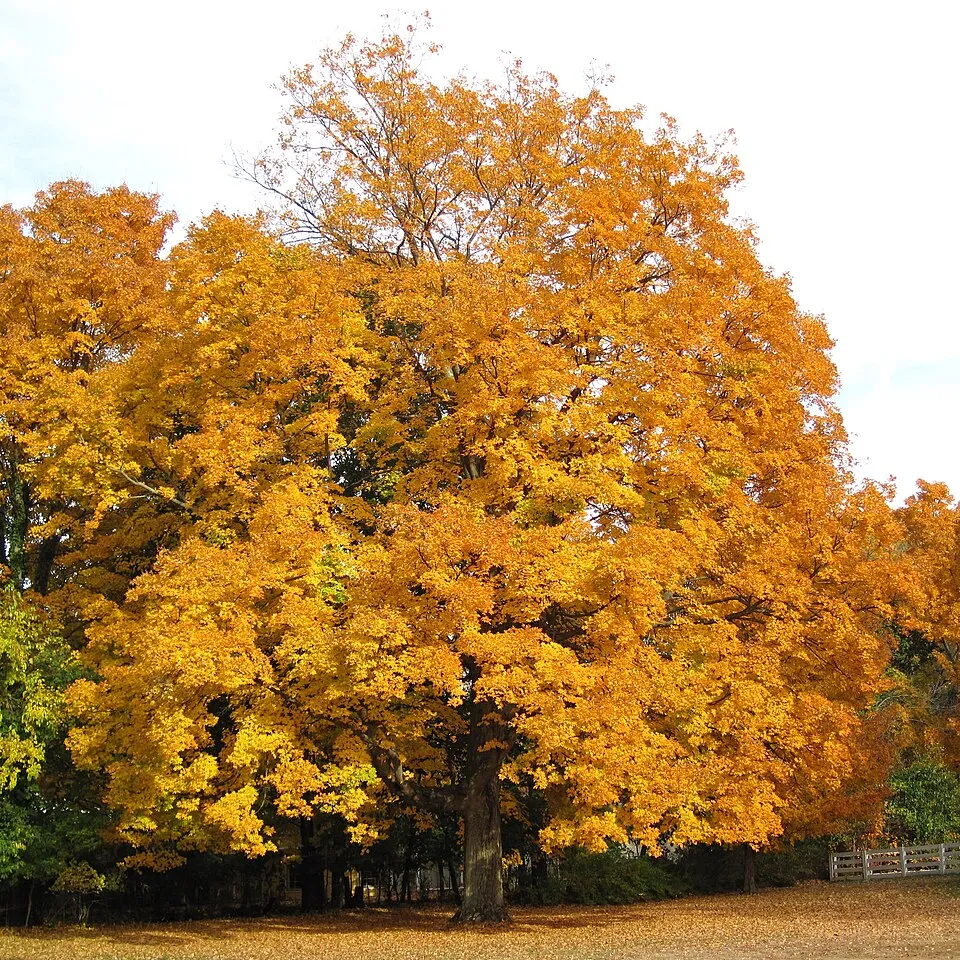
Acer saccharum, commonly known as the Sugar Maple or Hard Maple, is a majestic deciduous tree belonging to the Sapindaceae family. Native to the temperate forests of Eastern and central North America, its natural range extends from Canada south through the Appalachian Mountains to Georgia and west to Minnesota and northeast Texas.
This species is a prominent component of climax forests, thriving in moist, well-drained, slightly acidic, and fertile soils, typically in full sun to partial shade.
Morphologically, the Sugar Maple is characterized by its towering stature, often reaching heights of 50 to 120 feet, with a dense, spreading crown that provides significant shade. Its iconic leaves are palmately lobed, typically featuring five distinct lobes with coarsely toothed margins, which transform into brilliant shades of red, orange, and yellow during the autumn months, making it a celebrated ornamental tree. In spring, the tree produces inconspicuous, drooping racemes of small, yellowish-green flowers, which are later followed by distinctive winged samaras in summer—a characteristic fruit of the maple genus.
The bark of younger trees is smooth and gray, becoming furrowed and ridged with age. Acer saccharum is not only ecologically significant, supporting various wildlife, but also economically vital, primarily as the principal source of maple syrup, a cultural and culinary staple, and for its dense, durable timber.
Trusted Scientific References
1. Authoritative external sources for Acer saccharum
1.1 Wikipedia — Acer saccharum
1.2 Kew POWO (Plants of the World Online)
1.3 PubMed — peer-reviewed research
1.4 NCBI Taxonomy Browser
1.5 GBIF — Global Biodiversity
1.6Acer Saccharum should be interpreted through verified botanical identity, practical care, and responsible safety language. This recovery note adds the missing context needed for a complete profile: match light to the plant's habit, use well-drained soil, water according to season, and avoid unsupported medicinal or edible claims. For publishing, the plant can be presented as a source-backed garden plant with clear care guidance, common problem diagnosis, and conservative safety wording.
1.1.Acer Saccharum — Key Features
- ✓ <strong>Iconic North American</strong> — Iconic North American deciduous tree, national tree of Canada.
- ✓ <strong>Primary source of</strong> — Primary source of commercially produced maple syrup.
- ✓ <strong>Spectacular red, orange,</strong> — Spectacular red, orange, and yellow fall foliage.
- ✓ <strong>Valued for its</strong> — Valued for its strong, durable 'hard maple' timber.
- ✓ <strong>Rich in bioactive</strong> — Rich in bioactive phenolic compounds and flavonoids.
- ✓ <strong>Exhibits antioxidant and anti</strong> — inflammatory properties.
- ✓ <strong>Traditional uses for</strong> — Traditional uses for digestive and skin health.
- ✓ <strong>Provides ecological benefits</strong> — Provides ecological benefits as a shade tree and wildlife habitat.
- ✓ <strong>Requires specific soil</strong> — Requires specific soil and climate conditions for optimal growth.
- ✓ <strong>Distinctive five</strong> — lobed leaves and winged samara fruits.
1.2.Acer Saccharum — Quick Summary
- ✓ Acer saccharum is the iconic Sugar Maple, source of maple syrup.
- ✓ Known for stunning fall foliage and strong timber.
- ✓ Contains phenolic compounds, flavonoids, and tannins.
- ✓ Offers potential antioxidant, anti-inflammatory, and skin health benefits.
- ✓ Traditional uses include digestive and respiratory support.
- ✓ Generally safe as food, but medicinal extracts require caution.
2.Acer Saccharum — Scientific Identity
3.Acer Saccharum — Quick Facts
4.Acer Saccharum — Appearance & Identification
5.Acer Saccharum — Native Habitat
6.Acer Saccharum — Water Requirements
- ✓ Soil Preference — Thrives in moist, well-drained, slightly acidic to neutral, fertile loam soils enriched with organic matter.
- ✓ Light Requirements — Prefers full sun but can tolerate partial shade; optimal growth and fall color are achieved with ample sunlight.
- ✓ Watering Regimen — Requires consistent moisture, especially during dry periods; young trees need regular watering to establish a strong root system.
- ✓ Climate Adaptability — Best suited for cooler climates, intolerant of high heat, urban air pollution, and road salt, which can cause leaf scorch.
- ✓ Fertilization — Benefits from balanced tree fertilizer in spring, especially in nutrient-poor soils, to support vigorous growth.
- ✓ Pruning Practices — Minimal pruning is required, primarily to remove dead, damaged, or crossing branches to maintain tree health and structure.
- ✓ Pest and Disease Management — Monitor for common issues like aphids, borers, and diseases such as Verticillium wilt and anthracnose; ensure good air circulation.
- ✓ Propagation — Typically propagated by seed, which requires a period of cold stratification, or sometimes by grafting for specific cultivars.
Reviewed by the Flora Medical Global Botanical Review Panel
Multi-disciplinary editorial group · Botany · Ethnobotany · Herbal-medicine literature
Who reviewed this: This page was checked by the Flora Medical Global Botanical Review Panel — an in-house editorial group of botany graduates, ethnobotany researchers, and horticulture practitioners who collectively maintain our 7,000+ plant encyclopedia. Meet the team.
Our 4-step verification process
1. Taxonomic verification
Scientific names and synonyms cross-checked against Kew POWO, World Flora Online, and The Plant List.
2. Phytochemical & medicinal cross-reference
Active compounds, traditional uses, and reported activities are cross-referenced with PubMed, USDA Dr. Duke's database, and peer-reviewed ethnobotanical literature.
3. Conservation & distribution check
Distribution, ecology, and conservation status confirmed against GBIF occurrence records and the IUCN Red List.
4. Editorial & safety review
Every entry passes an editorial pass for clarity, originality, and safety notices (toxicity, contraindications, dosage caveats) before publication.
Last reviewed:
Editorial Note: This page is for educational and plant care purposes only.
Written by: Flora Medical Global Editorial Team
Reviewed by: Flora Medical Global Botanical Review Panel
Last Updated: June 15, 2026







Acer Saccharum — Comments & Community Reviews
Rate this plant