


Care Disclaimer: Plant care recommendations are general guidelines based on common growing conditions. Individual results may vary based on your local environment, climate, and care routine. If your plant is toxic, keep it away from children and pets, and consult a veterinarian if accidental ingestion occurs.
1.Alyssum — Overview
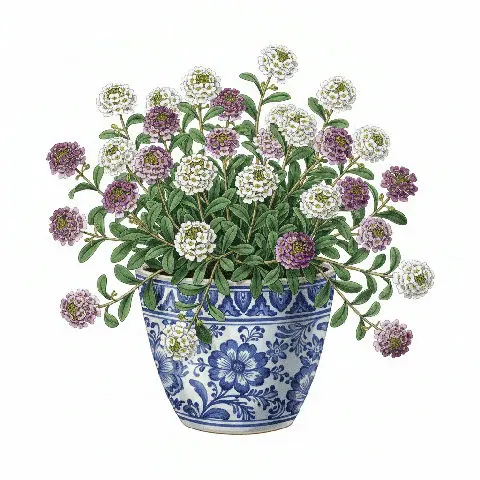
Lobularia maritima, widely recognized as Sweet Alyssum or simply Alyssum, is an enchanting, low-growing annual or short-lived perennial herb belonging to the Brassicaceae family, which also encompasses well-known vegetables like broccoli and cabbage. This species is indigenous to the sun-drenched Mediterranean basin, extending across North Africa, the Macaronesian archipelagos (Azores, Madeira, Canary Islands), and into southwestern Asia.
Its global popularity as an ornamental plant stems from its abundant and prolonged blooming period, its delicate yet pervasive honey-like fragrance, and remarkable hardiness across various conditions.
Botanically, the genus name Lobularia is derived from the Latin 'lobulus,' signifying a small lobule, a direct reference to the slightly notched silicles, which are the plant's characteristic seed pods. The specific epithet 'maritima' aptly describes its natural predilection for coastal and maritime environments, where it flourishes on sandy shores, rocky outcrops, and dunes. Sweet Alyssum typically forms dense, spreading mats, adorned with a profusion of tiny, four-petaled flowers.
While the most common wild varieties are pure white, horticultural selections now offer a vibrant spectrum, including shades of pink, purple, and yellow. Its aromatic qualities are not only aesthetically pleasing but also serve as a significant attractant for a diverse array of pollinators, particularly bees and butterflies, making it an invaluable asset in ecological gardens and sustainable agricultural practices. Beyond its ornamental charm, historical accounts and recent scientific inquiries hint at its deeper potential, moving beyond its traditional peripheral uses as a diuretic and febrifuge to uncover a richer phytochemical profile.
Trusted Scientific References
1. Authoritative external sources for Lobularia maritima
1.1 Wikipedia — Lobularia maritima
1.2 Kew POWO (Plants of the World Online)
1.3 PubMed — peer-reviewed research
1.4 NCBI Taxonomy Browser
1.5 GBIF — Global Biodiversity
1.1.Alyssum — Key Features
- ✓ <strong>Botanical Name</strong> — Lobularia maritima (L.) Desv.
- ✓ <strong>Common Name</strong> — Sweet Alyssum, Alyssum.
- ✓ <strong>Family</strong> — Brassicaceae (Mustard Family).
- ✓ <strong>Native Range</strong> — Mediterranean basin, North Africa, Macaronesia, Southwestern Asia.
- ✓ <strong>Key Compounds</strong> — Flavonoids (e.g., kaempferol), Glucosinolates, Terpenes, Phenolics.
- ✓ <strong>Primary Actions</strong> — Antioxidant, Anti-inflammatory, Pancreatic Lipase Inhibitor.
- ✓ <strong>Traditional Uses</strong> — Diuretic, Febrifuge, Culinary (food source).
- ✓ <strong>Growth Habit</strong> — Low-growing, mat-forming annual or short-lived perennial.
- ✓ <strong>Floral Scent</strong> — Distinctive, strong, sweet, honey-like fragrance.
- ✓ <strong>Pollinator Attractor</strong> — Highly valued for attracting bees, butterflies, and other beneficial insects.
1.2.Alyssum — Quick Summary
- ✓ Lobularia maritima, or Sweet Alyssum, is a fragrant Mediterranean herb of the Brassicaceae family.
- ✓ Rich in flavonoids, glucosinolates, and phenolic compounds, it offers notable health benefits.
- ✓ Modern research highlights its potent antioxidant, anti-inflammatory, and anti-obesity activities.
- ✓ Traditionally, it has been used as a diuretic, febrifuge, and even a food source in some cultures.
- ✓ Easy to cultivate, it's a popular ornamental that significantly attracts beneficial pollinators.
- ✓ Generally considered safe for external and moderate internal use, but caution is advised for specific health conditions and medication interactions.
2.Alyssum — Scientific Identity
3.Alyssum — Quick Facts
4.Alyssum — Appearance & Identification
5.Alyssum — Native Habitat
6.Alyssum — Water Requirements
- ✓ Climate and Hardiness — Thrives in Mediterranean-like climates, suitable for USDA zones 7-11 as a short-lived perennial, and commonly grown as an annual in cooler regions.
- ✓ Soil Requirements — Prefers well-drained, sandy, or loamy soils; it is notably tolerant of less fertile or poor soil conditions.
- ✓ Light Exposure — Best performance is achieved in full sun, though it can tolerate partial shade, especially in hotter climates.
- ✓ Watering — Requires moderate watering, particularly during establishment, but becomes quite drought-tolerant once mature.
- ✓ Propagation — Easily propagated from seeds; direct sowing outdoors after the last frost or starting seeds indoors 4-6 weeks prior is recommended.
- ✓ Fertilization — Generally a low-maintenance plant with modest nutrient requirements; light fertilization with a balanced, all-purpose fertilizer can be applied if growth appears stunted.
- ✓ Pests and Diseases — Relatively resistant to most pests and diseases, though occasionally susceptible to aphids or powdery mildew in humid conditions.
- ✓ Maintenance — Shear back spent blooms or trim the plant after its first flush of flowers to encourage continuous blooming and maintain a compact, tidy form.
Reviewed by the Flora Medical Global Botanical Review Panel
Multi-disciplinary editorial group · Botany · Ethnobotany · Herbal-medicine literature
Who reviewed this: This page was checked by the Flora Medical Global Botanical Review Panel — an in-house editorial group of botany graduates, ethnobotany researchers, and horticulture practitioners who collectively maintain our 7,000+ plant encyclopedia. Meet the team.
Our 4-step verification process
1. Taxonomic verification
Scientific names and synonyms cross-checked against Kew POWO, World Flora Online, and The Plant List.
2. Phytochemical & medicinal cross-reference
Active compounds, traditional uses, and reported activities are cross-referenced with PubMed, USDA Dr. Duke's database, and peer-reviewed ethnobotanical literature.
3. Conservation & distribution check
Distribution, ecology, and conservation status confirmed against GBIF occurrence records and the IUCN Red List.
4. Editorial & safety review
Every entry passes an editorial pass for clarity, originality, and safety notices (toxicity, contraindications, dosage caveats) before publication.
Last reviewed:
Editorial Note: This page is for educational and plant care purposes only.
Written by: Flora Medical Global Editorial Team
Reviewed by: Flora Medical Global Botanical Review Panel
Last Updated: June 15, 2026







Alyssum — Comments & Community Reviews
Rate this plant