


Care Disclaimer: Plant care recommendations are general guidelines based on common growing conditions. Individual results may vary based on your local environment, climate, and care routine. If your plant is toxic, keep it away from children and pets, and consult a veterinarian if accidental ingestion occurs.
1.Amaryllis — Overview
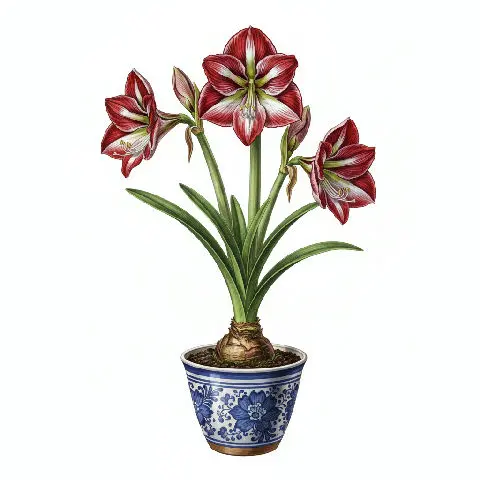
Amaryllis, botanically identified as Hippeastrum hybrid, encompasses a genus of approximately 90 species of perennial, bulbous plants belonging to the family Amaryllidaceae. These plants are primarily indigenous to the subtropical and tropical regions of South America, with a notable presence in Eastern Brazil, the central southern Andes (including Peru, Bolivia, and Argentina), and extending north to Mexico and the West Indies. The term 'Amaryllis' is widely and commercially applied to these cultivated hybrids, differentiating them from the true Amaryllis belladonna, which originates from South Africa. These hybrids are highly prized for their spectacular, large, lily-like flowers, which typically emerge during the winter months, establishing them as popular holiday houseplants.
Their striking trumpet-shaped blooms, often measuring 15-20 cm across, display a wide color palette from brilliant reds and whites to pinks, oranges, and various bicolors, frequently adorned with intricate striping or flecking. Historical cultivation of Hippeastrum commenced in the 17th century with species such as Hippeastrum vittatum and H. reginae. Over subsequent centuries, intensive hybridization efforts, particularly in the Netherlands, the United States, South Africa, Japan, and Israel, have yielded the diverse array of cultivated varieties observed today.
These breeding programs have focused on enhancing flower size, stem strength, bloom duration, and color diversity. Ecologically, Hippeastrum species thrive in well-drained soils, often beneath the canopy of larger trees in their native habitats, benefiting from filtered sunlight. Their robust bulbs store substantial nutrient reserves, enabling them to bloom profusely. Botanically, they exhibit a typical monocot structure with long, strap-like leaves that appear either before or simultaneously with the hollow flower stalk, or scape, which can reach heights of 30-75 cm and bears 2-6 (sometimes more) individual flowers.
Trusted Scientific References
1. Authoritative external sources for Hippeastrum hybrid
1.1 Wikipedia — Hippeastrum hybrid
1.2 Kew POWO (Plants of the World Online)
1.3 PubMed — peer-reviewed research
1.4 NCBI Taxonomy Browser
1.5 GBIF — Global Biodiversity
1.1.Amaryllis — Key Features
- ✓ <strong>Striking Ornamental Blooms</strong> — Features large, showy, trumpet-shaped flowers in a wide array of colors and patterns.
- ✓ <strong>Bulbous Perennial Nature</strong> — Grows from a bulb that stores nutrients, enabling prolific flowering and resilience.
- ✓ <strong>Popular Winter Bloomer</strong> — Frequently cultivated as a houseplant, providing vibrant flowers during the colder months.
- ✓ <strong>Toxic Alkaloid Content</strong> — Contains potent Amaryllidaceae alkaloids, making all plant parts, especially the bulb, poisonous if ingested.
- ✓ <strong>South American Native Origin</strong> — Primarily indigenous to tropical and subtropical regions of South America.
- ✓ <strong>Result of Extensive Hybridization</strong> — Modern varieties are the product of centuries of intensive breeding for enhanced aesthetics.
- ✓ <strong>Requires Distinct Dormancy Cycle</strong> — A period of rest is essential for the plant to rebloom reliably in subsequent seasons.
- ✓ <strong>Easy to Grow Indoors</strong> — With appropriate care, it thrives as a potted plant, adaptable to indoor environments.
- ✓ <strong>Characteristic Hollow Flower Stalk</strong> — Produces a sturdy, hollow scape that supports multiple large flowers.
- ✓ <strong>Long, Strap</strong> — Like Leaves — Develops glossy, medium-green foliage that can grow up to two feet in length.
1.2.Amaryllis — Quick Summary
- ✓ Ornamental plant, *Hippeastrum hybrid*, renowned for its large, vibrant, trumpet-shaped flowers.
- ✓ Contains toxic Amaryllidaceae alkaloids, including lycorine; not for medicinal use.
- ✓ Primarily cultivated globally as a popular holiday houseplant, blooming typically in winter.
- ✓ Requires specific cultivation practices for optimal growth and reblooming, including a critical dormancy period.
- ✓ Research interest in the alkaloids from related Amaryllidaceae species for potential antiviral, antitumor, and neuroprotective applications.
2.Amaryllis — Scientific Identity
3.Amaryllis — Quick Facts
4.Amaryllis — Appearance & Identification
5.Amaryllis — Native Habitat
6.Amaryllis — Water Requirements
- ✓ Bulb Selection — Choose large, firm, and dry bulbs free from any signs of mold, decay, or injury for optimal growth and flowering.
- ✓ Potting Medium & Container — Plant bulbs in a container approximately one inch larger than the bulb's diameter, using a well-drained potting mix high in organic matter. Ensure the top half of the bulb remains above the soil surface.
- ✓ Watering Regimen — Initially, keep the soil barely moist to prevent bulb rot. Increase watering once active growth (shoots and leaves) appears, allowing the top inch of soil to dry between waterings.
- ✓ Light and Temperature — Place the potted bulb in a sunny location at room temperature (65-70ºF) for blooming. To prolong the bloom period, move the plant to a cooler spot (60-65ºF) with indirect sunlight.
- ✓ Fertilization — After the blooming period, when leaves are actively growing, fertilize monthly with a balanced houseplant fertilizer (e.g., 5-10-10 or 10-10-10) at the recommended dilution rate.
- ✓ Inducing Dormancy — To encourage reblooming, allow the plant to go through an 8-10 week dormant period by ceasing watering, allowing leaves to die back, and storing the bulb in a cool, dark place (45-55ºF).
- ✓ Repotting Schedule — Repot *Hippeastrum* bulbs every few years, preferably after their dormant period, as the bulbs grow in diameter and prefer to be slightly pot-bound.
- ✓ Pest and Disease Management — Regularly inspect for common issues like red blotch (*Stagonospora curtissi*) and mealybugs. Use sterile potting medium and ensure good air circulation to minimize disease.
Reviewed by the Flora Medical Global Botanical Review Panel
Multi-disciplinary editorial group · Botany · Ethnobotany · Herbal-medicine literature
Who reviewed this: This page was checked by the Flora Medical Global Botanical Review Panel — an in-house editorial group of botany graduates, ethnobotany researchers, and horticulture practitioners who collectively maintain our 7,000+ plant encyclopedia. Meet the team.
Our 4-step verification process
1. Taxonomic verification
Scientific names and synonyms cross-checked against Kew POWO, World Flora Online, and The Plant List.
2. Phytochemical & medicinal cross-reference
Active compounds, traditional uses, and reported activities are cross-referenced with PubMed, USDA Dr. Duke's database, and peer-reviewed ethnobotanical literature.
3. Conservation & distribution check
Distribution, ecology, and conservation status confirmed against GBIF occurrence records and the IUCN Red List.
4. Editorial & safety review
Every entry passes an editorial pass for clarity, originality, and safety notices (toxicity, contraindications, dosage caveats) before publication.
Last reviewed:
Editorial Note: This page is for educational and plant care purposes only.
Written by: Flora Medical Global Editorial Team
Reviewed by: Flora Medical Global Botanical Review Panel
Last Updated: June 15, 2026







Amaryllis — Comments & Community Reviews
Rate this plant