


Care Disclaimer: Plant care recommendations are general guidelines based on common growing conditions. Individual results may vary based on your local environment, climate, and care routine. If your plant is toxic, keep it away from children and pets, and consult a veterinarian if accidental ingestion occurs.
1.Amorpha Canescens — Overview
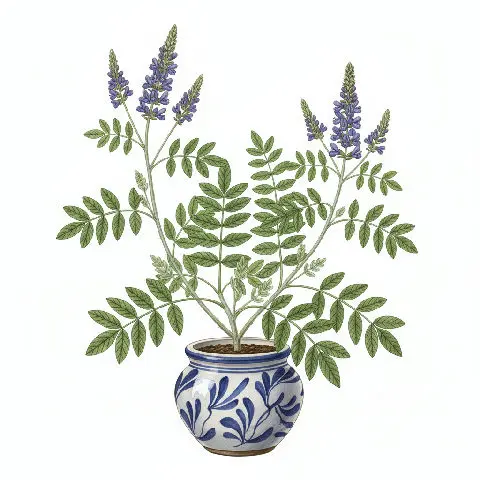
Amorpha canescens, universally known as Leadplant, is a resilient perennial subshrub native to the vast tallgrass prairies of North America. A distinguished member of the pea family, Fabaceae, it is easily recognized by its distinctive silvery-green, pinnately compound leaves which are densely covered in fine, lead-colored hairs, giving the plant its common name. Typically reaching a height of 1 to 3 feet, this plant produces striking dense spikes of small, vibrant purple flowers, each characterized by a single petal and conspicuous bright orange anthers that extend beyond the bloom.
Its robust architecture is supported by a remarkably deep, branching woody taproot system, which not only anchors the plant firmly but also grants it exceptional drought tolerance, allowing it to thrive in arid conditions. Leadplant is widely distributed across the central and eastern United States and parts of Canada, ranging from Montana eastward to Michigan, and south to New Mexico and Louisiana, as well as into Manitoba and Ontario. It flourishes in full sun to partial shade, adapting to a variety of soil types from somewhat acidic to alkaline, and even tolerating some salinity.
This species is an indicator of well-managed rangelands, demonstrating resistance to fire and moderate grazing pressures, and plays a crucial ecological role in its native habitats.
Trusted Scientific References
1. Authoritative external sources for Amorpha canescens
1.1 Wikipedia — Amorpha canescens
1.2 Kew POWO (Plants of the World Online)
1.3 PubMed — peer-reviewed research
1.4 NCBI Taxonomy Browser
1.5 GBIF — Global Biodiversity
1.6Amorpha Canescens should be interpreted through verified botanical identity, practical care, and responsible safety language. This recovery note adds the missing context needed for a complete profile: match light to the plant's habit, use well-drained soil, water according to season, and avoid unsupported medicinal or edible claims. For publishing, the plant can be presented as a source-backed garden plant with clear care guidance, common problem diagnosis, and conservative safety wording.
1.1.Amorpha Canescens — Key Features
- ✓ <strong>Silvery</strong> — green, pinnately compound leaves, lending the plant its common name 'Leadplant'.
- ✓ <strong>Distinctive dense spikes</strong> — Distinctive dense spikes of small, deep purple flowers with bright orange anthers.
- ✓ <strong>A robust member</strong> — A robust member of the Fabaceae (pea) family, native to North American tallgrass prairies.
- ✓ <strong>Possesses an extensive,</strong> — Possesses an extensive, deep taproot system, contributing to its exceptional drought tolerance.
- ✓ <strong>Contains amorphin, a</strong> — Contains amorphin, a natural rotenoid compound with documented insecticidal properties.
- ✓ <strong>Abundant in health</strong> — benefiting flavonoids, including quercetin and kaempferol derivatives.
- ✓ <strong>Exhibits nitrogen</strong> — fixing capabilities through root nodules, enhancing soil fertility.
- ✓ <strong>Holds significant ethnobotanical</strong> — Holds significant ethnobotanical value, with various traditional uses by Native American tribes.
- ✓ <strong>Highly effective for</strong> — Highly effective for erosion control and a key species in prairie restoration efforts.
- ✓ <strong>Provides valuable forage</strong> — Provides valuable forage for wildlife and acts as a significant floral resource for pollinators.
1.2.Amorpha Canescens — Quick Summary
- ✓ North American native prairie shrub known for its distinctive silvery foliage and vibrant purple flowers.
- ✓ Contains insecticidal rotenoids, notably amorphin, making it a strong candidate for natural biopesticide development.
- ✓ Rich in beneficial flavonoids, offering significant antioxidant and potential anti-inflammatory properties.
- ✓ Traditionally valued by various Native American tribes for a range of medicinal uses, including treating pinworms and skin conditions.
- ✓ Plays a crucial ecological role by fixing nitrogen in the soil and providing excellent erosion control.
- ✓ Requires specific seed stratification for cultivation and thrives in drought-tolerant, sunny environments.
2.Amorpha Canescens — Scientific Identity
3.Amorpha Canescens — Quick Facts
4.Amorpha Canescens — Appearance & Identification
5.Amorpha Canescens — Native Habitat
6.Amorpha Canescens — Water Requirements
- ✓ Seedbed Preparation — A firm, weed-free seedbed is crucial for successful establishment of Leadplant.
- ✓ Seeding Depth & Rate — Seeds should be planted at a shallow depth of 1/4 to 3/16 inch, with a rate of 20 to 30 pure live seeds (PLS) per square foot for solid stands.
- ✓ Stratification — Seeds require stratification; this can be achieved by fall sowing for natural winter stratification, or by soaking in 82-93°C water for 12 hours followed by a moist chill at 5°C for 30 days.
- ✓ Inoculation — Prior to planting, seeds must be inoculated with the appropriate Rhizobium bacteria to facilitate effective nitrogen fixation.
- ✓ Propagation — While primarily seed-propagated, Leadplant can also be grown from greenwood or hardwood cuttings, though transplanting success in prairie restorations is often limited.
- ✓ Soil & Sun Requirements — The plant thrives in full sun to partial shade and is adaptable to a wide range of soil conditions, from slightly acidic to alkaline, including those with some salinity.
- ✓ Water & Fire Tolerance — Its deep taproot system confers excellent drought tolerance, and the plant demonstrates resilience to fire, making it well-suited for prairie ecosystems.
- ✓ Management — During establishment, grazing should be withheld, and weeds controlled by mowing above seedlings; mature plants should be grazed or mowed conservatively after dormancy.
Reviewed by the Flora Medical Global Botanical Review Panel
Multi-disciplinary editorial group · Botany · Ethnobotany · Herbal-medicine literature
Who reviewed this: This page was checked by the Flora Medical Global Botanical Review Panel — an in-house editorial group of botany graduates, ethnobotany researchers, and horticulture practitioners who collectively maintain our 7,000+ plant encyclopedia. Meet the team.
Our 4-step verification process
1. Taxonomic verification
Scientific names and synonyms cross-checked against Kew POWO, World Flora Online, and The Plant List.
2. Phytochemical & medicinal cross-reference
Active compounds, traditional uses, and reported activities are cross-referenced with PubMed, USDA Dr. Duke's database, and peer-reviewed ethnobotanical literature.
3. Conservation & distribution check
Distribution, ecology, and conservation status confirmed against GBIF occurrence records and the IUCN Red List.
4. Editorial & safety review
Every entry passes an editorial pass for clarity, originality, and safety notices (toxicity, contraindications, dosage caveats) before publication.
Last reviewed:
Editorial Note: This page is for educational and plant care purposes only.
Written by: Flora Medical Global Editorial Team
Reviewed by: Flora Medical Global Botanical Review Panel
Last Updated: June 15, 2026







Amorpha Canescens — Comments & Community Reviews
Rate this plant