

Care Disclaimer: Plant care recommendations are general guidelines based on common growing conditions. Individual results may vary based on your local environment, climate, and care routine. If your plant is toxic, keep it away from children and pets, and consult a veterinarian if accidental ingestion occurs.
1.Anthyllis Vulneraria — Overview
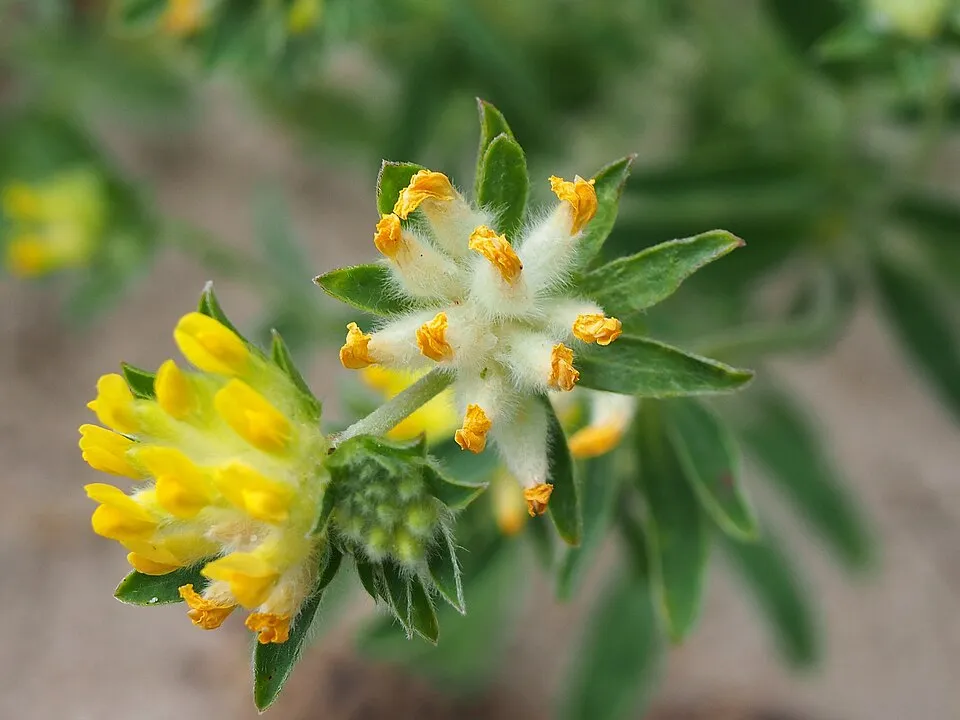
Anthyllis Vulneraria, commonly known as Common Kidney-vetch, is a captivating herbaceous perennial belonging to the Fabaceae family, a group renowned for its nitrogen-fixing capabilities and diverse medicinal members. This resilient plant typically grows to a height of 10 to 40 cm, forming a distinctive mound or sprawling habit. Its stems are often ascending, covered with fine, silky hairs, and can be simple or branched. The leaves are characteristically pinnate, meaning they are compound with leaflets arranged along a central stem, though basal leaves may appear simple.
These leaflets are typically oblong to lanceolate, with entire margins and a soft, hairy texture, arranged alternately along the stem, displaying a fresh green hue. Flowering occurs from late spring through summer, producing dense, clover-like heads of vibrant yellow, sometimes orange or red-tinged, bilaterally symmetrical flowers. These blooms are highly attractive to pollinators, particularly bees, contributing significantly to local biodiversity. The fruit is a small, ovoid legume, often enclosed within the persistent, inflated calyx, containing one to a few seeds.
Common Kidney-vetch thrives in well-drained, often calcareous soils, preferring open, sunny habitats such as meadows, pastures, chalk grasslands, and disturbed areas. Native to Europe, North Africa, and Western Asia, it has been introduced and naturalized in various parts of North America, showcasing its adaptability to diverse climatic conditions.
Trusted Scientific References
1. Authoritative external sources for Anthyllis Vulneraria
1.1 Wikipedia — Anthyllis Vulneraria
1.2 Kew POWO (Plants of the World Online)
1.3 PubMed — peer-reviewed research
1.4 NCBI Taxonomy Browser
1.5 GBIF — Global Biodiversity
1.6Anthyllis Vulneraria should be interpreted through verified botanical identity, practical care, and responsible safety language. This recovery note adds the missing context needed for a complete profile: match light to the plant's habit, use well-drained soil, water according to season, and avoid unsupported medicinal or edible claims. For publishing, the plant can be presented as a source-backed garden plant with clear care guidance, common problem diagnosis, and conservative safety wording.
1.1.Anthyllis Vulneraria — Key Features
- ✓ <strong>Botanical Classification</strong> — Member of the Fabaceae family, known for its nitrogen-fixing properties.
- ✓ <strong>Distinctive Morphology</strong> — Features pinnate leaves and dense heads of bright yellow, bilaterally symmetrical flowers.
- ✓ <strong>Adaptable Growth</strong> — A resilient perennial that tolerates varying climates and soil types, preferring sunny, open habitats.
- ✓ <strong>Traditional Wound Healer</strong> — Highly valued in folk medicine for its external application in healing cuts and abrasions.
- ✓ <strong>Internal Digestive Support</strong> — Historically used as a mild laxative and for general digestive well-being.
- ✓ <strong>Kidney Health Association</strong> — Carries the common name 'Kidney-vetch' due to traditional uses related to kidney support.
- ✓ <strong>Rich Phytochemistry</strong> — Abundant in beneficial compounds like flavonoids, tannins, saponins, and phenolic acids.
- ✓ <strong>Antioxidant Powerhouse</strong> — Provides robust cellular protection against oxidative stress.
- ✓ <strong>Anti</strong> — inflammatory Action — Helps reduce inflammation both topically and internally.
- ✓ <strong>Pollinator Friendly</strong> — Its vibrant flowers are a significant attractant for bees and other beneficial insects.
1.2.Anthyllis Vulneraria — Quick Summary
- ✓ Anthyllis Vulneraria, or Common Kidney-vetch, is a Fabaceae perennial herb.
- ✓ Traditionally used for wound healing, digestive health, and kidney support.
- ✓ Rich in flavonoids, tannins, and saponins, offering anti-inflammatory and antioxidant benefits.
- ✓ Thrives in sunny, well-drained soils and is relatively easy to cultivate.
- ✓ Available in various forms: teas, tinctures, poultices, and topical preparations.
- ✓ Exercise caution during pregnancy, lactation, and with pre-existing conditions; consult a health professional.
2.Anthyllis Vulneraria — Scientific Identity
3.Anthyllis Vulneraria — Quick Facts
4.Anthyllis Vulneraria — Appearance & Identification
5.Anthyllis Vulneraria — Native Habitat
6.Anthyllis Vulneraria — Water Requirements
- ✓ Soil Preference — Anthyllis Vulneraria thrives in well-drained, infertile to moderately fertile, often alkaline or calcareous soils, including loamy or sandy types.
- ✓ Sun Exposure — Requires full sun exposure for optimal growth and flowering, needing at least 6-8 hours of direct sunlight daily.
- ✓ Watering — Once established, Common Kidney-vetch is drought-tolerant, but young plants benefit from regular watering, allowing the top inch of soil to dry out between applications.
- ✓ Propagation — Can be propagated by seeds sown in spring or autumn, or by division of established clumps in early spring.
- ✓ Maintenance — Low maintenance; deadheading spent flowers can encourage further blooming and prevent excessive self-seeding. Avoid heavy fertilization.
- ✓ Climate Adaptability — Highly resilient to variations in humidity and temperature, making it suitable for a wide range of temperate climates.
- ✓ Pest and Disease Resistance — Generally robust and resistant to most common pests and diseases, particularly in appropriate growing conditions.
- ✓ Growth Habit — Forms a spreading or mounding groundcover, ideal for rock gardens, meadows, or as a component in pollinator-friendly landscapes.
Reviewed by the Flora Medical Global Botanical Review Panel
Multi-disciplinary editorial group · Botany · Ethnobotany · Herbal-medicine literature
Who reviewed this: This page was checked by the Flora Medical Global Botanical Review Panel — an in-house editorial group of botany graduates, ethnobotany researchers, and horticulture practitioners who collectively maintain our 7,000+ plant encyclopedia. Meet the team.
Our 4-step verification process
1. Taxonomic verification
Scientific names and synonyms cross-checked against Kew POWO, World Flora Online, and The Plant List.
2. Phytochemical & medicinal cross-reference
Active compounds, traditional uses, and reported activities are cross-referenced with PubMed, USDA Dr. Duke's database, and peer-reviewed ethnobotanical literature.
3. Conservation & distribution check
Distribution, ecology, and conservation status confirmed against GBIF occurrence records and the IUCN Red List.
4. Editorial & safety review
Every entry passes an editorial pass for clarity, originality, and safety notices (toxicity, contraindications, dosage caveats) before publication.
Last reviewed:
Editorial Note: This page is for educational and plant care purposes only.
Written by: Flora Medical Global Editorial Team
Reviewed by: Flora Medical Global Botanical Review Panel
Last Updated: June 15, 2026







Anthyllis Vulneraria — Comments & Community Reviews
Rate this plant