


Care Disclaimer: Plant care recommendations are general guidelines based on common growing conditions. Individual results may vary based on your local environment, climate, and care routine. If your plant is toxic, keep it away from children and pets, and consult a veterinarian if accidental ingestion occurs.
1.Aquilegia Canadensis — Overview
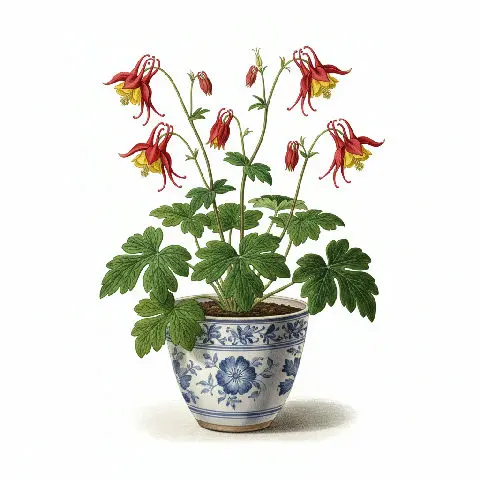
Aquilegia canadensis, commonly known as Eastern Red Columbine, Wild Columbine, or Granny's Bonnet, is an enchanting herbaceous perennial indigenous to a vast expanse of eastern North America. Its natural range extends from southern Canada, south to northern Florida, and west into Texas. This captivating plant is celebrated for its distinctive floral architecture, featuring spurred petals that gracefully curve backward, resembling a cluster of tiny trumpets or, as its genus name suggests, an eagle's claw. The delicate, fern-like, deeply lobed, alternate leaves provide a beautiful contrast to the vibrant red and yellow blooms.
Historically, diverse Indigenous peoples of North America recognized and utilized Aquilegia canadensis for a variety of medicinal purposes, demonstrating a profound traditional understanding of its botanical properties long before contemporary scientific investigation. Its applications ranged from alleviating pain to treating skin ailments, underscoring its historical significance. The plant typically thrives in well-drained, organically rich soils, commonly found in rocky woods, clearings, and along streambanks, indicating a preference for dappled sunlight to partial shade. Its ecological value is significant, serving as a crucial nectar source for hummingbirds and various long-tongued bees, thus fostering biodiversity.
The specialized flower morphology, with nectaries positioned at the end of its elongated spurs, exemplifies a fascinating co-evolutionary adaptation for hummingbird pollination. Botanically, Aquilegia canadensis is classified within the Ranunculaceae family, which also encompasses other potent genera such as buttercups and delphiniums. Modern pharmacological inquiries into Aquilegia canadensis have commenced to explore and, in some cases, validate its traditional uses, identifying various phytochemicals, including alkaloids, glycosides, and flavonoids, that contribute to its observed biological activities. While promising, comprehensive clinical trials for human therapeutic applications remain largely limited.
Trusted Scientific References
1. Authoritative external sources for Aquilegia canadensis
1.1 Wikipedia — Aquilegia canadensis
1.2 Kew POWO (Plants of the World Online)
1.3 PubMed — peer-reviewed research
1.4 NCBI Taxonomy Browser
1.5 GBIF — Global Biodiversity
1.1.Aquilegia Canadensis — Key Features
- ✓ <strong>Botanical Name</strong> — Aquilegia canadensis, denoting its Canadian origin.
- ✓ <strong>Common Names</strong> — Eastern Red Columbine, Wild Columbine, Granny's Bonnet, Canadian Columbine.
- ✓ <strong>Family</strong> — Ranunculaceae, the buttercup family, known for diverse and often potent species.
- ✓ <strong>Native Range</strong> — Extensive distribution across eastern North America.
- ✓ <strong>Flower Morphology</strong> — Distinctive red and yellow spurred, trumpet-shaped flowers adapted for specific pollinators.
- ✓ <strong>Pollinator Attraction</strong> — A magnet for hummingbirds and long-tongued bees, crucial for ecosystem health.
- ✓ <strong>Traditional Uses</strong> — Documented ethnobotanical uses by Indigenous peoples for pain, skin, and fever management.
- ✓ <strong>Toxicity</strong> — Contains toxic compounds throughout the plant, making internal consumption dangerous.
- ✓ <strong>Garden Use</strong> — Highly valued for ornamental beauty in woodland, native, and pollinator-friendly gardens.
- ✓ <strong>Growth Habit</strong> — Herbaceous perennial, typically growing 1 to 3 feet tall with a similar spread.
1.2.Aquilegia Canadensis — Quick Summary
- ✓ Eastern Red Columbine is a stunning native North American perennial known for its unique red and yellow spurred flowers.
- ✓ Historically, Indigenous peoples utilized Aquilegia canadensis for various medicinal purposes, including pain relief and skin treatments.
- ✓ The plant contains potentially toxic compounds like alkaloids and glycosides, alongside beneficial flavonoids, requiring extreme caution for internal use.
- ✓ It is a vital pollinator plant, actively attracting hummingbirds and long-tongued bees to gardens and natural areas.
- ✓ Thrives in partial shade and well-drained, organically rich soil, making it ideal for native, woodland, and rock gardens.
- ✓ Primarily valued for its ornamental and ecological benefits, internal therapeutic application is strongly advised against due to inherent toxicity.
2.Aquilegia Canadensis — Scientific Identity
3.Aquilegia Canadensis — Quick Facts
4.Aquilegia Canadensis — Appearance & Identification
5.Aquilegia Canadensis — Native Habitat
6.Aquilegia Canadensis — Water Requirements
- ✓ Soil Preference — Thrives best in organically rich, moist, and well-drained soils; prefers a slightly acidic to neutral pH (6.0-7.0).
- ✓ Light Requirements — Prefers partial shade or dappled sunlight; can tolerate more sun if adequate moisture is consistently provided.
- ✓ Water Needs — Requires consistent moisture, especially during dry periods, but is sensitive to waterlogged conditions.
- ✓ Propagation — Easily propagated by seed; cold stratification (60-90 days) significantly improves germination rates. Can self-seed readily.
- ✓ Planting Time — Sow seeds in late fall for natural cold stratification or in early spring after artificial stratification.
- ✓ Spacing — Plant individual specimens about 1 to 1.5 feet apart to allow for mature spread and good air circulation.
- ✓ Maintenance — Deadhead spent flowers to encourage further blooming and prevent excessive self-seeding; cut back foliage after it deteriorates in late summer or fall.
- ✓ Pest and Disease Resistance — Generally resistant to common leaf miners that plague other columbine species; occasional issues with powdery mildew in humid conditions.
Reviewed by the Flora Medical Global Botanical Review Panel
Multi-disciplinary editorial group · Botany · Ethnobotany · Herbal-medicine literature
Who reviewed this: This page was checked by the Flora Medical Global Botanical Review Panel — an in-house editorial group of botany graduates, ethnobotany researchers, and horticulture practitioners who collectively maintain our 7,000+ plant encyclopedia. Meet the team.
Our 4-step verification process
1. Taxonomic verification
Scientific names and synonyms cross-checked against Kew POWO, World Flora Online, and The Plant List.
2. Phytochemical & medicinal cross-reference
Active compounds, traditional uses, and reported activities are cross-referenced with PubMed, USDA Dr. Duke's database, and peer-reviewed ethnobotanical literature.
3. Conservation & distribution check
Distribution, ecology, and conservation status confirmed against GBIF occurrence records and the IUCN Red List.
4. Editorial & safety review
Every entry passes an editorial pass for clarity, originality, and safety notices (toxicity, contraindications, dosage caveats) before publication.
Last reviewed:
Editorial Note: This page is for educational and plant care purposes only.
Written by: Flora Medical Global Editorial Team
Reviewed by: Flora Medical Global Botanical Review Panel
Last Updated: June 15, 2026







Aquilegia Canadensis — Comments & Community Reviews
Rate this plant