
Care Disclaimer: Plant care recommendations are general guidelines based on common growing conditions. Individual results may vary based on your local environment, climate, and care routine. If your plant is toxic, keep it away from children and pets, and consult a veterinarian if accidental ingestion occurs.
1.Aquilegia — Overview
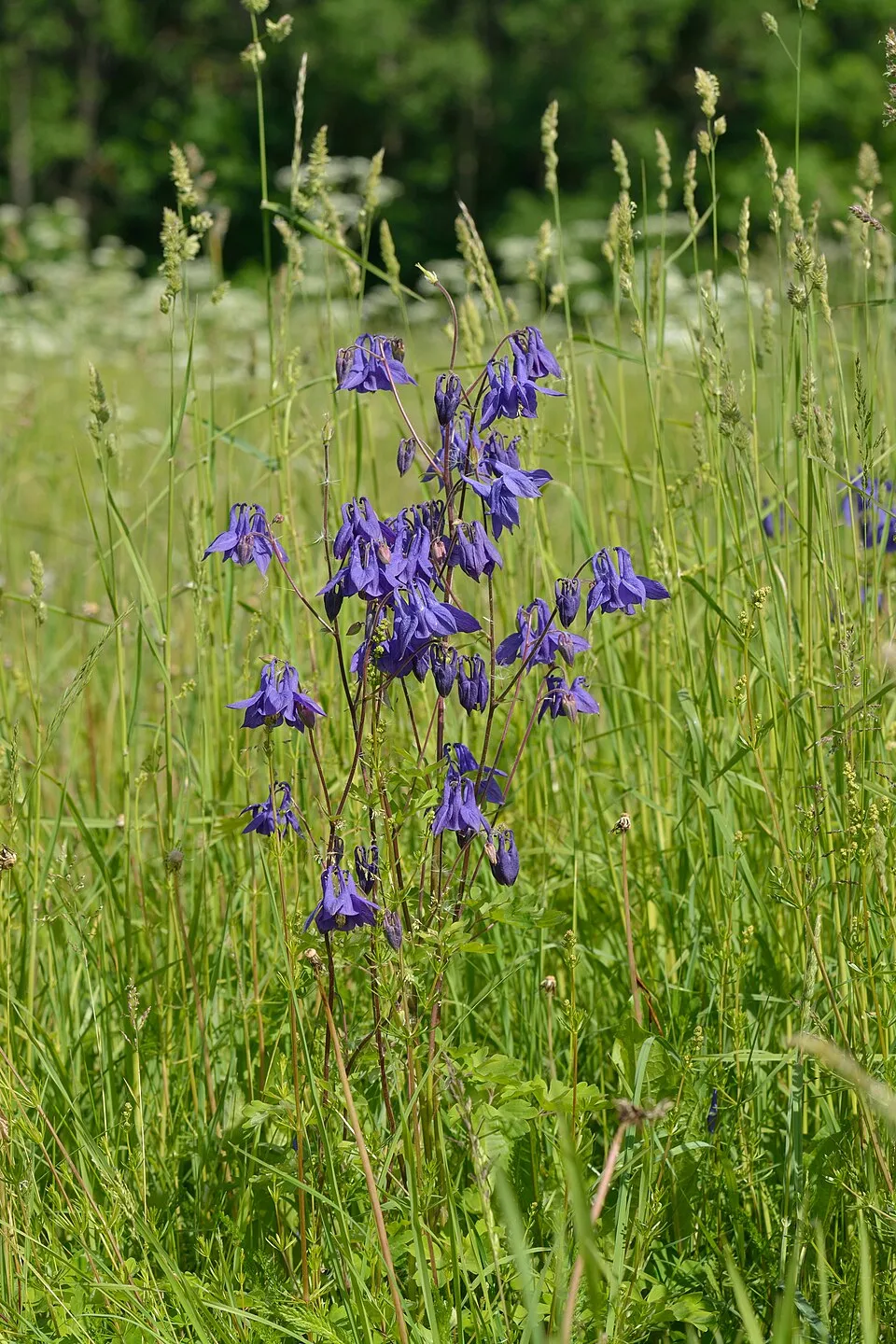
Aquilegia vulgaris, widely recognized as European columbine, common columbine, or granny's bonnet, is an enchanting perennial herb belonging to the Ranunculaceae family. Native to the diverse woodlands and meadows across Europe, this species has captivated observers for centuries with its distinctive, spurred flowers, which are thought to resemble a cluster of doves or an eagle's talons, inspiring its Latin name 'Aquilegia' from 'aquila' (eagle). The epithet 'vulgaris' denotes its common occurrence throughout its native range. This robust plant typically forms bushy clumps, anchored by a thick, often branched rootstock.
Its delicate, fern-like foliage, frequently exhibiting a glaucous (bluish-green) hue, emerges from basal leaves that are deeply lobed or divided into three leaflets, each with rounded teeth. Aerial stems, ranging from 50 to 90 cm tall, are leafy and pubescent, particularly towards the top. During late spring to early summer (May to June in its native range, extending to July in naturalized areas), elegant, nodding flowers bloom on slender, branched peduncles that are densely covered in trichomes. These solitary or clustered flowers, measuring 30-60mm in diameter, come in an array of colors including purple, blue, pink, white, and bicolors.
Each flower is characterized by five sepals and five petals, with each petal featuring a prominent, backward-pointing spur that stores nectar, making it a favorite of long-tongued pollinators like bumblebees and hawk-moths. Beyond its native European habitat, Aquilegia vulgaris has become widely naturalized across parts of Asia, Oceania, North America, and South America, showcasing its adaptability. Culturally, it held significance in ancient Greece and Rome as a symbol of fertility and later in Christian art representing virtuous behavior and the Holy Spirit, though it also carried malevolent symbolism in other contexts like Shakespearean literature. Historically, its medicinal properties were explored with extreme caution due to its inherent toxicity.
Trusted Scientific References
1. Authoritative external sources for Aquilegia vulgaris
1.1 Wikipedia — Aquilegia vulgaris
1.2 Kew POWO (Plants of the World Online)
1.3 PubMed — peer-reviewed research
1.4 NCBI Taxonomy Browser
1.5 GBIF — Global Biodiversity
1.1.Aquilegia — Key Features
- ✓ <strong>Distinctive spurred flowers</strong> — Distinctive spurred flowers resembling eagle's talons or doves.
- ✓ <strong>Perennial herbaceous plant</strong> — Perennial herbaceous plant forming bushy clumps.
- ✓ <strong>Native to European</strong> — Native to European woodlands and meadows.
- ✓ <strong>Possesses significant inherent</strong> — Possesses significant inherent toxicity, not for medicinal self-use.
- ✓ <strong>Historically used with</strong> — Historically used with extreme caution as a diuretic and sudorific.
- ✓ <strong>Rich cultural and</strong> — Rich cultural and symbolic history across different eras.
- ✓ <strong>Delicate, fern</strong> — like, glaucous foliage.
- ✓ <strong>Flowers display a wide range of colors</strong> — purple, blue, pink, white, bicolors.
- ✓ <strong>Readily self</strong> — seeds, contributing to its naturalization.
- ✓ <strong>Flowers are adapted for pollination by long</strong> — tongued insects.
1.2.Aquilegia — Quick Summary
- ✓ Highly toxic ornamental perennial with unique spurred flowers.
- ✓ Native to Europe, widely cultivated globally.
- ✓ Contains poisonous cyanogenic glycosides and isoquinoline alkaloids.
- ✓ Traditional uses were extremely limited and carried significant risk.
- ✓ Primarily valued for its aesthetic beauty in gardens.
- ✓ Ingestion leads to severe gastrointestinal, cardiac, and neurological symptoms.
2.Aquilegia — Scientific Identity
3.Aquilegia — Quick Facts
4.Aquilegia — Appearance & Identification
5.Aquilegia — Native Habitat
6.Aquilegia — Water Requirements
- ✓ Seed Propagation — Aquilegia vulgaris is readily grown from seed; cold stratification for 3-4 weeks significantly improves germination rates.
- ✓ Soil Requirements — Thrives in well-drained, fertile soil rich in organic matter, with a preference for neutral to slightly alkaline pH.
- ✓ Light Conditions — Prefers partial shade, especially in hotter climates, but can tolerate full sun in cooler, moist environments.
- ✓ Watering Regimen — Requires moderate and consistent moisture, particularly during dry spells; avoid waterlogging to prevent root rot.
- ✓ Spacing Recommendations — Space plants about 30-45 cm apart to allow for mature bushy growth and good air circulation.
- ✓ Maintenance Practices — Deadheading spent flowers prevents excessive self-seeding and encourages prolonged blooming; prune back foliage after flowering for tidiness.
- ✓ Hardiness Zones — A hardy perennial, it typically thrives in USDA zones 3-9, tolerating a range of temperatures.
- ✓ Pests and Diseases — Generally resistant to most pests, though susceptible to leaf miners and powdery mildew in humid conditions.
Reviewed by the Flora Medical Global Botanical Review Panel
Multi-disciplinary editorial group · Botany · Ethnobotany · Herbal-medicine literature
Who reviewed this: This page was checked by the Flora Medical Global Botanical Review Panel — an in-house editorial group of botany graduates, ethnobotany researchers, and horticulture practitioners who collectively maintain our 7,000+ plant encyclopedia. Meet the team.
Our 4-step verification process
1. Taxonomic verification
Scientific names and synonyms cross-checked against Kew POWO, World Flora Online, and The Plant List.
2. Phytochemical & medicinal cross-reference
Active compounds, traditional uses, and reported activities are cross-referenced with PubMed, USDA Dr. Duke's database, and peer-reviewed ethnobotanical literature.
3. Conservation & distribution check
Distribution, ecology, and conservation status confirmed against GBIF occurrence records and the IUCN Red List.
4. Editorial & safety review
Every entry passes an editorial pass for clarity, originality, and safety notices (toxicity, contraindications, dosage caveats) before publication.
Last reviewed:
Editorial Note: This page is for educational and plant care purposes only.
Written by: Flora Medical Global Editorial Team
Reviewed by: Flora Medical Global Botanical Review Panel
Last Updated: June 15, 2026







Aquilegia — Comments & Community Reviews
Rate this plant