
Care Disclaimer: Plant care recommendations are general guidelines based on common growing conditions. Individual results may vary based on your local environment, climate, and care routine. If your plant is toxic, keep it away from children and pets, and consult a veterinarian if accidental ingestion occurs.
1.Arum Italicum — Overview
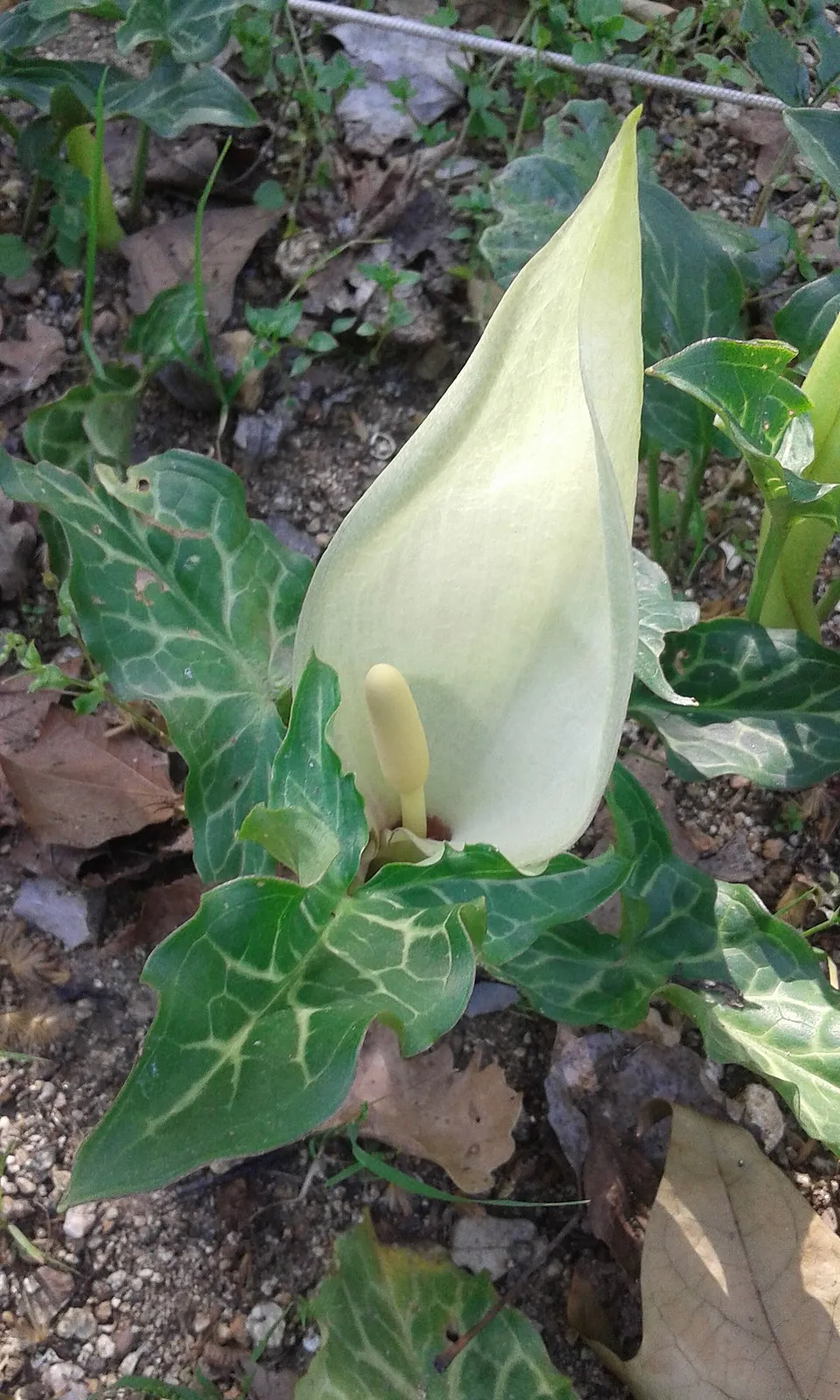
Arum italicum, commonly known as Italian Arum, Lords-and-Ladies, or Cuckoo-Pint, is a captivating perennial herbaceous plant belonging to the Araceae family. Native across southern and western Europe, northern Africa, and parts of the Middle East, this species is highly valued as an ornamental due to its distinctive and visually appealing foliage that emerges in autumn and persists through the colder months, providing crucial winter interest.
The plant typically achieves a height of 30-60 cm (12-24 inches) with a similar spread, thriving in conditions that mimic its native riparian and woodland habitats, preferring moist, humus-rich soils and tolerating partial shade to full sun.
The genus name 'Arum' originates from the Greek 'aron,' referring to the characteristically hot and pungent taste of its roots, a clear early warning of its potent properties. 'Italicum' denotes its Italian origin. The plant's arrow-shaped, glossy green leaves are often dramatically variegated with pale green or cream-colored veins.
In spring, a unique flowering structure appears: a 'spadix' (a fleshy spike) partially enveloped by a pale yellowish-green 'spathe,' which may exhibit purple edges or blotches. This inflorescence emits a pungent scent to attract pollinating insects, primarily flies, temporarily trapping them to ensure efficient pollen transfer.
Following successful pollination, the spadix develops into a striking cluster of bright orange-to-red berries in late summer and early autumn. While highly ornamental, these berries are a critical indicator of the plant's inherent toxicity.
All parts of Arum italicum, especially the tubers and berries, contain insoluble calcium oxalate crystals, which are responsible for its acrid, caustic, and highly irritant properties. Despite its beauty, Italian Arum is considered invasive in certain regions of the United States due to its rapid spread via corms and seeds, making careful management essential.
Trusted Scientific References
1. Authoritative external sources for Arum italicum
1.1 Wikipedia — Arum italicum
1.2 Kew POWO (Plants of the World Online)
1.3 PubMed — peer-reviewed research
1.4 NCBI Taxonomy Browser
1.5 GBIF — Global Biodiversity
1.1.Arum Italicum — Key Features
- ✓ <strong>Distinctive arrow</strong> — shaped, often variegated, glossy green leaves.
- ✓ <strong>Foliage emerges in</strong> — Foliage emerges in autumn and persists through winter, providing cold-season interest.
- ✓ <strong>Unique inflorescence featuring a pale yellowish</strong> — green spathe enclosing a yellow spadix.
- ✓ <strong>Produces striking clusters of bright orange</strong> — to-red berries in late summer/early autumn.
- ✓ <strong>All plant parts,</strong> — All plant parts, especially corms and berries, are highly toxic due to calcium oxalate.
- ✓ <strong>Perennial herbaceous plant,</strong> — Perennial herbaceous plant, growing from underground corms that multiply rapidly.
- ✓ <strong>Emits a pungent</strong> — Emits a pungent odor during flowering to attract flies for pollination.
- ✓ <strong>Native to southern</strong> — Native to southern Europe, northern Africa, and parts of the Middle East.
- ✓ <strong>Considered an invasive</strong> — Considered an invasive species in some parts of the United States due to aggressive spread.
- ✓ <strong>Reaches a typical height of 30</strong> — 60 cm (12-24 inches) with a similar spread.
1.2.Arum Italicum — Quick Summary
- ✓ Arum italicum is a highly ornamental perennial known for its distinctive winter foliage and bright red berries.
- ✓ All parts of the plant are extremely toxic due to insoluble calcium oxalate crystals, causing severe irritation upon contact or ingestion.
- ✓ It has significant invasive potential in certain regions, spreading aggressively via corms and seeds.
- ✓ Historically, it was used with extreme caution and extensive detoxification in folk medicine, but it has no safe modern medicinal applications.
- ✓ Requires careful handling in gardens, with a strong emphasis on preventing ingestion by humans and pets.
- ✓ Its unique lifecycle includes winter-active leaves and summer dormancy, followed by striking berry clusters.
2.Arum Italicum — Scientific Identity
3.Arum Italicum — Quick Facts
4.Arum Italicum — Appearance & Identification
5.Arum Italicum — Native Habitat
6.Arum Italicum — Water Requirements
- ✓ Site Selection — Plant in partial shade to full sun, replicating its native woodland understory habitat.
- ✓ Soil Requirements — Prefers moist, well-draining, humus-rich soils, but is tolerant of a wide range of soil types.
- ✓ Propagation — Spreads aggressively via underground corms and self-seeds readily from its prolific berry production.
- ✓ Planting Depth — Plant corms 10-15 cm (4-6 inches) deep in late summer or early autumn for winter foliage emergence.
- ✓ Water & Nutrients — Requires consistent moisture, especially during active growth; minimal fertilization is typically needed.
- ✓ Containment — Due to its invasive potential, consider planting in containers or areas with physical barriers to restrict spread.
- ✓ Fruit Removal — To prevent unwanted self-seeding, remove berry clusters before they ripen and disperse their seeds.
- ✓ Dormancy — Foliage dies back in summer, and the plant enters a dormant phase, re-emerging in the fall.
Reviewed by the Flora Medical Global Botanical Review Panel
Multi-disciplinary editorial group · Botany · Ethnobotany · Herbal-medicine literature
Who reviewed this: This page was checked by the Flora Medical Global Botanical Review Panel — an in-house editorial group of botany graduates, ethnobotany researchers, and horticulture practitioners who collectively maintain our 7,000+ plant encyclopedia. Meet the team.
Our 4-step verification process
1. Taxonomic verification
Scientific names and synonyms cross-checked against Kew POWO, World Flora Online, and The Plant List.
2. Phytochemical & medicinal cross-reference
Active compounds, traditional uses, and reported activities are cross-referenced with PubMed, USDA Dr. Duke's database, and peer-reviewed ethnobotanical literature.
3. Conservation & distribution check
Distribution, ecology, and conservation status confirmed against GBIF occurrence records and the IUCN Red List.
4. Editorial & safety review
Every entry passes an editorial pass for clarity, originality, and safety notices (toxicity, contraindications, dosage caveats) before publication.
Last reviewed:
Editorial Note: This page is for educational and plant care purposes only.
Written by: Flora Medical Global Editorial Team
Reviewed by: Flora Medical Global Botanical Review Panel
Last Updated: June 15, 2026







Arum Italicum — Comments & Community Reviews
Rate this plant