


Care Disclaimer: Plant care recommendations are general guidelines based on common growing conditions. Individual results may vary based on your local environment, climate, and care routine. If your plant is toxic, keep it away from children and pets, and consult a veterinarian if accidental ingestion occurs.
1.Aruncus Dioicus — Overview
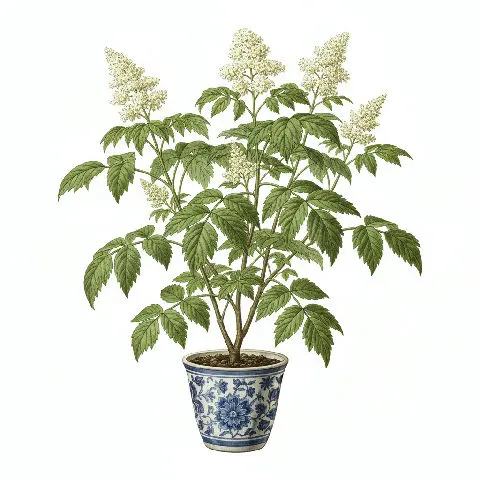
Aruncus dioicus, commonly known as Goat's Beard or Bride's Feathers, is a majestic herbaceous perennial belonging to the Rosaceae family. This elegant plant typically grows to an impressive height of 2 meters (6 feet) and can spread up to 3 meters (9 feet) wide, forming dense, bushy clumps.
Its most striking feature is the profusion of large, feathery plumes of creamy white flowers that emerge from early to mid-summer, creating a stunning visual spectacle reminiscent of a grander astilbe. The foliage is equally attractive, composed of deeply cut, dark green leaves that maintain their lush appearance throughout the growing season.
Native to damp woods, shady places, and stream banks, particularly in mountainous regions across Europe, North America, and Asia, Aruncus dioicus thrives in conditions that mimic its natural woodland habitat. It is a dioecious species, meaning individual plants bear either male or female flowers, necessitating both sexes for seed production.
While primarily valued for its ornamental appeal in woodland gardens, shaded borders, and naturalized settings, its robust nature and adaptability to various soil types, from sandy to heavy clay, and a wide pH range, make it a resilient and captivating addition to many landscapes. Its fast growth rate allows it to quickly establish and provide substantial ground cover, effectively suppressing invasive plants.
Trusted Scientific References
1. Authoritative external sources for Aruncus dioicus
1.1 Wikipedia — Aruncus dioicus
1.2 Kew POWO (Plants of the World Online)
1.3 PubMed — peer-reviewed research
1.4 NCBI Taxonomy Browser
1.5 GBIF — Global Biodiversity
1.6Aruncus Dioicus should be interpreted through verified botanical identity, practical care, and responsible safety language. This recovery note adds the missing context needed for a complete profile: match light to the plant's habit, use well-drained soil, water according to season, and avoid unsupported medicinal or edible claims. For publishing, the plant can be presented as a source-backed garden plant with clear care guidance, common problem diagnosis, and conservative safety wording.
1.1.Aruncus Dioicus — Key Features
- ✓ <strong>Tall, elegant herbaceous</strong> — Tall, elegant herbaceous perennial reaching up to 2 meters.
- ✓ <strong>Produces striking creamy</strong> — Produces striking creamy white, feathery flower plumes in summer.
- ✓ <strong>Known commonly as</strong> — Known commonly as Goat's Beard or Bride's Feathers.
- ✓ <strong>Belongs to the</strong> — Belongs to the Rosaceae family.
- ✓ <strong>Dioecious species, requiring</strong> — Dioecious species, requiring both male and female plants for seed.
- ✓ <strong>Contains triterpene saponins</strong> — Contains triterpene saponins and beneficial flavonoids.
- ✓ <strong>Leaves contain cyanogenic</strong> — Leaves contain cyanogenic glycosides, warranting caution.
- ✓ <strong>Traditionally used as</strong> — Traditionally used as an astringent, diuretic, and antipyretic.
- ✓ <strong>Excellent ornamental plant</strong> — Excellent ornamental plant for shaded woodland gardens.
- ✓ <strong>Hardy perennial, tolerant</strong> — Hardy perennial, tolerant of various soil types and moisture levels.
1.2.Aruncus Dioicus — Quick Summary
- ✓ Aruncus dioicus, or Goat's Beard, is a tall, elegant perennial with feathery white flowers.
- ✓ Traditionally used in folk medicine for astringent, diuretic, and anti-inflammatory purposes.
- ✓ Contains triterpene saponins, flavonoids, and potentially toxic cyanogenic glycosides in leaves.
- ✓ Modern scientific validation for medicinal claims is very limited, primarily anecdotal.
- ✓ Primarily valued as an ornamental plant; internal medicinal use is strongly discouraged without expert guidance.
- ✓ Hardy, shade-loving plant, adaptable to moist woodland garden conditions.
2.Aruncus Dioicus — Scientific Identity
3.Aruncus Dioicus — Quick Facts
4.Aruncus Dioicus — Appearance & Identification
5.Aruncus Dioicus — Native Habitat
6.Aruncus Dioicus — Water Requirements
- ✓ Site Selection — Thrives in semi-shade to full shade, especially in light woodland or dappled conditions; tolerates full sun if soil moisture is consistently high.
- ✓ Soil Requirements — Adaptable to a wide range of soils, including light (sandy), medium (loamy), and heavy (clay), preferring moist to wet conditions.
- ✓ pH Tolerance — Successfully grows in mildly acid, neutral, and basic (mildly alkaline) soils, and can even tolerate very acid or very alkaline environments.
- ✓ Water Needs — Prefers consistently moist to wet soil but can surprisingly tolerate fairly dry sites once established, making it quite resilient.
- ✓ Propagation — Best propagated from seed sown in a cold frame as soon as it is ripe; stored seeds can be sown in late winter or early spring.
- ✓ Growth Habit — A fast-growing perennial that forms very large, dense clumps, making it an excellent choice for ground cover or mass planting.
- ✓ Hardiness — Fully hardy to USDA zones 3-7 and UK zone 7, capable of withstanding temperatures down to at least -20°C.
- ✓ Dioecious Nature — To ensure seed production, both male and female plants must be grown, as individual plants only bear flowers of one sex.
Reviewed by the Flora Medical Global Botanical Review Panel
Multi-disciplinary editorial group · Botany · Ethnobotany · Herbal-medicine literature
Who reviewed this: This page was checked by the Flora Medical Global Botanical Review Panel — an in-house editorial group of botany graduates, ethnobotany researchers, and horticulture practitioners who collectively maintain our 7,000+ plant encyclopedia. Meet the team.
Our 4-step verification process
1. Taxonomic verification
Scientific names and synonyms cross-checked against Kew POWO, World Flora Online, and The Plant List.
2. Phytochemical & medicinal cross-reference
Active compounds, traditional uses, and reported activities are cross-referenced with PubMed, USDA Dr. Duke's database, and peer-reviewed ethnobotanical literature.
3. Conservation & distribution check
Distribution, ecology, and conservation status confirmed against GBIF occurrence records and the IUCN Red List.
4. Editorial & safety review
Every entry passes an editorial pass for clarity, originality, and safety notices (toxicity, contraindications, dosage caveats) before publication.
Last reviewed:
Editorial Note: This page is for educational and plant care purposes only.
Written by: Flora Medical Global Editorial Team
Reviewed by: Flora Medical Global Botanical Review Panel
Last Updated: June 15, 2026







Aruncus Dioicus — Comments & Community Reviews
Rate this plant