

Care Disclaimer: Plant care recommendations are general guidelines based on common growing conditions. Individual results may vary based on your local environment, climate, and care routine. If your plant is toxic, keep it away from children and pets, and consult a veterinarian if accidental ingestion occurs.
1.Asclepias Incarnata — Overview
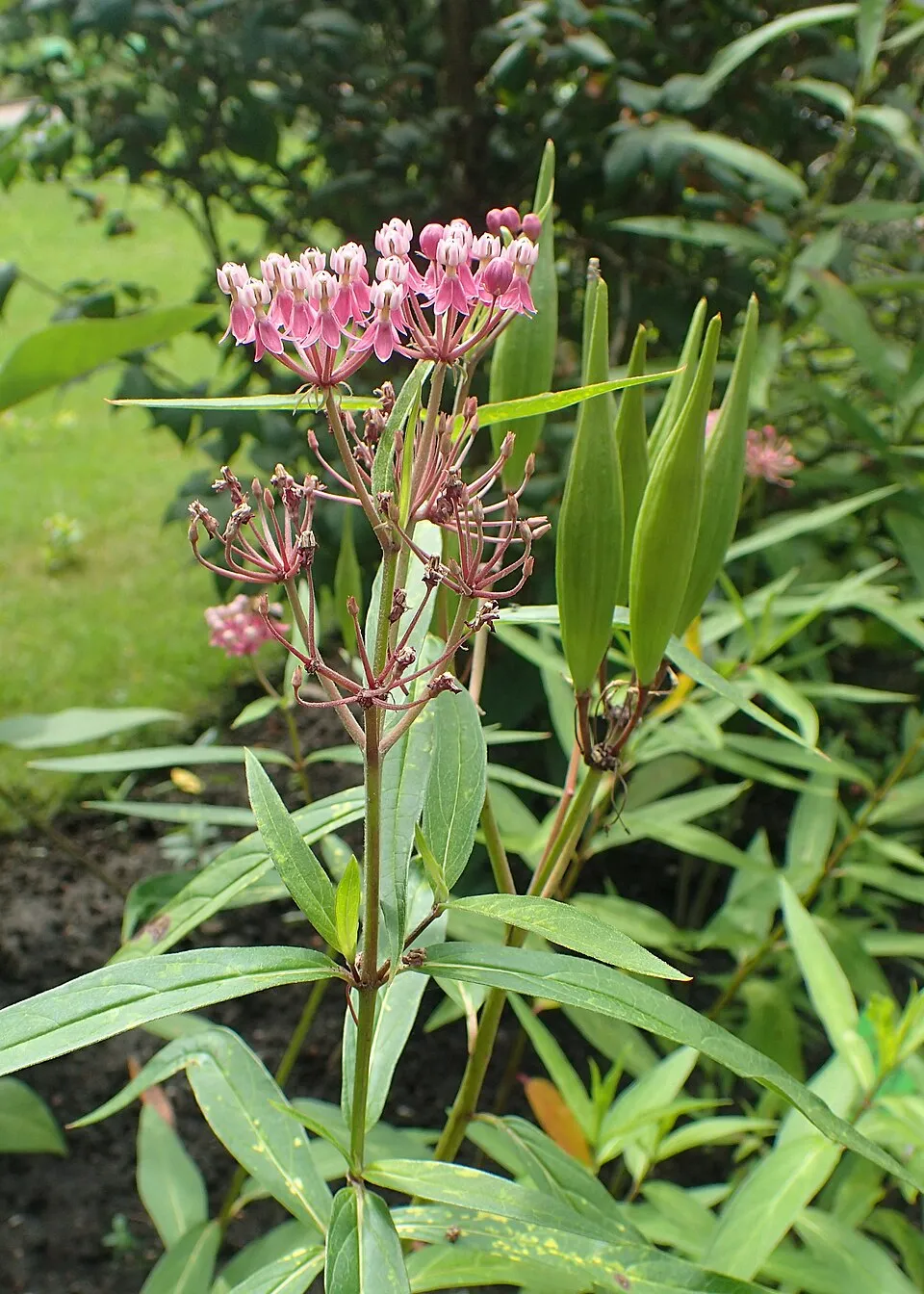
Asclepias incarnata, commonly known as Swamp Milkweed or Pink Milkweed, is a resilient herbaceous perennial native to a wide range of temperate regions across North America. This captivating plant typically attains a height of 90 to 150 centimeters, occasionally reaching up to 180 cm under ideal moist conditions, establishing a prominent vertical presence in wetland landscapes, riparian zones, and moist meadows. Its growth habit is robust and upright, forming dense clumps over time. The foliage consists of distinctively narrow, lanceolate leaves, usually measuring between 7 to 15 centimeters in length and 1 to 2.5 cm in width. These leaves are arranged oppositely along the stem, displaying a glabrous, deep green texture, often acquiring a subtle purplish hue towards the end of the growing season, particularly when exposed to full sun.
Their margins are entire, and venation is pinnate, clearly visible on both surfaces. The sturdy stems are herbaceous, branching openly, and contain a less milky sap compared to other Asclepias species. The root system is fibrous, forming an extensive network that efficiently absorbs water, crucial for its wetland adaptation. The most striking feature of Asclepias incarnata is its prolific inflorescence, borne in dense, terminal clusters known as umbels. These umbels are composed of numerous small, star-shaped florets, typically ranging in color from rose-purple to deep pink, though white variants (forma 'Alba') are also found.
The flowers are bisexual and highly attractive to a diverse array of pollinators, including monarch butterflies, bees, and hummingbirds, blooming from mid-summer through early autumn. Following successful pollination, elongated, tan-brown follicles develop, persisting into winter and releasing numerous seeds, each equipped with silky hairs for wind dispersal. Taxonomically, Asclepias incarnata belongs to the Asclepiadaceae family, now often classified within the broader Apocynaceae family.
Trusted Scientific References
1. Authoritative external sources for Asclepias Incarnata
1.1 Wikipedia — Asclepias Incarnata
1.2 Kew POWO (Plants of the World Online)
1.3 PubMed — peer-reviewed research
1.4 NCBI Taxonomy Browser
1.5 GBIF — Global Biodiversity
1.1.Asclepias Incarnata — Key Features
- ✓ <strong>Native North American</strong> — Native North American perennial, thriving in moist to wet habitats like wetlands and riparian zones.
- ✓ <strong>Distinctive narrow, lanceolate</strong> — Distinctive narrow, lanceolate leaves arranged oppositely along the stem.
- ✓ <strong>Bears showy clusters of rose</strong> — purple to deep pink flowers in dense, terminal umbels.
- ✓ <strong>Essential host plant</strong> — Essential host plant for monarch butterfly larvae and a significant nectar source for adult butterflies.
- ✓ <strong>Produces a less</strong> — Produces a less milky sap compared to many other Asclepias species, but still contains latex.
- ✓ <strong>Contains potent cardiac</strong> — Contains potent cardiac glycosides, rendering it highly toxic if ingested by humans or livestock.
- ✓ <strong>Develops elongated, tan</strong> — brown follicles (seed pods) that persist into winter, aiding seed dispersal.
- ✓ <strong>Attracts a wide</strong> — Attracts a wide array of pollinators, including bees, butterflies, and hummingbirds, enhancing biodiversity.
- ✓ <strong>Primarily cultivated for</strong> — Primarily cultivated for ecological restoration, pollinator support, and ornamental purposes.
- ✓ <strong>Historical medicinal uses</strong> — Historical medicinal uses exist but are accompanied by severe toxicity warnings and require expert supervision.
1.2.Asclepias Incarnata — Quick Summary
- ✓ Swamp Milkweed (Asclepias incarnata) is a North American native perennial known for its vibrant pink-purple flowers.
- ✓ It is a critical host plant for monarch butterfly caterpillars and a valuable pollinator magnet.
- ✓ Contains potent cardiac glycosides, making the entire plant, especially the roots, highly toxic if ingested.
- ✓ Traditionally used with extreme caution as an emetic, purgative, and for respiratory ailments.
- ✓ Cultivated primarily for ornamental value and ecological benefits rather than medicinal use.
- ✓ Internal consumption is dangerous and strongly discouraged due to severe cardiac and gastrointestinal risks.
2.Asclepias Incarnata — Scientific Identity
3.Asclepias Incarnata — Quick Facts
4.Asclepias Incarnata — Appearance & Identification
5.Asclepias Incarnata — Native Habitat
6.Asclepias Incarnata — Water Requirements
- ✓ Soil Preference — Thrives in moist to wet, well-drained loamy soils rich in organic matter; adaptable to clay soils, reflecting its native wetland habitat.
- ✓ Light Requirements — Prefers full sun exposure for optimal flowering and robust growth, though it can tolerate partial shade, which may result in fewer blooms.
- ✓ Water Needs — Requires consistently moist soil, especially during establishment; ideal for rain gardens, pond edges, or areas with naturally high soil moisture.
- ✓ Propagation by Seed — Seeds require a cold stratification period of 30-60 days at 4°C (39°F) to break dormancy before spring sowing.
- ✓ Vegetative Propagation — Can be propagated by dividing established clumps in early spring or late fall, ensuring each division has healthy roots and shoots.
- ✓ Pollinator Attraction — Plant in visible areas to maximize its ecological benefit, as its flowers are a critical nectar source for monarch butterflies and other pollinators.
- ✓ Maintenance — Generally low maintenance once established; deadheading spent flowers can encourage further blooming, and cutting back in late fall helps maintain vigor.
- ✓ Pest and Disease Resistance — Highly resistant to deer and most common garden pests, though aphids can occasionally be an issue.
Reviewed by the Flora Medical Global Botanical Review Panel
Multi-disciplinary editorial group · Botany · Ethnobotany · Herbal-medicine literature
Who reviewed this: This page was checked by the Flora Medical Global Botanical Review Panel — an in-house editorial group of botany graduates, ethnobotany researchers, and horticulture practitioners who collectively maintain our 7,000+ plant encyclopedia. Meet the team.
Our 4-step verification process
1. Taxonomic verification
Scientific names and synonyms cross-checked against Kew POWO, World Flora Online, and The Plant List.
2. Phytochemical & medicinal cross-reference
Active compounds, traditional uses, and reported activities are cross-referenced with PubMed, USDA Dr. Duke's database, and peer-reviewed ethnobotanical literature.
3. Conservation & distribution check
Distribution, ecology, and conservation status confirmed against GBIF occurrence records and the IUCN Red List.
4. Editorial & safety review
Every entry passes an editorial pass for clarity, originality, and safety notices (toxicity, contraindications, dosage caveats) before publication.
Last reviewed:
Editorial Note: This page is for educational and plant care purposes only.
Written by: Flora Medical Global Editorial Team
Reviewed by: Flora Medical Global Botanical Review Panel
Last Updated: June 15, 2026







Asclepias Incarnata — Comments & Community Reviews
Rate this plant