


Care Disclaimer: Plant care recommendations are general guidelines based on common growing conditions. Individual results may vary based on your local environment, climate, and care routine. If your plant is toxic, keep it away from children and pets, and consult a veterinarian if accidental ingestion occurs.
1.Asclepias Syriaca — Overview
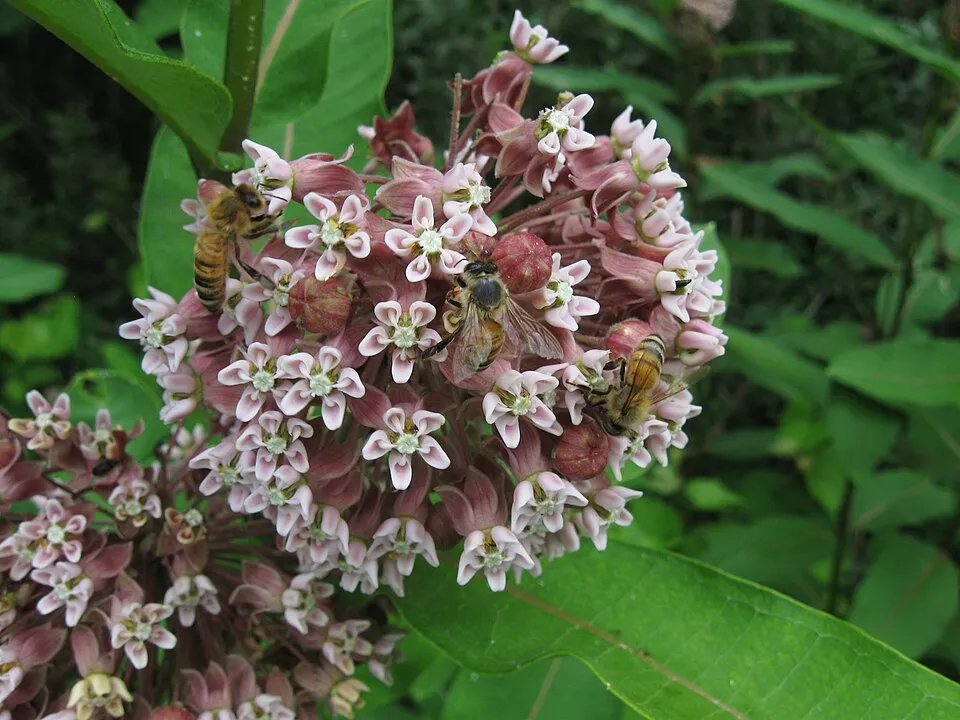
Asclepias syriaca, commonly known as Common Milkweed, is a robust herbaceous perennial belonging to the Asclepiadaceae family, now recognized as a subfamily within Apocynaceae. This distinctive plant typically reaches heights of 1 to 1.5 meters, forming dense colonies through its extensive rhizomatous root system. Its stout, upright stems are adorned with large, thick, paddle-shaped leaves, measuring 15-20 cm long and 5-9 cm wide. The leaves are oppositely arranged, featuring a light to dark green upper surface and a paler, sometimes almost white, underside with a prominent midrib.
When any part of the plant is broken, it exudes a characteristic white, milky latex sap. Flowering occurs from late spring to early summer, producing dense, nearly spherical clusters (umbels) of small, exquisitely scented flowers. These flowers range in color from greenish-pink to rosy pink or purplish-pink, attracting a wide array of pollinators. Following successful pollination, inflated, warty pods, about 10 cm long, develop, turning brown as they mature.
Each pod splits open to release 50-100 seeds, each equipped with a silky white coma, or 'parachute,' facilitating wind dispersal. Native to most of the eastern United States and southern Canada, Common Milkweed thrives in diverse habitats including fence rows, roadsides, open fields, prairies, and cultivated gardens, preferring full sun and well-drained soils.
Trusted Scientific References
1. Authoritative external sources for Asclepias Syriaca
1.1 Wikipedia — Asclepias Syriaca
1.2 Kew POWO (Plants of the World Online)
1.3 PubMed — peer-reviewed research
1.4 NCBI Taxonomy Browser
1.5 GBIF — Global Biodiversity
1.6Asclepias Syriaca should be interpreted through verified botanical identity, practical care, and responsible safety language. This recovery note adds the missing context needed for a complete profile: match light to the plant's habit, use well-drained soil, water according to season, and avoid unsupported medicinal or edible claims. For publishing, the plant can be presented as a source-backed garden plant with clear care guidance, common problem diagnosis, and conservative safety wording.
1.1.Asclepias Syriaca — Key Features
- ✓ <strong>Native North American</strong> — Native North American perennial wildflower.
- ✓ <strong>Essential host plant</strong> — Essential host plant for Monarch butterfly caterpillars.
- ✓ <strong>Exudes characteristic white,</strong> — Exudes characteristic white, milky latex sap.
- ✓ <strong>Contains toxic cardiac</strong> — Contains toxic cardiac glycosides (cardenolides).
- ✓ <strong>Produces sweetly scented pink</strong> — to-purple flowers in umbels.
- ✓ <strong>Features large, thick, paddle</strong> — shaped leaves.
- ✓ <strong>Spreads vigorously through</strong> — Spreads vigorously through underground rhizomes, forming colonies.
- ✓ <strong>Seeds are dispersed</strong> — Seeds are dispersed by wind, aided by a silky white coma.
- ✓ <strong>Possesses historical traditional</strong> — Possesses historical traditional medicinal uses, primarily external applications.
- ✓ <strong>Thrives in full sun and well</strong> — drained soil conditions.
1.2.Asclepias Syriaca — Quick Summary
- ✓ Common Milkweed (Asclepias syriaca) is a native North American perennial known for its distinctive milky sap.
- ✓ It is an essential host plant for Monarch butterfly caterpillars, crucial for their lifecycle and conservation.
- ✓ The plant contains cardiac glycosides, rendering it toxic if ingested and requiring extreme caution in handling.
- ✓ Historically used externally for warts and internally for lung ailments, modern internal use is highly discouraged due to toxicity.
- ✓ Valued primarily for its ecological role in supporting pollinators and its ornamental appeal in native plant gardens.
2.Asclepias Syriaca — Scientific Identity
3.Asclepias Syriaca — Quick Facts
4.Asclepias Syriaca — Appearance & Identification
5.Asclepias Syriaca — Native Habitat
6.Asclepias Syriaca — Water Requirements
- ✓ Soil Preference — Thrives best in well-drained soil with a pH ranging from 6.0 to 7.5, accommodating various soil types from sandy to clay.
- ✓ Light Requirements — Prefers full sun exposure for optimal growth and flowering, though it can tolerate light shade, albeit with reduced vigor.
- ✓ Watering — Requires regular watering, particularly during dry spells, but exhibits good drought tolerance once established due to its deep root system.
- ✓ Planting Time — Best planted in the spring after the last frost date to allow ample time for establishment and growth before winter.
- ✓ Fertilization — Benefits from a light application of a balanced organic fertilizer in spring to enhance growth, flowering, and overall plant health.
- ✓ Propagation — Readily propagates from seeds and spreads aggressively via its deep rhizomes, quickly forming dense colonies.
- ✓ Garden Placement — Due to its vigorous spreading nature, it should be planted in areas where its colonial growth habit can be accommodated or managed.
- ✓ Pollinator Support — Cultivating Common Milkweed is crucial for supporting Monarch butterfly populations, as it is the sole host plant for their caterpillars.
Reviewed by the Flora Medical Global Botanical Review Panel
Multi-disciplinary editorial group · Botany · Ethnobotany · Herbal-medicine literature
Who reviewed this: This page was checked by the Flora Medical Global Botanical Review Panel — an in-house editorial group of botany graduates, ethnobotany researchers, and horticulture practitioners who collectively maintain our 7,000+ plant encyclopedia. Meet the team.
Our 4-step verification process
1. Taxonomic verification
Scientific names and synonyms cross-checked against Kew POWO, World Flora Online, and The Plant List.
2. Phytochemical & medicinal cross-reference
Active compounds, traditional uses, and reported activities are cross-referenced with PubMed, USDA Dr. Duke's database, and peer-reviewed ethnobotanical literature.
3. Conservation & distribution check
Distribution, ecology, and conservation status confirmed against GBIF occurrence records and the IUCN Red List.
4. Editorial & safety review
Every entry passes an editorial pass for clarity, originality, and safety notices (toxicity, contraindications, dosage caveats) before publication.
Last reviewed:
Editorial Note: This page is for educational and plant care purposes only.
Written by: Flora Medical Global Editorial Team
Reviewed by: Flora Medical Global Botanical Review Panel
Last Updated: June 15, 2026







Asclepias Syriaca — Comments & Community Reviews
Rate this plant