


Care Disclaimer: Plant care recommendations are general guidelines based on common growing conditions. Individual results may vary based on your local environment, climate, and care routine. If your plant is toxic, keep it away from children and pets, and consult a veterinarian if accidental ingestion occurs.
1.Asclepias Tuberosa — Overview
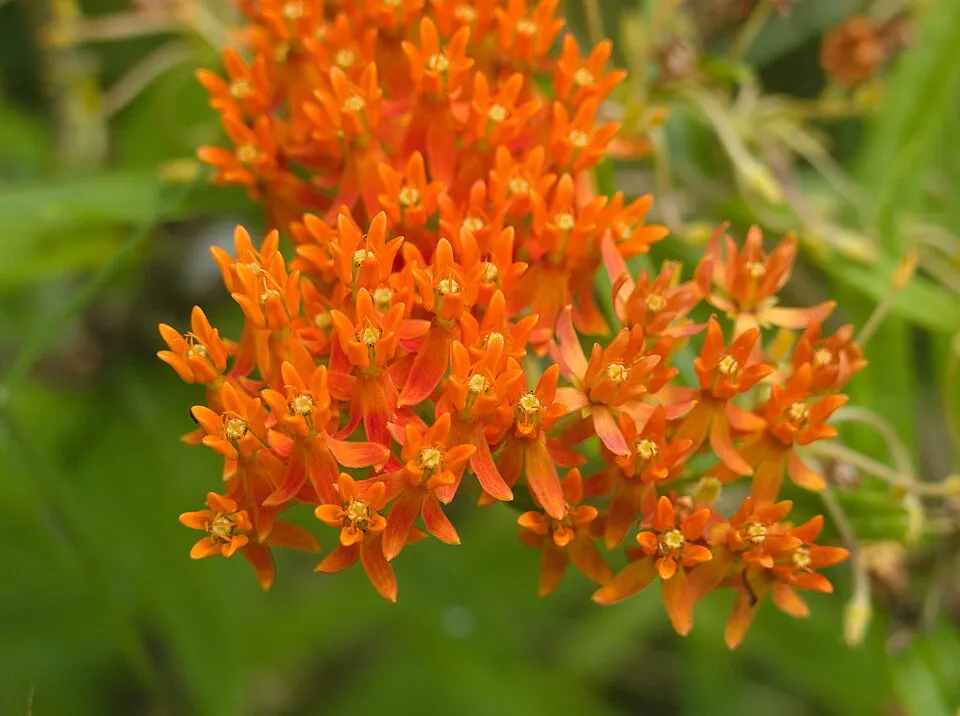
Asclepias tuberosa, commonly known as Butterfly Milkweed or Pleurisy Root, is a captivating perennial herb renowned for its vibrant orange blossoms and significant ecological role. Typically growing 0.3 to 0.9 meters (1 to 3 feet) tall, it develops from robust, woody rootstocks that are often tuberous and enlarged. Its stems are characteristically hairy, erect, and frequently form dense clumps, containing a clear, watery sap, distinguishing it from other milkweeds that typically have milky sap.
The leaves are alternate, simple, and lance-shaped, measuring approximately 5 to 10 centimeters long. They exhibit a shiny green surface above and a velvety texture beneath, contributing to the plant's lush appearance.
The flowering display occurs from late spring to early summer, featuring showy, rounded to flat-topped clusters of individual flowers near the branch tips. Each flower presents five downward-bent petals, ranging in color from bright orange to red, and occasionally yellow, topped by a crown of five erect hoods.
Following successful pollination, the plant produces distinctive hairy, spindle-shaped pods, 8 to 15 centimeters in length, which contain numerous seeds, each equipped with a tuft of long, white silky hairs for wind dispersal.
Native to a broad expanse of the United States, particularly the eastern and mid-western regions, Asclepias tuberosa thrives in diverse open habitats. It is commonly found in sandy, loamy, or rocky limestone soils of prairies, open woodlands, roadsides, and disturbed areas. Taxonomically, it belongs to the Apocynaceae family (formerly Asclepiadaceae), a family known for its specialized flowers and often milky sap (though A.
tuberosa is an exception). The genus name, Asclepias, honors Asklepios, the Greek god of medicine, while 'tuberosa' refers to its enlarged, tuberous root system. This species is a critical host plant for Monarch butterfly larvae and attracts a wide array of other pollinators, making it an invaluable addition to biodiversity-focused landscapes.
Trusted Scientific References
1. Authoritative external sources for Asclepias Tuberosa
1.1 Wikipedia — Asclepias Tuberosa
1.2 Kew POWO (Plants of the World Online)
1.3 PubMed — peer-reviewed research
1.4 NCBI Taxonomy Browser
1.5 GBIF — Global Biodiversity
1.1.Asclepias Tuberosa — Key Features
- ✓ <strong>Vibrant Orange Flowers</strong> — Showy, rounded clusters of bright orange to red blossoms.
- ✓ <strong>Monarch Host Plant</strong> — Essential for the life cycle of Monarch butterflies.
- ✓ <strong>Tuberous Root System</strong> — Features enlarged, woody roots, giving it its 'tuberosa' epithet.
- ✓ <strong>Clear Sap</strong> — Unlike most milkweeds, it produces a watery, rather than milky, sap.
- ✓ <strong>Traditional Respiratory Aid</strong> — Historically valued as 'Pleurisy Root' for lung conditions.
- ✓ <strong>Native to Eastern/Midwestern US</strong> — Thrives in open, well-drained habitats.
- ✓ <strong>Pollinator Magnet</strong> — Attracts a wide variety of bees, butterflies, and other beneficial insects.
- ✓ <strong>Drought Tolerant</strong> — Well-adapted to drier conditions due to its robust root system.
- ✓ <strong>Contains Cardiac Glycosides</strong> — Possesses potent compounds that require careful handling and pose toxicity risks.
- ✓ <strong>Ethnobotanical Significance</strong> — Used by Native American tribes for food, fiber, and medicine.
1.2.Asclepias Tuberosa — Quick Summary
- ✓ Butterfly Milkweed (Asclepias tuberosa) is a vibrant perennial herb native to eastern and central North America.
- ✓ Renowned as a critical host plant for Monarch butterfly larvae and a valuable pollinator attractor.
- ✓ Historically known as 'Pleurisy Root,' it was traditionally used for respiratory ailments and wound healing.
- ✓ Contains cardiac glycosides, making it potentially toxic if ingested without expert guidance or proper preparation.
- ✓ Its bright orange flowers and clear sap distinguish it from other milkweed species.
- ✓ A significant plant in both ecological restoration and traditional ethnobotanical practices.
2.Asclepias Tuberosa — Scientific Identity
3.Asclepias Tuberosa — Quick Facts
4.Asclepias Tuberosa — Appearance & Identification
5.Asclepias Tuberosa — Native Habitat
6.Asclepias Tuberosa — Water Requirements
- ✓ Seed Propagation — Easily grown from seed; collect pods after ripening but before splitting to prevent wind dispersal.
- ✓ Cold Stratification — Seeds require a cold treatment for approximately three months to break dormancy and improve germination rates.
- ✓ Direct Sowing — Plant seeds directly into the ground in the fall for natural cold stratification and spring germination.
- ✓ Rhizome Cuttings — Propagate effectively by dividing dormant tuberous rhizomes, ensuring each piece has at least one bud.
- ✓ Planting Timing — For rhizome cuttings, plant in late fall to allow sufficient root development before winter.
- ✓ Soil Preference — Thrives in sandy, loamy, or rocky limestone soils; prefers well-drained conditions.
- ✓ Sun Exposure — Requires full sun for optimal growth and flowering, typical of its prairie and open woodland habitats.
- ✓ Management — Annual burning in the fall can stimulate new, taller growth and enhance flower and seed production, mimicking natural prairie conditions.
Reviewed by the Flora Medical Global Botanical Review Panel
Multi-disciplinary editorial group · Botany · Ethnobotany · Herbal-medicine literature
Who reviewed this: This page was checked by the Flora Medical Global Botanical Review Panel — an in-house editorial group of botany graduates, ethnobotany researchers, and horticulture practitioners who collectively maintain our 7,000+ plant encyclopedia. Meet the team.
Our 4-step verification process
1. Taxonomic verification
Scientific names and synonyms cross-checked against Kew POWO, World Flora Online, and The Plant List.
2. Phytochemical & medicinal cross-reference
Active compounds, traditional uses, and reported activities are cross-referenced with PubMed, USDA Dr. Duke's database, and peer-reviewed ethnobotanical literature.
3. Conservation & distribution check
Distribution, ecology, and conservation status confirmed against GBIF occurrence records and the IUCN Red List.
4. Editorial & safety review
Every entry passes an editorial pass for clarity, originality, and safety notices (toxicity, contraindications, dosage caveats) before publication.
Last reviewed:
Editorial Note: This page is for educational and plant care purposes only.
Written by: Flora Medical Global Editorial Team
Reviewed by: Flora Medical Global Botanical Review Panel
Last Updated: June 15, 2026







Asclepias Tuberosa — Comments & Community Reviews
Rate this plant